Andrea di Bartolo
1360 – 1428
In short
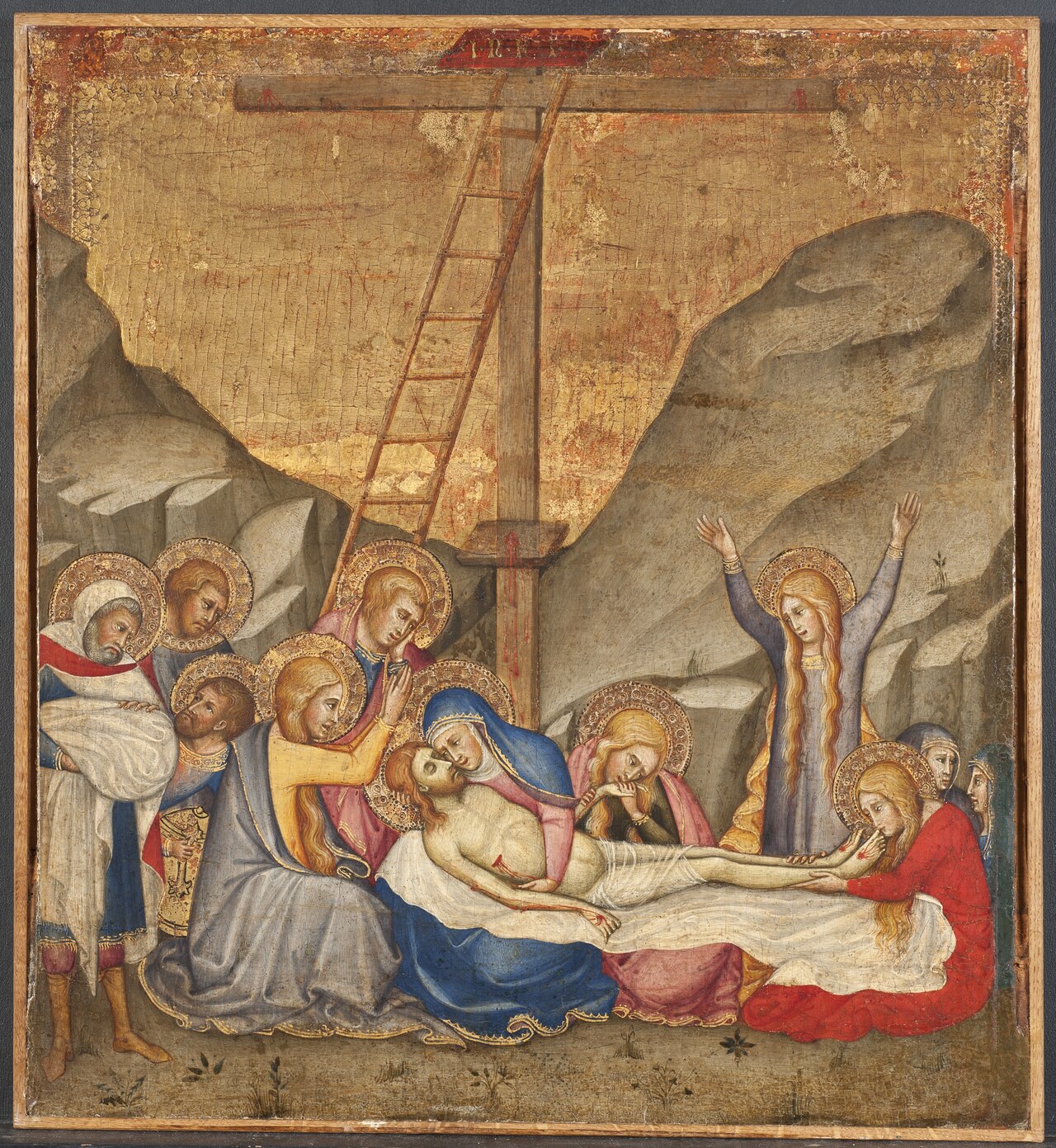
Andrea di Bartolo (c.1360–1428) was a Sienese painter, stained‑glass designer and manuscript illuminator known for his devotional panels such as Christ Carrying the Cross (1415) and The Lamentation (1400). Working mainly in Siena between the late 14th and early 15th centuries, he exemplified the elegant, narrative style of the late Sienese school.
Notable works



Early life Andrea di Bartolo was born in Siena around 1360, a city that was then a thriving centre of artistic production. Little is recorded about his family background, but his surname suggests a patronymic link to a father named Bartolo, a common naming practice in medieval Tuscany. Siena’s artistic environment was dominated by the legacy of Duccio di Buoninsegna and the subsequent generation of Sienese masters, whose graceful lines and rich colour palettes would shape Andrea’s formative training. He likely began his apprenticeship in a local workshop during the 1370s, absorbing the city’s distinctive approach to narrative composition and the use of gold leaf in both panel painting and manuscript illumination.
Career and style By the late 1380s Andrea emerged as an independent practitioner, a period documented by surviving contracts that place him in Siena from 1389 onward. His oeuvre straddles three media—panel painting, stained glass, and illumination—reflecting the versatile skill set expected of a Sienese artist. In panel work he adhered to the late Gothic idiom of the Sienese school: delicate, elongated figures, a subtle modelling of forms through layered tempera, and an emphasis on decorative pattern over strict naturalism. His colour palette favoured luminous blues, deep reds and gilded backgrounds, creating a spiritual ambience suited to devotional subjects.
Andrea’s style evolved alongside the broader transition toward early International Gothic trends. While retaining the lyrical line work of his predecessors, he incorporated a more dynamic spatial arrangement, allowing multiple narrative episodes to unfold within a single composition. This synthesis of Sienese lyricism and emerging pan‑European decorative richness became a hallmark of his later work.
Signature techniques Andrea di Bartolo’s technical signature can be identified through several recurring methods:
* Layered tempera with gold leaf – He built figures up in thin tempera layers, often under a glaze of delicate gold leaf that catches light and reinforces the sacred aura of his subjects. * Fine linear detailing – Hair, drapery folds and architectural elements are rendered with a precise, almost calligraphic line, a trait shared with contemporary illuminators. * Narrative compartmentalisation – In larger panels, Andrea organised scenes into distinct registers or zones, each containing a self‑contained episode that together convey a larger story. * Stained‑glass motifs – In his glass designs, he employed bold, coloured lead cames that echo the strong outlines of his painted figures, creating a visual continuity across media.
These techniques allowed his works to be instantly recognisable to contemporary patrons and later scholars alike.
Major works Andrea’s surviving corpus is modest but includes several key pieces that illustrate his artistic development.
* The Lamentation (c. 1400) – Executed for a Sienese confraternity, this panel depicts the Virgin and saints mourning Christ’s body. The composition centres on a luminous Christ, whose pallor is heightened by a gold background. The mourners’ gestures are rendered with subtle emotional nuance, while the intricate gilt detailing on the Virgin’s veil exemplifies Andrea’s mastery of tempera and gold leaf.
* Coronation of the Virgin (1405) – This work presents the Virgin being crowned by Christ within an ethereal architectural setting. The piece showcases Andrea’s growing command of spatial depth; the throne is suggested through receding arches and a graduated perspective that was uncommon in earlier Sienese panels. The crowns and heavenly mantle are rendered in brilliant ultramarine and vermilion, underscoring the sanctity of the scene.
* Madonna of Humility, portable altarpiece (1410) – Designed as a small, transportable altarpiece, the painting features the Virgin seated on a low cushion, a motif popular among private devotional objects. Andrea’s handling of the Madonna’s gentle expression and the delicate folds of her habit demonstrates his refined approach to intimate, personal piety.
* Christ Carrying the Cross (1415) – Perhaps his most dramatic work, this panel captures the moment of Christ’s arduous journey to Golgotha. Andrea employs a stark diagonal composition that pulls the viewer’s eye across the canvas, while the figure’s suffering is conveyed through a subtle chiaroscuro effect, a rare experiment in his otherwise luminous palette.
* Annunciation and Saints – Though undated, this multi‑figure composition pairs the Angelic announcement with a group of attendant saints. The piece is notable for its balanced arrangement of figures, each rendered with individualised facial features—a departure from the more formulaic depictions of earlier Sienese practice.
These works collectively highlight Andrea’s ability to blend devotional intensity with decorative elegance, a synthesis that kept his commissions in demand throughout his career.
Influence and legacy Andrea di Bartolo operated at a transitional moment for Sienese art. While the city’s dominant style remained rooted in the Gothic tradition, Andrea’s subtle incorporation of emerging International Gothic elements positioned him as a bridge between the two eras. His paintings continued to circulate in Siena and its surrounding territories well into the 15th century, influencing younger artists who sought to emulate his graceful line work and refined colour schemes.
Moreover, his contributions to stained‑glass design and manuscript illumination underscored the interdisciplinary nature of Sienese workshops, where artists often moved fluidly between media. This versatility helped preserve the city’s reputation for high‑quality decorative arts during a period of political and economic fluctuation.
Modern scholarship regards Andrea di Bartolo as a representative figure of the late Sienese school—an artist whose works embody the spiritual serenity and ornamental richness that defined the city’s visual culture before the full onset of the Renaissance. His panels remain in several museum collections, where they continue to inform studies of Gothic narrative art and the evolution of religious iconography in early‑modern Italy.
--- In sum, Andrea di Bartolo’s career illustrates the sustained vitality of Sienese artistic traditions at the cusp of change, and his surviving works provide valuable insight into the devotional aesthetics of late medieval Italy.
Frequently asked questions
Who was Andrea di Bartolo?
Andrea di Bartolo (c. 1360–1428) was a Sienese painter, stained‑glass designer and manuscript illuminator known for his religious panels such as Christ Carrying the Cross.
What artistic style or movement is he associated with?
He worked within the late Sienese school, blending the city’s lyrical Gothic tradition with emerging International Gothic decorative elements.
What are his most famous works?
Key works include The Lamentation (c. 1400), Coronation of the Virgin (1405), Madonna of Humility (1410), Christ Carrying the Cross (1415) and an Annunciation with Saints.
Why is Andrea di Bartolo important in art history?
He exemplifies the transition from traditional Sienese Gothic art to the more elaborate International Gothic style, and his versatile practice across painting, glass, and illumination reflects the interdisciplinary nature of medieval workshops.
How can I recognise a painting by Andrea di Bartolo?
Look for delicate, elongated figures, layered tempera with gold leaf, fine linear detailing, and a compartmentalised narrative layout that together create a luminous, devotional atmosphere.