Alfred Verwee
1838 – 1895
In short
Alfred Verwee (1838–1895) was a Belgian painter linked to French Realism, renowned for his vivid depictions of animals, particularly cattle and horses, as well as rural landscapes. His best‑known paintings include 'Fight between two young bulls' (1883) and a series of works that celebrate the everyday life of the Belgian countryside.
Notable works
.jpg)
.jpg)
.jpg)
Early life Alfred Jacques Verwee was born in 1838 in the municipality of Saint‑Josse‑ten‑Noode, then a suburb of Brussels. He grew up in a period when Belgium was establishing its own artistic identity, while also looking to France for contemporary influences. Verwee’s family was not artistic, but his early fascination with the natural world and the animals of the Flemish countryside set the foundation for his later career. As a teenager he began to receive informal drawing lessons, copying the works of local masters and studying the anatomy of farm animals that surrounded his home.
Career and style In the 1850s Verwee moved to Brussels to pursue a professional artistic path. He entered the ateliers of the Royal Academy of Fine Arts, where he received formal training in drawing and composition. The academy’s curriculum, steeped in academic classicism, was tempered by the rising tide of Realism that was sweeping France. Verwee was drawn to the French Realist painters who championed direct observation of life, and he incorporated this ethos into his own practice.
Throughout the 1860s and 1870s Verwee travelled extensively across the Belgian countryside, often working en plein air. He painted on location, capturing the light and atmosphere of the fields, rivers and stables that he visited. His subjects were predominantly animals—cattle, horses, and occasionally livestock in moments of activity or repose. By focusing on the everyday, Verwee aligned himself with the Realist principle of depicting the world without idealisation. His work also extended to seascapes and broader landscapes, but it is his animal paintings that remain his most identifiable legacy.
Signature techniques Verwee’s technique is characterised by a careful observation of anatomy coupled with a loose, yet purposeful brushwork. He often began with a precise underdrawing that established the proportions of the animal, then applied layers of colour to suggest form and texture. Light plays a decisive role in his compositions; he favoured the soft, diffused illumination of early morning or late afternoon, which allowed the flesh tones of horses and the hide of cattle to emerge with a natural warmth.
He employed a limited palette, typically built around earth tones, muted greens and occasional touches of ochre, which helped to integrate the animal figures into their surroundings. In water scenes, such as those involving streams or brooks, Verwee rendered reflections with subtle, horizontal strokes that convey both movement and calm. His handling of the background is often more impressionistic, allowing the viewer’s eye to focus on the central animal subject.
Major works - **Fight between two young bulls (1883)** – This painting captures a moment of violent confrontation between two adolescent bulls. Verwee places the animals in a barren, sun‑baked arena, emphasizing the tension through stark contrasts of light and shadow. The muscular bodies are rendered with precise anatomical detail, while the surrounding ground is suggested with broader strokes, underscoring the drama of the encounter.
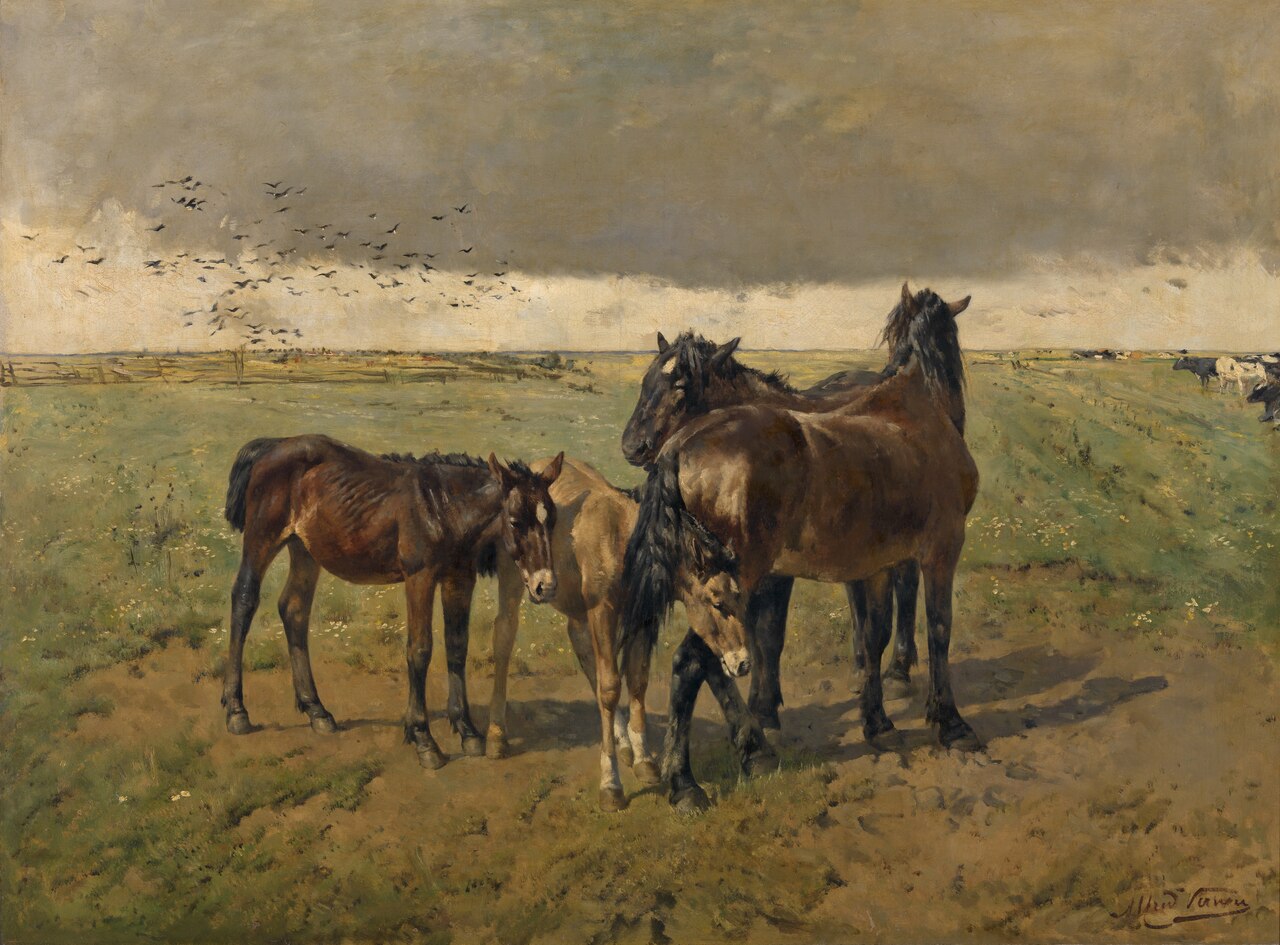
- Foals in the Paddock – In this work Verwee portrays a group of young horses at rest in a fenced paddock. The composition is tranquil, with the foals positioned in varying poses that convey curiosity and innocence. The artist’s delicate handling of the horses’ coats—highlighting the subtle changes in colour across their bodies—demonstrates his skill in rendering texture.
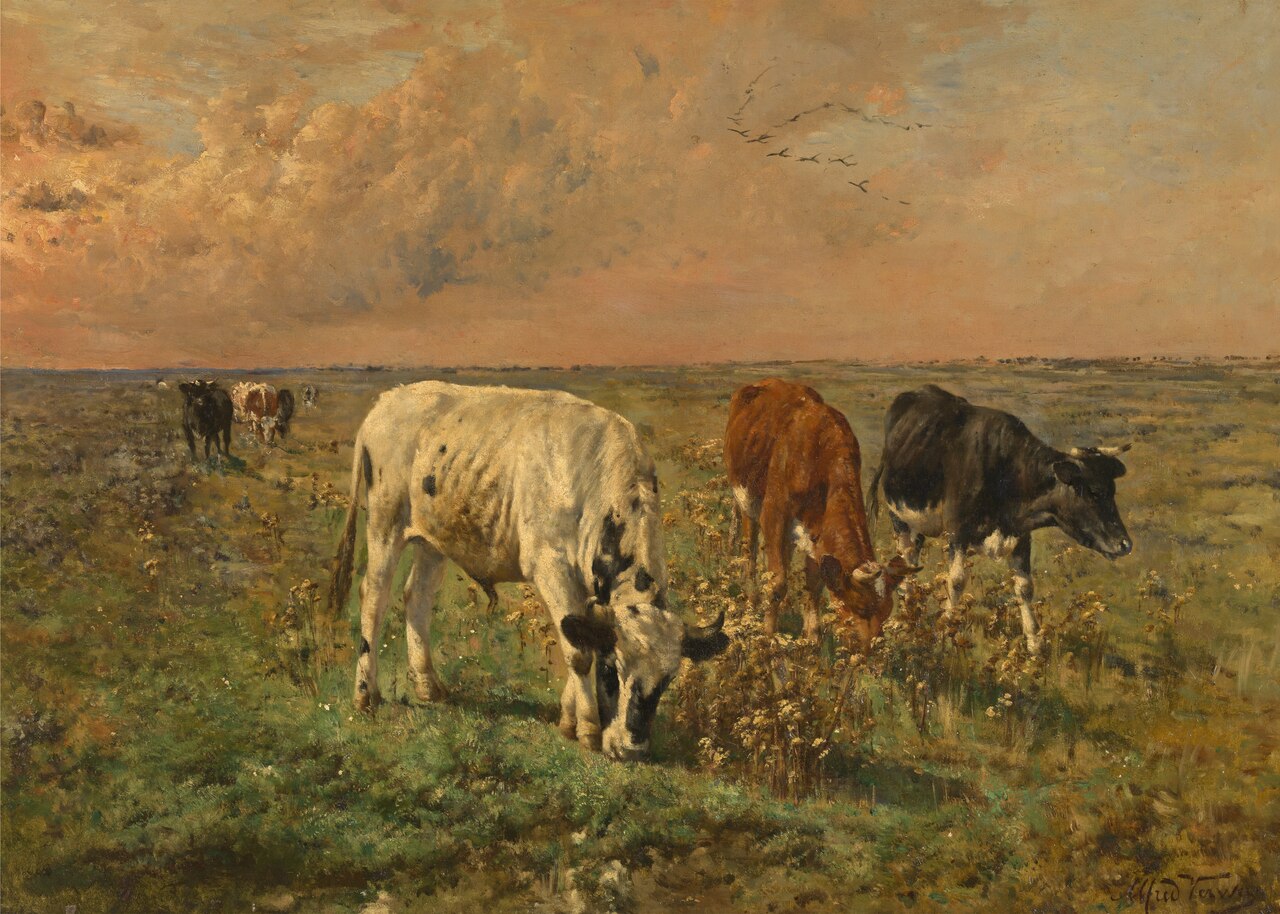
- Cows in a Pasture – This piece presents a serene pastoral scene where a herd of cows grazes under a cloudy sky. Verwee’s use of muted greens and soft browns creates a harmonious atmosphere. The cows are depicted with a calm dignity, each animal rendered with individual character, illustrating Verwee’s commitment to observing the particularities of his subjects.
- Study of a Horse – As the title suggests, this work functions as an anatomical study. Verwee isolates the horse against a neutral background, allowing the viewer to appreciate the structure of the animal’s musculature and skeletal form. The brushwork is restrained, focusing on tonal variation to model the three‑dimensional shape.
- Cattle by a Brook – In this composition the cattle are shown drinking from a shallow stream. The reflective surface of the water is rendered with fine, horizontal strokes that capture the subtle ripples caused by the animals’ movement. Verwee juxtaposes the warm tones of the cattle’s hides with the cool blues of the brook, creating a balanced colour scheme that highlights the interaction between land and water.
Influence and legacy Alfred Verwee’s dedication to realistic animal painting placed him among the leading Belgian Realists of the late nineteenth century. His works were exhibited in Brussels and Paris, where they were praised for their authenticity and technical proficiency. By foregrounding the everyday lives of farm animals, Verwee contributed to a broader appreciation of rural subjects within the fine‑art tradition, influencing younger Belgian artists who sought to document the countryside with a similar eye for detail.
After his death in Brussels in 1895, Verwee’s paintings entered both private and public collections. Museums in Belgium, such as the Royal Museums of Fine Arts in Brussels, continue to display his work, and his canvases are regularly featured in exhibitions that explore Realism and animal painting. Contemporary artists who specialise in equine and bovine subjects often cite Verwee as an early exemplar of how to combine rigorous anatomical study with an evocative sense of place.
Overall, Verwee’s legacy lies in his ability to bridge academic training with the Realist impulse to portray the natural world honestly. His paintings remain valuable reference points for scholars of nineteenth‑century European art, and they continue to resonate with viewers who appreciate the quiet dignity of rural life captured on canvas.
Frequently asked questions
Who was Alfred Verwee?
Alfred Verwee (1838–1895) was a Belgian painter associated with French Realism, best known for his realistic depictions of animals, especially cattle and horses, and for his rural landscapes.
What style or movement did he belong to?
Verwee worked within the Realist tradition, adopting the French Realist emphasis on direct observation and truthful representation of everyday rural subjects.
What are his most famous works?
His most recognised paintings include 'Fight between two young bulls' (1883), 'Foals in the Paddock', 'Cows in a Pasture', 'Study of a Horse' and 'Cattle by a Brook'.
Why does Verwee matter in art history?
He helped legitimise animal and countryside scenes as serious artistic subjects in Belgium, influencing later painters and contributing to the broader European Realist movement.
How can I recognise an Alfred Verwee painting?
Look for meticulous animal anatomy, a restrained colour palette of earth tones, soft natural light, and a focus on quiet rural moments, often featuring cattle or horses in open landscapes.