Albert Baertsoen
1866 – 1922
In short
Albert Baertsoen (1866–1922) was a Belgian painter, pastellist and graphic artist known for his townscapes and landscapes, especially scenes of his native Ghent, and later works depicting London during World War I.
Notable works
.jpg)
.jpg)
.jpg)
.jpg)
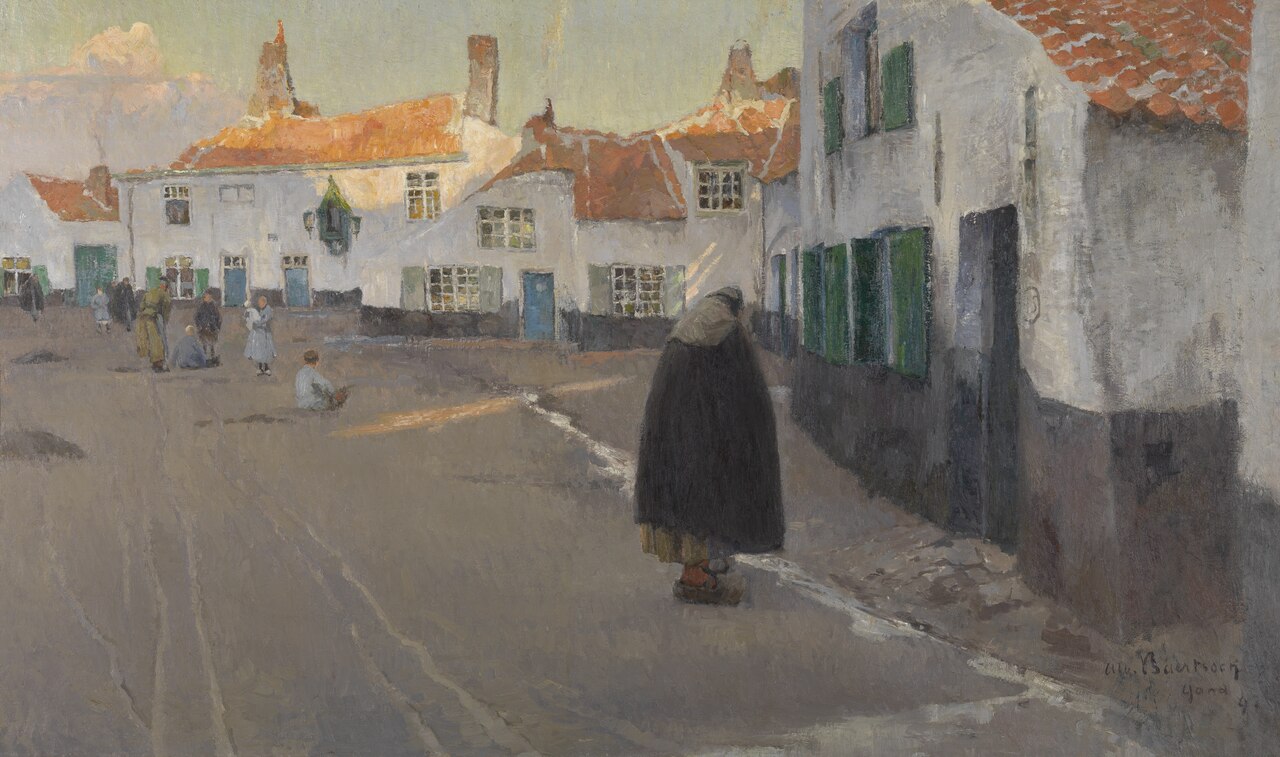
Early life Albert Baertsoen was born in 1866 in Ghent, a historic city in the Flemish region of Belgium. He grew up in a middle‑class family that valued education and the arts. Ghent’s medieval architecture and bustling canals left a lasting impression on the young Baertsoen, who began sketching the city’s streets and waterways from an early age. He received his first formal training at the Royal Academy of Fine Arts in Ghent, where he studied drawing, composition and the fundamentals of painting. The academy’s curriculum, rooted in classical techniques, provided Baertsoen with a solid technical foundation while exposing him to the evolving currents of European art in the late nineteenth century.
Career and style After completing his studies, Baertsoen established himself as a professional artist in Ghent. He quickly became known for his ability to capture the atmosphere of urban environments, a focus that set him apart from many of his contemporaries who favoured rural scenes. His work reflects a synthesis of realism and a softer, more impressionistic handling of light and colour. Baertsoen’s cityscapes often depict everyday life—workers on the ramparts, market stalls, and quiet riverbanks—rendered with a careful eye for architectural detail yet suffused with a lyrical sense of mood. The outbreak of World War I forced Baertsoen to relocate temporarily to London, where he continued to paint, documenting the city’s fog‑laden streets and the impact of wartime conditions. This period broadened his visual vocabulary, introducing a more subdued palette and a heightened sense of atmosphere that can be seen in his later works.
Signature techniques Baertsoen worked across several media, including oil, pastel and graphic printmaking. In oil paintings he employed a layered approach, building up thin glazes to achieve depth and subtle tonal variations. His pastels are notable for their delicate application; he often used a combination of hard and soft pastel sticks to create both fine architectural lines and soft, atmospheric backgrounds. In his graphic work, Baertsoen favoured lithography and etching, techniques that allowed him to render intricate line work while preserving the spontaneity of his sketch‑like compositions. Across all media, he demonstrated a consistent interest in atmospheric effects—clouds, mist, and the play of sunlight on stone and water—using these elements to convey the emotional tenor of a place.
Major works - **Thaw in Ghent (1902)** – This oil painting captures a late‑winter scene in Ghent, where the first signs of thaw soften the city's stone facades. Baertsoen’s use of muted blues and greys, contrasted with the warm glow of street lamps, conveys both the chill of the season and the promise of spring. - **Rope‑makers on The Ramparts (1895)** – A vivid representation of labourers working along Ghent’s historic ramparts, this work combines detailed architectural rendering with a dynamic composition that emphasises the movement of the workers and the texture of the rope‑making process. - **Clouds over the Sea (1895)** – Executed in pastel, this piece focuses on the sky rather than the sea itself. Baertsoen’s deft blending of whites and pale blues creates a sense of vastness and calm, illustrating his skill in capturing atmospheric conditions. - **Mud barge (1901)** – This painting portrays a barge laden with mud navigating a canal, a common sight in Ghent’s bustling waterways. The artist’s careful observation of reflections and the earthy tones of the cargo demonstrate his commitment to realistic detail. - **Square in Flanders (1897)** – Depicting a lively market square, Baertsoen combines a bustling crowd with precise architectural elements. The composition balances foreground figures with a deep perspective that draws the viewer into the scene.
Influence and legacy Albert Baertsoen’s body of work provides a valuable visual record of late‑nineteenth‑ and early‑twentieth‑century urban life in Belgium and, briefly, in wartime London. Though he never aligned himself with a specific avant‑garde movement, his synthesis of realist detail and impressionistic atmosphere influenced younger Belgian artists who sought to document their rapidly modernising cities. His pastel technique, in particular, was admired for its subtlety and has been cited in later studies of Belgian pastel art. Baertsoen’s works are held in several public collections, including the Museum of Fine Arts in Ghent, where they continue to be exhibited as exemplars of regional urban painting. Scholars regard his paintings as essential references for understanding the visual culture of Ghent during a period of significant social and architectural change.
Frequently asked questions
Who was Albert Baertsoen?
Albert Baertsoen (1866–1922) was a Belgian painter, pastellist and graphic artist best known for his townscapes and landscapes, especially scenes of Ghent.
What artistic style or movement is Baertsoen associated with?
Baertsoen did not belong to a formal movement; his work blends realistic detail with impressionistic handling of light and atmosphere.
What are his most famous works?
Key works include *Thaw in Ghent* (1902), *Rope‑makers on The Ramparts* (1895), *Clouds over the Sea* (1895), *Mud barge* (1901) and *Square in Flanders* (1897).
Why is Baertsoen important in art history?
He provides a detailed visual record of urban life in Ghent and early‑20th‑century London, influencing later Belgian artists interested in cityscapes and atmospheric effects.
How can I recognise a Baertsoen painting?
Look for meticulous architectural rendering combined with soft, pastel‑like atmospheric washes, often featuring misty skies, reflective water and a calm, muted colour palette.