Adrien Étienne Gaudez
1845 – 1902
In short
Adrien Étienne Gaudez (1845–1902) was a French sculptor renowned for his large bronze monuments. Trained at the École des Beaux‑Arts under François Jouffroy, he worked throughout the late 19th century and is noted for works such as Antoine Parmentier (1888) and David (1880).
Notable works


Early life
Adrien Étienne Gaudez was born in Lyon in 1845. Little is recorded of his family background, but his early education in the arts was evidently strong enough to secure a place at the prestigious École des Beaux‑Arts in Paris. At the École, Gaudez studied under François Jouffroy, a leading figure in French academic sculpture, where he acquired a solid grounding in classical drawing, modelling and the technical aspects of bronze casting. His formative years coincided with a period of political upheaval; in 1870, during the Franco‑Prussian War, Gaudez was taken prisoner of war. The experience of captivity, though brief, left an imprint on his outlook and perhaps intensified his commitment to the commemorative function of public sculpture.
Career and style
Following his release, Gaudez returned to Paris and began to establish himself as a professional sculptor. He exhibited regularly at the Salon, the official exhibition of the Académie des Beaux‑Arts, where his works were received favourably for their technical proficiency and adherence to the academic standards of the day. Gaudez’s style can be described as firmly academic, with a realist sensibility that favoured clear, dignified representations of historical and allegorical subjects. While he did not align himself with a specific avant‑garde movement, his work reflects the broader 19th‑century French emphasis on monumental public art, intended to convey civic virtues and national pride.
The sculptor’s career was largely defined by commissions for public monuments and institutional collections. He worked primarily in bronze, a medium that allowed for both durability in outdoor settings and the fine detail required for his figurative compositions. Throughout the 1880s, Gaudez secured a series of high‑profile commissions that cemented his reputation as a reliable creator of large‑scale statuary.
Signature techniques
Gaudez’s technical approach combined traditional modelling practices with the casting processes of foundries that specialised in large bronze works. He typically began with a clay or plaster maquette, refining the anatomy and drapery before forwarding the model to a foundry for bronze casting. The final pieces often displayed a smooth patina, applied to enhance the visual depth and to protect the metal from corrosion. His attention to anatomical accuracy and the subtle rendering of fabric folds were hallmarks of his practice, enabling his figures to convey both physical presence and a sense of narrative calm.
Another distinguishing feature of Gaudeç’s oeuvre is his use of allegorical symbolism within a realistic framework. For instance, the figures he created for public monuments frequently incorporated attributes—such as tools, books or scrolls—that identified the subject’s profession or moral significance, without resorting to overtly decorative excess. This restraint aligns with the academic emphasis on clarity and didactic purpose.
Major works
Among Gaudez’s most notable commissions is the bronze statue of Antoine Parmentier (1888). Parmentier, celebrated for promoting the potato as a staple food in France, is depicted in a thoughtful pose, holding a scroll that alludes to his scientific writings. The statue was intended for a municipal space, reflecting the 19th‑century trend of honouring figures who contributed to public welfare.
Another significant work is the bronze representation of Jean‑Rodolphe Perronet, a renowned 18th‑century civil engineer. Gaudez’s rendition captures Perronet in the act of surveying, with a theodolite and a set of plans at his side. The sculpture underscores Gaudez’s ability to convey professional expertise through subtle gestures and precise detailing, reinforcing the engineer’s legacy within the built environment.
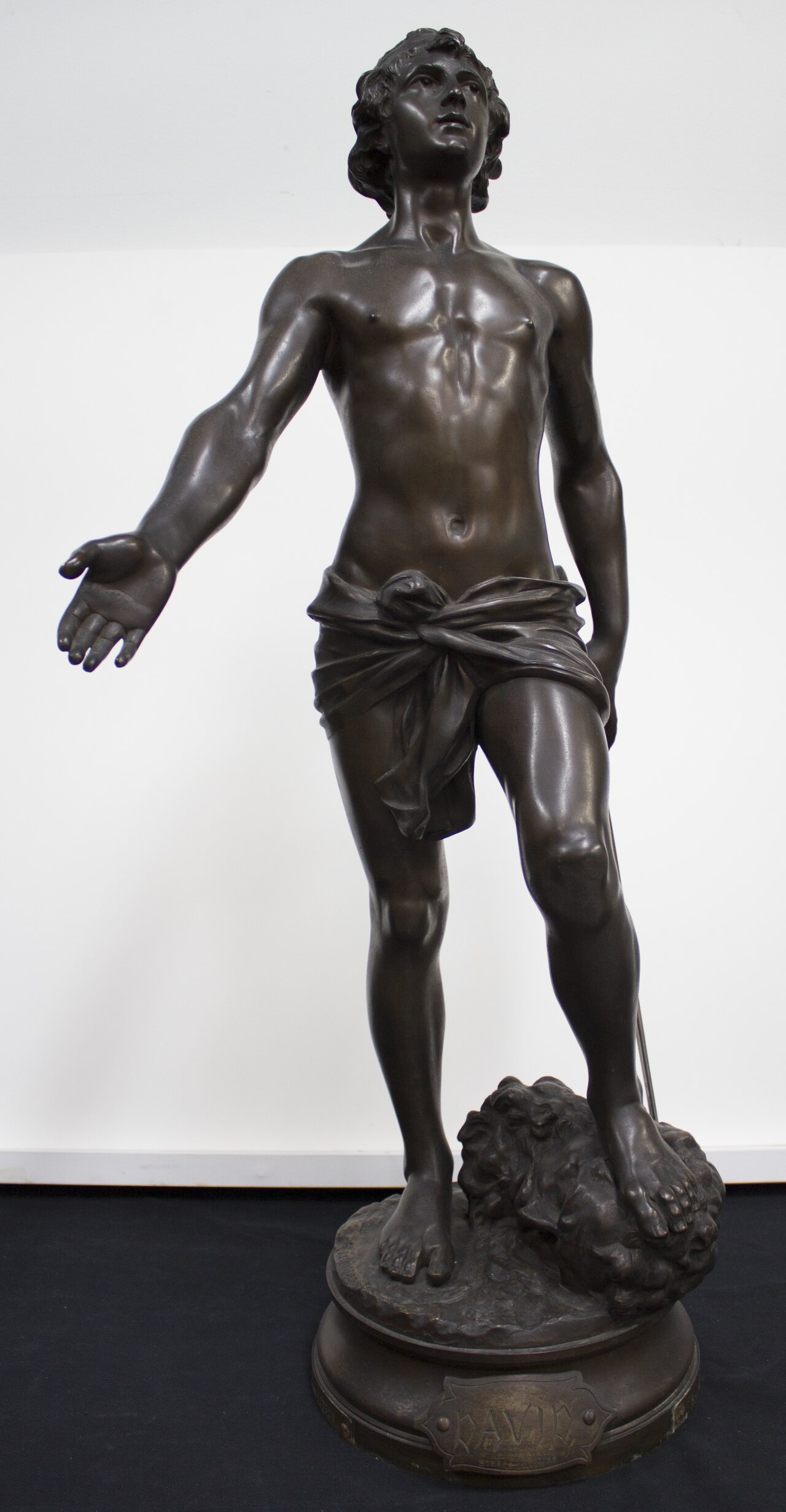
The statue of David (1880) exemplifies Gaudez’s classical training. Rendered in bronze, the figure presents the biblical hero in a moment of contemplation, muscular yet restrained, echoing the neoclassical ideal of heroic calm. Though the precise location of this piece varies in records, it has been displayed in several public exhibitions, demonstrating the sculptor’s capacity to reinterpret timeless subjects for contemporary audiences.
These works, together with other lesser‑known commissions, illustrate Gaudez’s commitment to creating monuments that serve both aesthetic and civic functions. They remain representative of the broader French tradition of commemorative sculpture that flourished in the latter half of the 19th century.
Influence and legacy
Adrien Étienne Gaudez died in Neuilly‑sur‑Seine in 1902, leaving behind a modest but significant body of work. While he never achieved the fame of contemporaries such as Auguste Rodin, his contributions to public sculpture provided a reliable model of academic craftsmanship for younger sculptors navigating the transition toward modernist tendencies. His bronze monuments continued to occupy public squares and institutional courtyards well into the 20th century, offering a tangible link to the values of the French Third Republic.
In contemporary art‑historical scholarship, Gaudez is recognised primarily for his role in sustaining the academic tradition of monumental bronze sculpture during a period of rapid artistic change. His works are occasionally featured in retrospectives of 19th‑century French sculpture, and they serve as reference points for the study of state‑commissioned art and its impact on urban visual culture. Though his name may not appear in mainstream narratives of French art, Gaudez’s statues endure as exemplars of the technical skill and civic purpose that characterised much of the era’s public art.
Frequently asked questions
Who was Adrien Étienne Gaudez?
Adrien Étienne Gaudez (1845–1902) was a French sculptor noted for creating large bronze monuments, trained at the École des Beaux‑Arts under François Jouffjoy.
What artistic style or movement is Gaudez associated with?
Gaudez worked within the academic tradition of 19th‑century French sculpture, producing realistic, classically inspired figures for public commissions.
What are Gaudez’s most famous works?
His best‑known pieces include the bronze statues of Antoine Parmentier (1888), Jean‑Rodolphe Perronet, and David (1880).
Why is Gaudez important in art history?
He exemplifies the skilled, civic‑focused bronze sculpture that shaped French public spaces in the late 1800s, offering a model of academic craftsmanship during a transformative era.
How can I recognise a sculpture by Gaudez?
Look for bronze figures with precise anatomical detail, restrained allegorical symbols, a smooth patina, and a dignified, narrative pose typical of academic French monuments.