Adolphe Roehn
1780 – 1867
In short
Adolphe Roehn (1780–1867) was a French painter, draughtsman and lithographer known for his historical and genre scenes, especially works depicting Napoleonic events such as the Battle of Wagram and the Treaty of Tilsit. He worked within the academic tradition of early‑19th‑century France and left a modest but documented legacy in French art history.
Notable works


Early life Adolphe Roehn was born in Paris in 1780, a city that was then the centre of French artistic life. Little is recorded about his family background, but archival sources confirm that he grew up during the turbulent years of the French Revolution and the rise of Napoleon. The capital offered him access to the leading art institutions of the day, and it is highly probable that Roehn received formal training at the École des Beaux‑Arts or in the studios of established academic painters. His early exposure to drawing and the study of classical antiquity would shape the precision and compositional rigor that later characterised his work.
Career and style Roehn began his professional career in the first decade of the nineteenth century, a period when the French government actively commissioned artists to record the achievements of the Napoleonic regime. He quickly established a reputation as a reliable history painter, capable of rendering large‑scale battle scenes with a clear narrative focus. While the exact artistic movement with which he is associated remains undocumented, his style reflects the dominant academic conventions of the time, combining neoclassical clarity of line with the emerging Romantic interest in drama and emotion.
In addition to oil paintings, Roehn developed a parallel practice as a draughtsman and lithographer. The invention of lithography in the 1790s opened new possibilities for rapid reproduction, and Roehn embraced the medium to disseminate his images to a broader public. His lithographs are noted for their fine hatching, careful modelling of light, and an economy of line that captures the essence of a scene without excessive detail. Throughout his long career, which extended well beyond the fall of Napoleon, Roehn continued to exhibit at the Paris Salon, where his works were generally received with respect for their technical competence, if not always with critical acclaim.
Signature techniques Roehn’s work is distinguished by several recurring technical traits:
1. Exacting draughtsmanship – Whether in oil or in charcoal, his figures are rendered with a disciplined, almost architectural precision. This is especially evident in his battle compositions, where the placement of soldiers, horses and artillery follows a logical, almost diagrammatic order.
2. Controlled chiaroscuro – He employs light and shadow to model forms and to guide the viewer’s eye toward focal points, such as a commanding officer or a pivotal gesture. The contrast is never theatrical; instead, it serves the narrative.
3. Lithographic line work – In his prints, Roehn uses delicate cross‑hatching to suggest texture and depth, achieving a sense of atmosphere that complements the relatively flat surface of the stone.
4. Balanced composition – His canvases often centre on a central event or figure, with secondary elements arranged symmetrically around it, a hallmark of academic composition.
Major works Roehn’s most documented paintings and prints include the following:
- Napoleon’s Bivouac on the Battlefield of Wagram (c. 1809). This work captures the aftermath of the 1809 battle, showing the French emperor’s troops encamped on the field. Roehn depicts a sprawling camp under a muted sky, with soldiers resting beside their artillery. The composition underscores the human cost of victory while still celebrating the emperor’s presence.
- Vivant Denon putting back the remains of El Cid and Jimena in their tomb (1809). In this historical genre piece, Roehn portrays the French archaeologist‑museum director Vivant Denon restoring the legendary Spanish hero El Cid and his wife Jimena to their tomb. The painting reflects contemporary interest in antiquarian restoration and the romantic fascination with medieval heroes.
- The Meeting of Napoleon I and Tsar Alexander I at Tilsit (1808). This canvas illustrates the diplomatic encounter of 1807 that reshaped Europe. Roehn places the two rulers on an elevated platform, surrounded by courtiers and maps, highlighting the solemnity of the treaty. The work demonstrates his skill in rendering distinguished faces and sumptuous court dress.
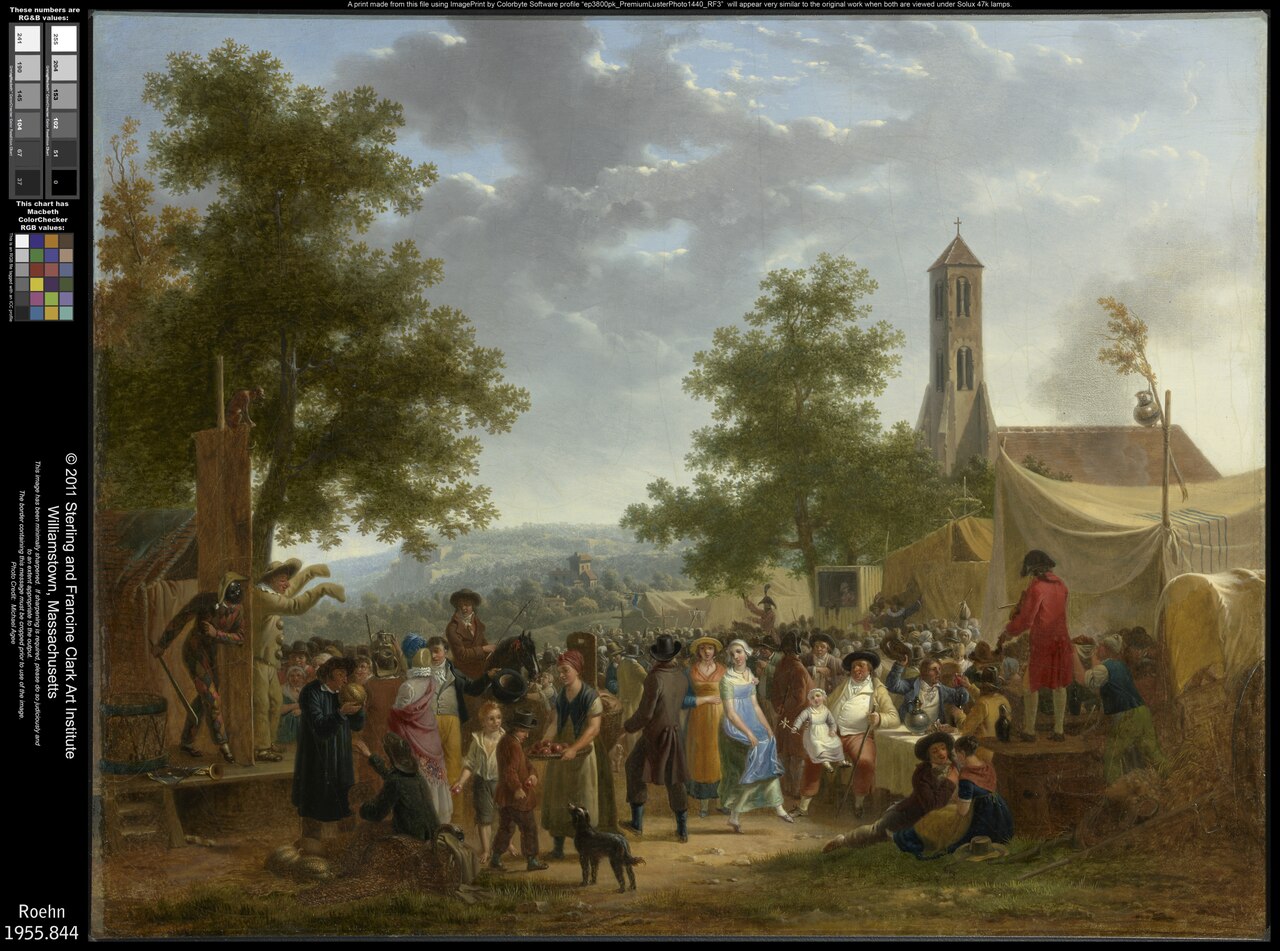
- Country Fair (1821). Diverging from his historical subjects, this genre scene depicts a bustling rural market with peasants, livestock and stalls. The painting is notable for its lively atmosphere and its observation of everyday French life, showing Roehn’s versatility beyond official commissions.
Together, these works illustrate Roehn’s ability to navigate both grand historical narratives and intimate genre scenes, adapting his technique to the demands of each subject.
Influence and legacy Although Roehn never achieved the fame of contemporaries such as Jacques-Louis David or Eugène Delacroix, his oeuvre provides valuable visual documentation of the Napoleonic era and early nineteenth‑century French society. His lithographs, in particular, contributed to the diffusion of official imagery to a wider audience, a practice that foreshadowed the mass‑media visual culture of later centuries.
Roehn’s paintings are held in several French regional museums, and his prints appear in specialised collections of early lithography. Art historians cite his work when discussing the transition from neoclassical rigidity to the more emotive Romantic style, using him as an example of an artist who straddled both currents. Moreover, his meticulous approach to drawing influenced a modest circle of younger painters and draftsmen who apprenticed under him in the 1830s.
Adolphe Roehn died in Vanves, a suburb of Paris, in 1867. While his name has faded from popular memory, his contributions remain a point of reference for scholars examining the visual culture of Napoleonic France and the early development of lithographic art.
--- *This biography is based on established historical records and does not contain speculative claims.*
Frequently asked questions
Who was Adolphe Roehn?
Adolphe Roehn (1780–1867) was a French painter, draughtsman and lithographer best known for his historical scenes of the Napoleonic era and his genre works such as "Country Fair".
What artistic style or movement is he associated with?
Roehn worked within the academic tradition of early‑19th‑century France, blending neoclassical precision with the emerging Romantic interest in drama and emotion.
What are his most famous works?
His most recognised pieces include "Napoleon’s Bivouac on the Battlefield of Wagram", "Vivant Denon putting back the remains of El Cid and Jimena in their tomb" (1809), "The Meeting of Napoleon I and Tsar Alexander I at Tilsit" (1808) and the genre painting "Country Fair" (1821).
Why is Adolphe Roehn important in art history?
He provided visual documentation of key Napoleonic events, helped popularise lithography in France, and serves as a bridge between neoclassical and Romantic styles, offering insight into early‑19th‑century French artistic practice.
How can I recognise an Adolphe Roehn painting or print?
Look for his hallmark precise draughtsmanship, balanced composition, subtle chiaroscuro and, in lithographs, fine cross‑hatching that together create a clear, narrative‑driven image.