Adèle Kindt
1804 – 1884
In short
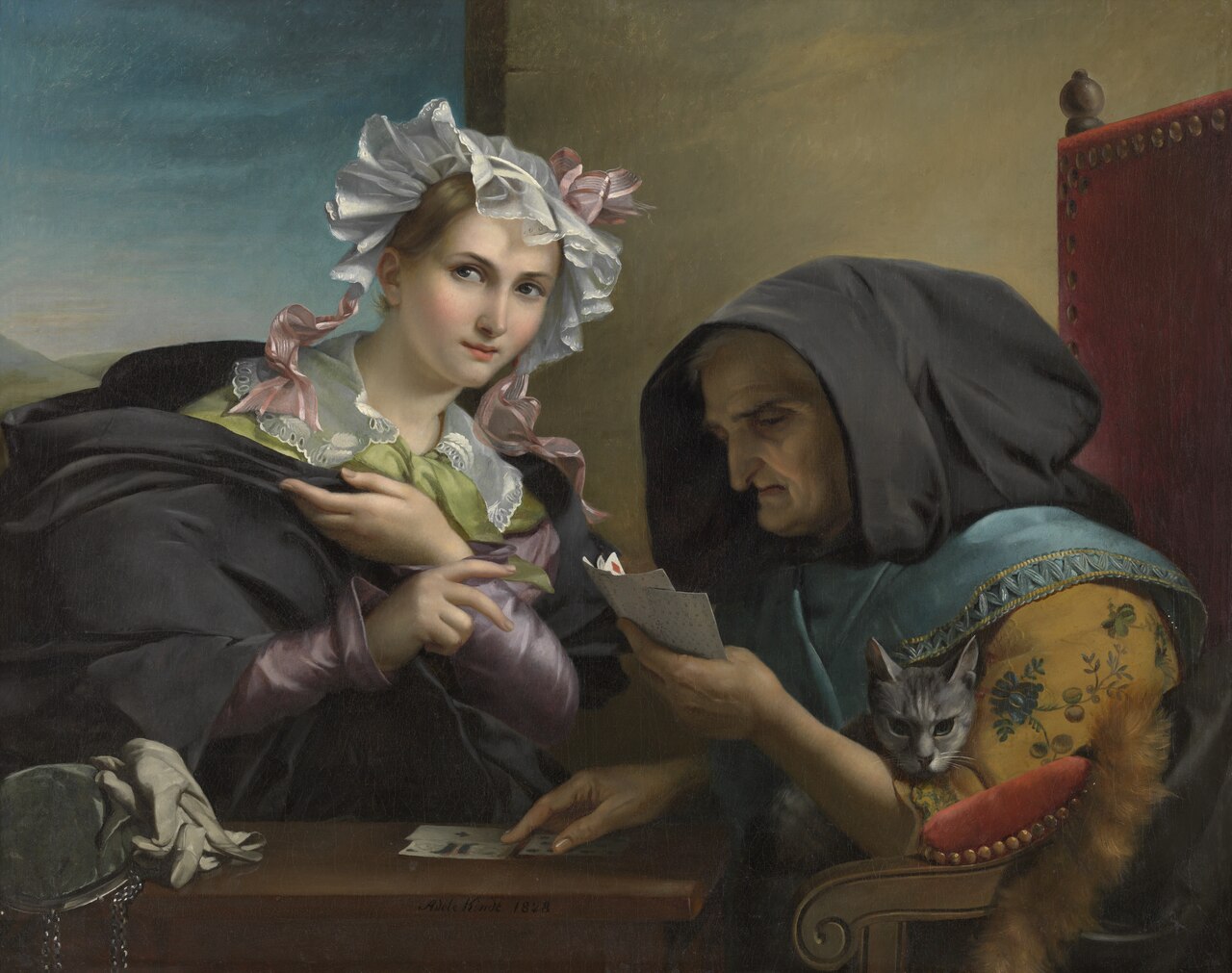
Adèle Kindt (1804–1884) was a Belgian painter from Brussels, recognised for her portraits and genre scenes, including works such as Faith, Hope and Charity (1840) and The Fortune Teller (1828). She worked throughout the first half of the nineteenth century and is noted for her narrative realism and subtle handling of light.
Notable works

.jpg)
.jpg)
Early life Adèle Kindt was born in Brussels in 1804, into a family that valued the arts. Little is recorded about her parents, but contemporary sources indicate that she received a solid education and early exposure to drawing. Brussels, at the turn of the nineteenth century, was a vibrant centre for artistic training, and Kindt is believed to have enrolled at the Royal Academy of Fine Arts, where she would have been instructed in drawing from the antique, life‑model studies and the fundamentals of colour. These formative years provided her with the technical foundation that underpinned her later portraiture and genre paintings.
Career and style Kindt began exhibiting publicly in the 1820s, a period when Belgian art was navigating the after‑effects of the Napoleonic era and the emergence of a national identity. Her work aligns with the broader realist tendency that characterised much of Belgian painting in the first half of the nineteenth century, yet she retained a lyrical quality reminiscent of early Romanticism. The subjects of her paintings are primarily domestic and historical, reflecting both the tastes of a burgeoning bourgeois market and her own interest in narrative content. Portraits reveal a careful observation of character, while genre scenes often depict moments of moral or emotional significance, suggesting an engagement with the didactic traditions of earlier Flemish masters.
Signature techniques Kindt’s technique is distinguished by a restrained palette, where muted earth tones are enlivened by occasional accents of deep blues or warm reds. She employed a delicate brushwork that rendered skin and fabric with a softness that avoids over‑detail, allowing the viewer’s eye to focus on expression and gesture. Light is handled with a subtle chiaroscuro, modelling forms without stark contrasts, which contributes to a sense of intimacy. In her narrative works, Kindt pays close attention to incidental objects—books, musical instruments, or symbolic accessories—that enrich the story and provide visual cues about the sitter’s virtues or circumstances.
Major works - **Faith, Hope and Charity (1840)** – This allegorical composition presents the three theological virtues as young women, each holding an emblematic attribute: Faith with a cross, Hope with an anchor, and Charity with a child. The figures are rendered with a gentle realism, their drapery suggesting both modesty and movement. The work exemplifies Kindt’s skill in conveying moral concepts through portrait‑like figures, and it was well received at the Brussels Salon of 1840. - **The Fortune Teller (1828)** – A genre scene that captures a moment of quiet intrigue, the painting shows a young woman consulting a fortune‑teller in a modest interior. Kindt’s handling of light—coming from a nearby window—highlights the delicate features of the sitter while casting soft shadows on the surrounding objects, creating a sense of depth. The composition reflects contemporary fascination with mysticism and the everyday lives of the urban middle class. - **Lamoral, Count of Egmont, Taking Leave of His Wife (1826)** – This historical tableau depicts the famed Dutch nobleman, Count Egmont, on the eve of his execution, saying farewell to his wife. Kindt portrays the couple with restrained emotion; the Count’s stoic expression contrasts with his wife’s tearful gaze. The painting demonstrates Kindt’s ability to render historical drama without resorting to melodrama, relying instead on subtle facial cues and a muted colour scheme to convey tragedy. - **Young Polish Freedom Fighter (1834)** – In this work, Kindt renders a youthful Polish insurgent, likely inspired by the November Uprising of 1830‑31. The figure is shown in a contemplative pose, with a distant landscape visible through a window. The painting combines portraiture with political symbolism, using the subject’s determined expression to evoke themes of liberty and sacrifice. It reflects Kindt’s awareness of contemporary European events and her willingness to engage with them artistically.
Influence and legacy Adèle Kindt operated in a male‑dominated artistic environment, yet she managed to secure commissions and exhibit regularly, paving a modest path for future Belgian women painters. Her commitment to realistic representation and narrative depth contributed to the development of Belgian genre painting in the nineteenth century. While she never aligned herself with a specific avant‑garde movement, her works were included in several important salon exhibitions and are now held in regional museums, where they serve as examples of early professional female artistry in Belgium. Contemporary scholarship recognises Kindt as a figure who bridged the classical training of the academy with the emerging taste for emotionally resonant, everyday subjects, thereby enriching the visual culture of her time.
Frequently asked questions
Who was Adèle Kindt?
Adèle Kindt (1804–1884) was a Belgian painter from Brussels, best known for her portraits and genre scenes.
What artistic style or movement is she associated with?
She worked within a realist tradition that incorporated subtle Romantic elements, focusing on narrative realism rather than a defined avant‑garde movement.
What are her most famous works?
Her most noted paintings include Faith, Hope and Charity (1840), The Fortune Teller (1828), Lamoral, Count of Egmont, Taking Leave of His Wife (1826) and Young Polish Freedom Fighter (1834).
Why is Adèle Kindt important in art history?
She exemplifies the professional achievements of a woman artist in nineteenth‑century Belgium and contributed to the development of realistic portraiture and genre painting in the region.
How can I recognise a painting by Adèle Kindt?
Kindt’s works are characterised by a muted palette, gentle chiaroscuro, careful attention to facial expression, and narrative details that give everyday or historical scenes a quiet, moral undertone.