Abd al-Samad
1500 – 1593
In short
Abd al‑Samad (c.1500–1593) was a Persian‑born miniaturist who migrated to the Mughal court in India, where he helped shape the early Mughal painting style and later directed the imperial workshop under Emperor Akbar.
Notable works
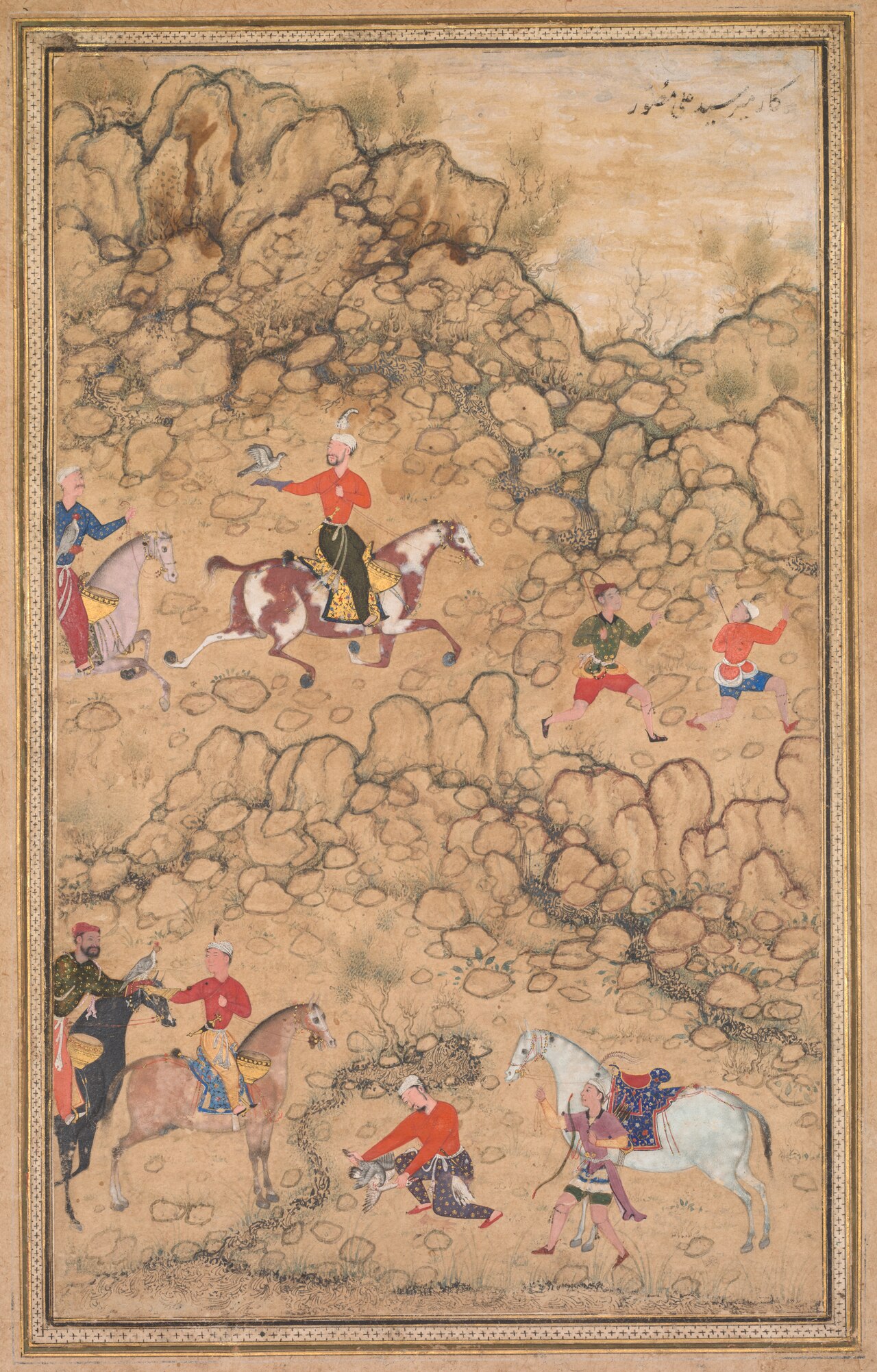

_-_Hunting_with_Falcons_in_a_Landscape_(recto)_-_2013.292.a_-_Cleveland_Museum_of_Art.jpg)
Early life Abd al‑Samad, also recorded as Khwāja ‘Abd‑us‑Ṣamad Shirāzī, was born around 1500 in Shiraz, a major centre of Persian art and culture. Details of his family background and early training are scarce, but the artistic environment of Shiraz—renowned for its illuminated manuscripts and miniature painting—would have provided a solid foundation in the Persian miniature tradition. By the mid‑16th century he had established a reputation as a skilled painter, a status that facilitated his move to the Indian subcontinent, where the newly‑established Mughal empire was actively recruiting Persian artists.
Career and style Abd al‑Samad arrived in the Mughal court sometime in the 1550s, during the reign of Emperor Akbar (r. 1556‑1605). He joined a group of Persian expatriate artists who were tasked with creating a distinct visual language for the empire, one that blended Persian techniques with Indian themes and the emerging European influence that arrived via trade routes. Over the next two decades he rose through the workshop hierarchy, eventually being appointed head of the imperial atelier around 1572. Under his direction, the Mughal style matured, characterised by a greater naturalism, refined colour palettes, and a more sophisticated treatment of space and perspective compared with earlier Persian models.
Abd al‑Samad’s own paintings display a synthesis of these influences. While his compositions retain the intricate detailing and decorative richness of Persian miniatures, they also incorporate a heightened observation of flora, fauna and human anatomy that reflects the Mughal court’s interest in realism. His works often feature elaborate courtly scenes, hunting expeditions, and narrative episodes drawn from Persian poetry, yet the figures are rendered with a softness and three‑dimensionality that set them apart from earlier Persian precedents.
Signature techniques The artist’s signature techniques include:
* Layered washes and fine brushwork – Abd al‑Samad employed delicate, translucent washes to model faces and fabrics, building depth through successive layers. * Dynamic composition – He arranged subjects along diagonal axes, creating a sense of movement, especially evident in hunting scenes. * Integrated calligraphy – In several works the reverse side contains Chagatai Turkish poetry rendered in elegant script, demonstrating his facility with textual as well as visual elements. * Naturalistic rendering of animals – His falcons, horses and other fauna are portrayed with anatomical accuracy, a hallmark of Mughal naturalism.
These techniques, combined with a disciplined use of colour—often muted earth tones punctuated by vivid reds and blues—form the visual hallmark of his mature oeuvre.
Major works Abd al‑Samad’s surviving corpus is limited, yet several pieces illustrate his artistic range:
1. Hunting with Falcons in a Landscape (recto) – This miniature depicts a noble rider pursued by falcons across a lush landscape. The composition balances the figure’s elegant posture with the kinetic energy of the birds, while the detailed foliage conveys a sense of depth uncommon in earlier Persian miniatures.
2. Hunting with Falcons in a Landscape (verso) – The reverse side bears a calligraphic inscription of Chagatai Turkish poems praising wine, attributed to Sultan Muhammad Nur (c. 1472–1536) and Mirza Muhammad (active c. 1520s). The inclusion of poetry highlights the interdisciplinary nature of Mughal manuscripts, where text and image were intended to complement each other.
3. Jamshid Writing on a Rock (1588) – This work portrays the legendary king Jamshid inscribing his achievements upon a stone, an episode drawn from Persian myth. The painting exemplifies Abd al‑Samad’s mature style: the figure is rendered with subtle modelling, the background landscape is rendered with atmospheric perspective, and the overall composition conveys a narrative gravitas befitting a royal patron.
These works, dated between 1510 and 1588, demonstrate the artist’s ability to adapt Persian iconography to the tastes of the Mughal elite while contributing to a distinct visual lexicon that would dominate Indian court painting for generations.
Influence and legacy Abd al‑Samad’s impact on Mughal art is profound. As head of Akbar’s imperial workshop, he oversaw a generation of artists, including the celebrated Mirza Ali and the later master Bichitr. His emphasis on naturalistic detail and integrated textual elements set a precedent that shaped the aesthetic direction of Mughal painting throughout the 16th and early 17th centuries. Scholars such as Barbara Brend have argued that Abd al‑Samad may be identical to the Persian painter Mirza Ali, a hypothesis that underscores the fluidity of artistic identities in this period.
Beyond his administrative role, Abd al‑Samad’s own paintings continued to be copied and referenced by later artists, ensuring that his compositional strategies and technical innovations remained part of the Mughal visual repertoire. The synthesis he achieved between Persian miniature tradition and emerging Indian sensibilities laid the groundwork for the celebrated works of later masters like Abu l‑Qasim Khalil and the richly detailed court chronicles of the Akbarnama.
In contemporary scholarship, Abd al‑Samad is recognised not only for his artistic contributions but also as a cultural bridge, exemplifying how cross‑regional exchange enriched the visual culture of South Asia. His surviving works are valuable primary sources for understanding the evolution of Mughal painting, the patronage practices of Emperor Akbar, and the broader artistic dialogues between Persia and the Indian subcontinent during the early modern era.
Frequently asked questions
Who was Abd al‑Samad?
Abd al‑Samad (c.1500–1593) was a Persian‑born miniaturist who moved to the Mughal court in India and became a leading figure in the development of Mughal painting under Emperor Akbar.
What artistic style or movement is he associated with?
He is linked to the early Mughal miniature tradition, a synthesis of Persian miniature techniques with Indian subjects and a growing naturalistic approach.
What are his most famous works?
Key works include the ‘Hunting with Falcons in a Landscape’ miniatures (both recto and verso) and ‘Jamshid Writing on a Rock’ (1588), all noted for their detailed composition and integrated calligraphy.
Why is Abd al‑Samad important in art history?
He helped shape the mature Mughal style, directed the imperial workshop, and influenced subsequent generations of Indian painters, making him a pivotal bridge between Persian and Indian artistic traditions.
How can I recognise an Abd al‑Samad painting?
Look for finely layered washes, naturalistic animal depictions, diagonal compositions of hunting scenes, and often a verso side featuring elegant Chagatai Turkish poetry.