William Frederick Mitchell
1845 – 1914
In short
William Frederick Mitchell (1845–1914) was a British marine painter who specialised in detailed depictions of naval and merchant vessels, producing works for both private patrons and official commissions.
Notable works
_-_HMS_%27Atalanta%27_-_BHC4254_-_Royal_Museums_Greenwich.jpg)
_-_The_Paddle_Steamer_%27Ella%27_-_BHC3314_-_Royal_Museums_Greenwich.jpg)
_-_William_F._Mitchell.png)
.jpg)
Early life William Frederick Mitchell was born in 1845 in the port city of Portsmouth, a hub of naval activity that would shape his artistic focus. Little is recorded about his family background or formal education, but the maritime environment of his hometown provided a constant visual reference of ships, docks, and sea traffic. Growing up amid the bustling dockyards, Mitchell absorbed the technical language of shipbuilding and the visual drama of vessels at work, laying the foundation for a career that would centre on precise, almost documentary renderings of maritime subjects.
Career and style Mitchell emerged as a professional painter in the latter half of the 19th century, a period when the British Empire’s naval power was at its zenith. He secured commissions from shipowners, naval officers, and publishing houses that required accurate visual records of contemporary vessels. His style combined the realism of academic painting with a meticulous attention to the structural details of hulls, rigging, and machinery. Rather than embracing the avant‑garde trends of his time, Mitchell adhered to a pragmatic approach: his canvases served as both works of art and technical illustrations. The colour palette is restrained, often dominated by the blues and greys of sea and sky, with occasional highlights that emphasise the gleam of metal or the glow of lanterns.
Signature techniques Mitchell’s paintings are distinguished by several recurring techniques. He employed a fine, almost pen‑like brushstroke to render rigging, deck fittings, and rivets, giving each ship a sense of tactile reality. Light is handled with a subtle chiaroscuro that models the three‑dimensional form of the hull while preserving the atmospheric quality of the surrounding water. He frequently painted ships from a slightly elevated perspective, allowing the viewer to see both the deck layout and the hull shape. This compositional choice, paired with a careful rendering of reflections on wet surfaces, creates a convincing illusion of depth and movement. Mitchell also made extensive use of preparatory sketches, often executed in watercolour, to capture the exact proportions of a vessel before committing it to oil on canvas.
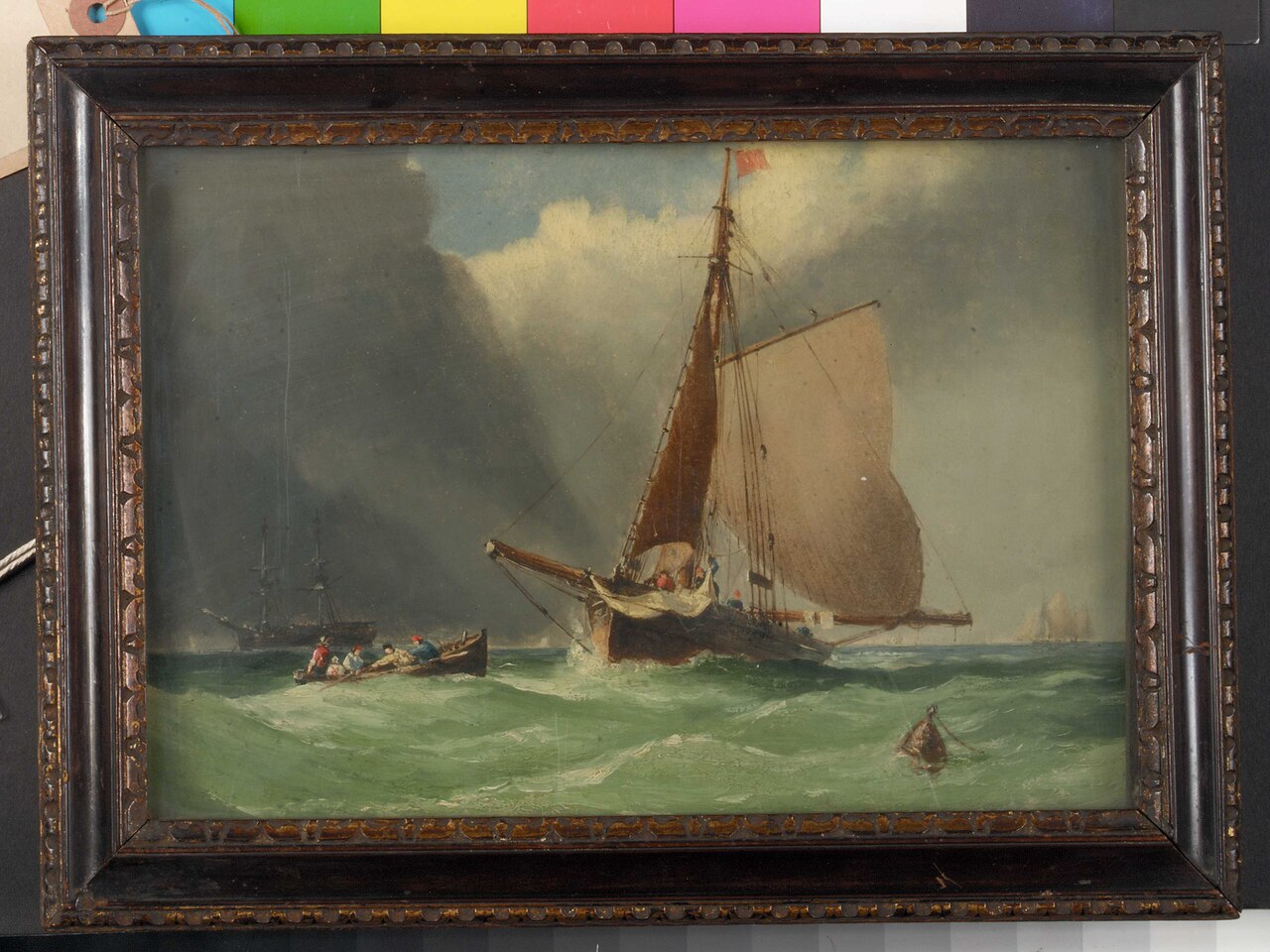
Major works Among Mitchell’s most celebrated pieces is **"A fishing smack picking up a boat" (1870)**, which captures a modest working vessel in the act of rescuing a smaller craft. The painting is notable for its narrative tension—the calm sea contrasted with the urgency of the rescue—while preserving the technical accuracy of the smack’s hull and rigging. **"The paddle steamer 'Ella'" (1868)** showcases Mitchell’s ability to depict the transition from sail to steam. The steamer’s paddle wheels are rendered with precise motion lines, and the smoke plume is rendered with delicate gradations that convey both power and elegance. **"Archer" (ship, 1888) (1887)** illustrates a late‑Victorian sailing ship, rendered in full sail with a focus on the intricate arrangement of its yards and sails. The work demonstrates Mitchell’s skill in portraying the interplay of wind and canvas. **"HMS Atalanta"** is a naval portrait that emphasizes the warship’s sleek lines and the disciplined order of its deck crew, reflecting the Royal Navy’s pride in its fleet. Finally, **"HMS Crocodile" (1895)** presents a later‑period warship with a focus on its ironclad hull and the emerging technologies of the era, providing a visual record of naval evolution at the turn of the century.
Influence and legacy Although Mitchell never aligned himself with a specific artistic movement, his dedication to accuracy made his oeuvre an invaluable resource for historians, model‑makers, and maritime enthusiasts. Contemporary shipbuilders consulted his paintings for reference, and his work appeared in nautical journals and exhibition catalogues, reinforcing the visual standards of marine documentation. In the decades after his death in 1914 on the Isle of Wight town of Ryde, Mitchell’s paintings continued to be reproduced in books on British naval history, cementing his reputation as one of the most reliable visual chroniclers of the Victorian and Edwardian fleets. Modern exhibitions of maritime art often include his pieces as exemplars of the intersection between fine art and technical illustration, and his methodical approach influences today’s marine illustrators who balance aesthetic appeal with factual fidelity.
Frequently asked questions
Who was William Frederick Mitchell?
He was a British marine painter (1845–1914) known for detailed, technically accurate depictions of naval and merchant ships.
What artistic style or movement is Mitchell associated with?
Mitchell did not belong to a specific avant‑garde movement; his work is best described as realistic marine illustration with academic painting techniques.
What are his most famous works?
Key works include "A fishing smack picking up a boat" (1870), "The paddle steamer 'Ella'" (1868), "Archer" (1888), "HMS Atalanta", and "HMS Crocodile" (1895).
Why is Mitchell important to art and naval history?
His paintings serve as precise visual records of 19th‑century vessels, aiding historians, model‑makers, and maritime scholars in understanding ship design and naval heritage.
How can I recognise a William Frederick Mitchell painting?
Look for meticulous hull detail, fine rigging brushwork, a slightly elevated viewpoint, and a restrained colour palette that emphasizes the realistic portrayal of sea and ship.