William Charles Ross
1794 – 1860
In short
William Charles Ross (1794–1860) was a British portrait and miniature painter, noted for his refined depictions of aristocratic sitters and for his election to the Royal Academy in 1842.
Notable works



Early life
William Charles Ross was born in London in 1794 to a family of Scottish descent. His father, a tradesman with artistic interests, encouraged young William’s talent, and he received his first formal instruction at a local drawing school. By his early teens Ross was already exhibiting sketches at the Royal Academy Schools, demonstrating a precocious ability to capture likenesses with a delicate touch. The bustling artistic environment of early‑nineteenth‑century London, combined with his exposure to both English and Scottish artistic traditions, shaped his early aesthetic sensibilities.
Career and style
Ross’s professional debut came in the 1810s, when he exhibited historical subjects alongside portraits. Though his early works included narrative scenes, he soon discovered a particular affinity for portraiture, especially miniature painting on ivory and vellum. His style is characterised by a smooth, almost porcelain‑like rendering of skin tones, meticulous attention to fabric detail, and a restrained yet expressive handling of light. Unlike many contemporaries who favoured bold brushwork, Ross preferred a refined, controlled technique that suited the intimate scale of miniatures. Throughout the 1820s and 1830s he secured commissions from the British aristocracy, producing both full‑size portraits and diminutive likenesses that were prized as personal mementos.
In 1842 Ross was elected an Associate of the Royal Academy and later became a full Academician, a testament to his standing among peers. His reputation extended beyond Britain; collectors in continental Europe admired his ability to convey the elegance of the English elite with a subtle, almost lyrical quality.
Signature techniques
Ross’s miniatures are distinguished by several recurring technical hallmarks:
* Layered glazing – He applied thin, translucent layers of water‑colour pigment to build depth, allowing the underlying ivory to glow through the flesh tones. * Fine stippling – Minute stippled dots were used to suggest hair texture and the delicate sheen of silk or lace. * Controlled palette – A limited range of muted earth tones and soft blues dominated his work, creating a harmonious, understated atmosphere. * Precise edge work – The borders of faces and garments are rendered with crisp, clean lines, contrasting with the softer modelling of the interior forms.
These methods gave his miniatures a sense of three‑dimensionality that was unusual for the medium and contributed to their lasting appeal.
Major works
Among Ross’s most celebrated pieces are:
* Thomas Erskine, 1st Baron Erskine (1823) – A full‑size oil portrait that captures the jurist’s dignified bearing. The composition places Erskine against a dark backdrop, allowing the subtle modelling of his face and the crisp white of his cravat to dominate the viewer’s attention.
* Randolph, 9th Earl of Galloway – This portrait emphasizes the aristocrat’s status through the inclusion of regalia and a richly embroidered coat. Ross’s handling of the satin fabric demonstrates his skill in rendering texture and the play of light on complex surfaces.
* A lady, called Mrs Ackland (1809) – One of his early miniatures, the work shows a young woman in a simple yet elegant dress. The delicate blush on the cheeks and the faint suggestion of a pearl necklace exemplify Ross’s subtle approach to decorative detail.
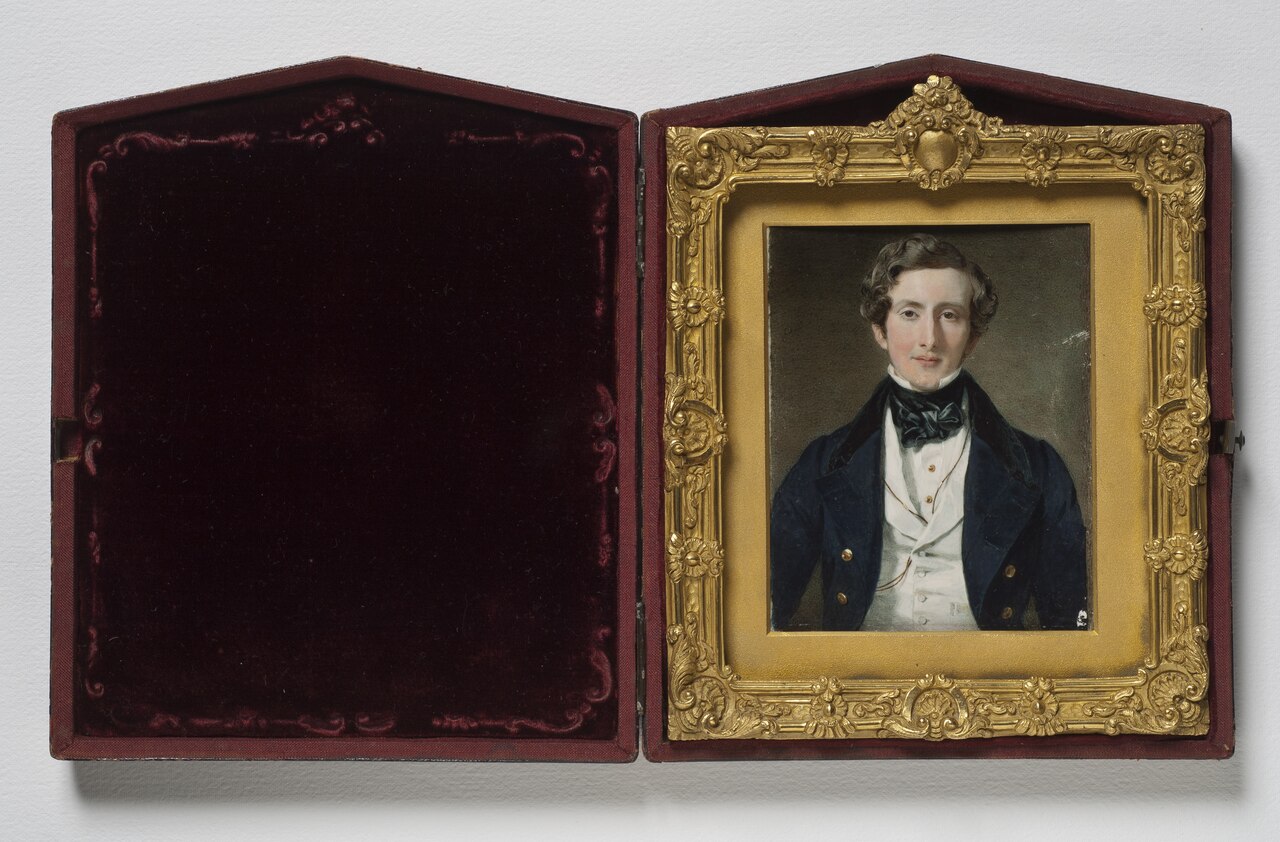
* Unknown man (1841) – Though the sitter’s identity remains uncertain, the painting showcases Ross’s mature style. The subject’s thoughtful expression, softened by a muted background, reflects the artist’s capacity to convey inner character without overt narrative cues.
* Ögonminiatyr av Victoria av Sachsen‑Coburg, hertiginna av Nemours – A miniature of Princess Victoria, later Queen Victoria’s sister, rendered with exquisite precision. The work is notable for its faithful rendering of royal attire and the delicate handling of the sitter’s veil, highlighting Ross’s reputation as a trusted portraitist for high‑profile clients.
These works collectively illustrate Ross’s versatility across scale, medium, and subject, while maintaining a consistent aesthetic of refined realism.
Influence and legacy
William Charles Ross played a pivotal role in sustaining the tradition of miniature painting at a time when photography was beginning to encroach on the market for personal likenesses. His meticulous technique set a benchmark for later miniaturists, who often emulated his glazing methods and restrained palette. Moreover, his election to the Royal Academy affirmed the artistic legitimacy of miniature work, encouraging institutions to recognise the medium’s artistic merit.
In the decades following his death in London in 1860, Ross’s portraits continued to circulate among private collections and museum holdings, particularly in the United Kingdom and Scandinavia. Contemporary scholars cite his oeuvre as a valuable visual record of early‑Victorian aristocratic fashion and portrait conventions. While his name may not be as widely known as some of his larger‑scale contemporaries, Ross remains an essential figure for understanding the intersection of portraiture, miniature technique, and the social networks of the British elite in the first half of the nineteenth century.
Overall, Ross’s body of work exemplifies a blend of technical mastery and subtle psychological insight, securing his place in the canon of British portrait art.
Frequently asked questions
Who was William Charles Ross?
William Charles Ross (1794–1860) was a British portrait and miniature painter of Scottish descent, renowned for his refined depictions of aristocratic sitters and elected to the Royal Academy in 1842.
What style or movement is Ross associated with?
Ross worked within the tradition of British portraiture, employing a restrained, highly detailed style that emphasized smooth modelling, delicate glazing, and a muted colour palette.
What are his most famous works?
Key works include the portrait of Thomas Erskine, 1st Baron Erskine (1823), the miniature of Princess Victoria of Saxe‑Coburg, the portrait of the 9th Earl of Galloway, the early miniature of Mrs Ackland (1809), and the enigmatic ‘Unknown man’ (1841).
Why does Ross matter in art history?
Ross upheld the art of miniature painting during the rise of photography, set technical standards for the medium, and his election to the Royal Academy helped legitise miniature portraiture as a fine art.
How can I recognise a Ross painting?
Look for smooth, porcelain‑like skin tones, meticulous stippling for hair and fabric, a limited, harmonious palette, and sharply defined edges that contrast with softly modelled interiors.