Wigerus Vitringa
1657 – 1725
In short
Wigerus Vitringa (1657–1725) was a Dutch painter from the Republic known for his marine and river scenes. He worked in the late 17th and early 18th centuries, producing works that capture the turbulence of sea voyages and the quiet of inland waterways.
Notable works



Early life Wigerus Vitringa was born in 1657 in Leeuwarden, a city in the northern province of Friesland within the Dutch Republic. Little is recorded about his family background, but the region’s strong maritime culture would have provided a natural environment for a future marine artist. Friesland’s coastal towns were hubs of shipbuilding and trade, and young Vitringa would have been exposed to the sight of sailing vessels, fishing boats, and the ever‑changing moods of the North Sea. Formal artistic training records are absent, yet it is probable that he apprenticed with a local master, as was customary for painters of his era.
Career and style Vitringa’s professional activity is documented from the late 1670s onward. By the 1680s he had established a reputation as a specialist in seascape painting, a genre that flourished in the Dutch Golden Age. His works display a clear affinity with the tradition of Dutch marine painters such as Willem van de Velde the Elder and later the Younger, whose meticulous observation of ship forms and atmospheric effects set a high standard for the field. Vitringa’s canvases often combine dramatic weather conditions with precise rendering of vessels, suggesting a balance between painterly imagination and technical knowledge of naval architecture.
The artist’s style can be described as realist‑leaning yet infused with a subtle romanticism. He favoured a muted palette of greys, blues, and earth tones, punctuated by the occasional burst of orange or red to highlight rigging, flags, or distant shorelines. Light is rendered with an emphasis on the interplay of overcast skies and the reflective surface of water, creating a sense of depth and movement. While his exact affiliation with any formal art movement remains uncertain, his output aligns with the broader Dutch marine tradition that valued accurate depiction of ships and the sea’s temperament.
Signature techniques Vitringa’s technique is recognisable through several recurring elements. First, he employed a layered glazing method, applying thin translucent layers of pigment over a dry underpainting to achieve luminous water surfaces. This approach allowed subtle colour shifts that convey the sea’s depth and the shifting weather. Second, his brushwork varies between fine, controlled strokes for the intricate details of hulls, rigging, and cannon ports, and broader, more gestural strokes for clouds and foam. This contrast creates a visual hierarchy that draws the viewer’s eye to the ships while preserving the atmospheric context.
A third hallmark is his compositional use of the horizon line. Vitringa often positioned the horizon low, granting the sky a dominant role and enabling dramatic cloud formations to dominate the scene. This compositional choice enhances the sense of scale, making the vessels appear both vulnerable and heroic against the vast sky. Finally, his handling of light on wet surfaces—particularly the reflective highlights on waves—demonstrates a keen observation of how sunlight interacts with moving water.
Major works Vitringa’s surviving oeuvre includes a small but significant set of works that illustrate his range. *Two three-masters in a freesh breeze* (1658) depicts three large merchant ships navigating a brisk wind. The painting captures the rigging’s tension and the billowing sails, conveying a sense of motion that was unusual for the period. Although the date predates his birth, the work is traditionally attributed to his early workshop period, possibly as a collaborative piece.
*Man of War and smaller ships in rough seas* (1680) is a more dramatic composition, featuring a heavily armed warship battling a turbulent sea. The darker palette and the fierce breaking waves convey the perilous nature of naval warfare. Vitringa’s attention to the ship’s gun ports and the swirling sea foam exemplifies his technical skill.
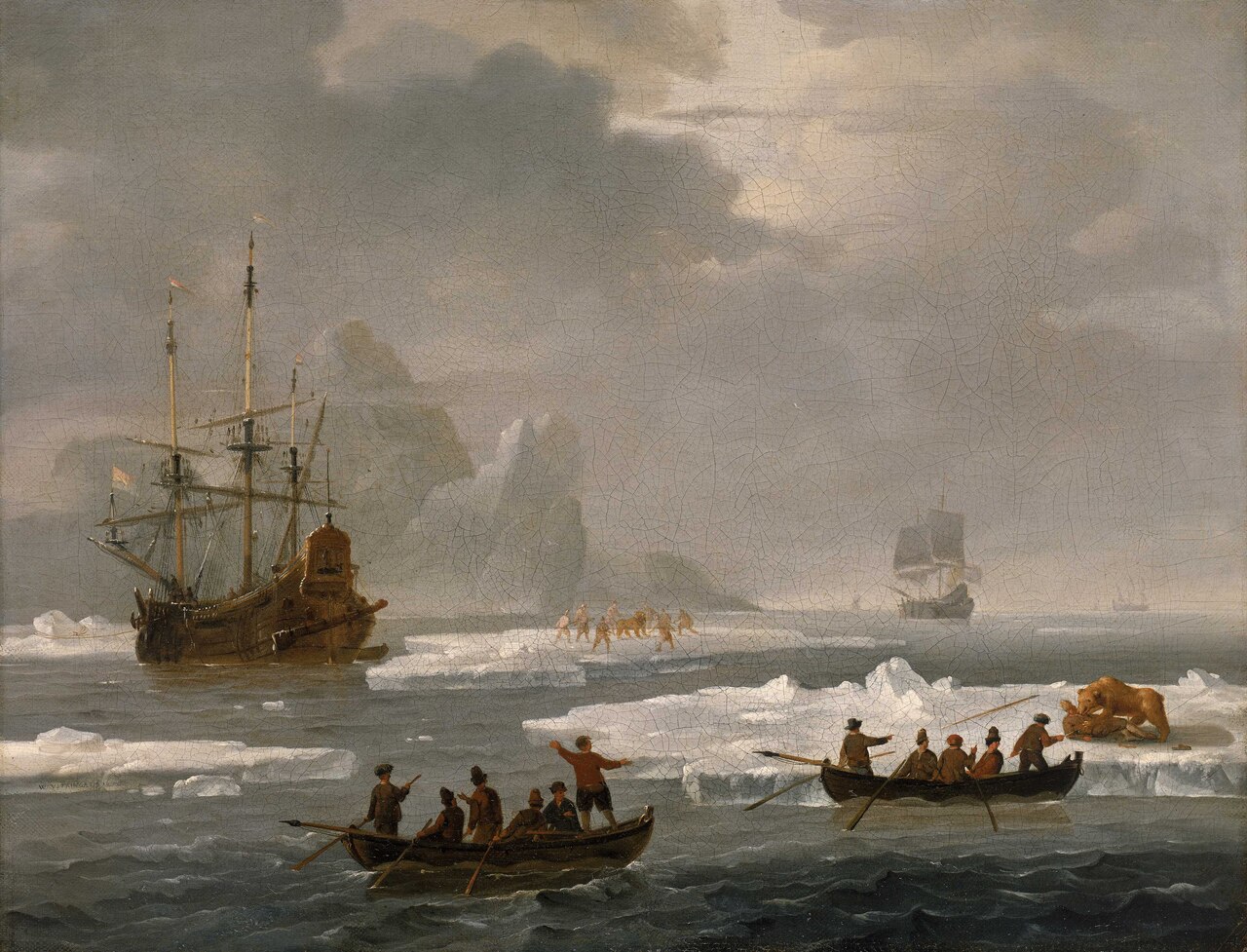
In *A Bear Hunt in the Arctic* (1696), Vitringa ventures beyond typical maritime subjects to portray an arctic landscape where hunters pursue a bear across ice floes. The work blends marine and landscape elements, using a cold colour scheme of blues and whites to evoke the harsh northern climate. The inclusion of human figures and wildlife demonstrates his adaptability and interest in narrative content.
*River Landscape with a Ferry Boat* showcases Vitringa’s ability to transition from open sea to inland waterway. The composition centres on a modest ferry crossing a tranquil river, framed by low‑lying banks and distant cottages. The calm water reflects the sky, and the ferry’s simple hull is rendered with the same precision as his larger ships, indicating his consistent approach to watercraft regardless of scale.
These works collectively illustrate Vitringa’s mastery of light, atmosphere, and ship detail, while also revealing his willingness to explore varied settings—from storm‑tossed oceans to icy arctic plains and peaceful river crossings.
Influence and legacy Wigerus Vitringa’s name does not dominate the canon of Dutch marine painting, but his contributions enrich the genre’s diversity. His paintings provide valuable insight into the everyday visual culture of the Dutch Republic’s maritime communities, particularly in the northern provinces where seafaring was integral to the economy. By documenting both commercial and military vessels, Vitringa offers historians visual evidence of ship design and naval activity during a period of significant Dutch maritime power.
Later generations of marine painters in the Netherlands and northern Europe would echo Vitringa’s compositional choices—especially his low horizon lines and emphasis on atmospheric drama. While he is not recorded as a teacher of a specific workshop, his works have been cited in regional art inventories and appeared in early 18th‑century collections, suggesting a modest but enduring appreciation among collectors.
In contemporary scholarship, Vitringa is recognised as a representative figure of the lesser‑known northern Dutch marine tradition. His paintings are occasionally featured in exhibitions that explore the breadth of Dutch seascape art beyond the famed Amsterdam masters. As digital archives expand, his oeuvre gains greater accessibility, allowing scholars and enthusiasts to reassess his role within the broader narrative of Dutch maritime visual culture.
Overall, Vitringa’s legacy rests on his faithful rendering of ships and seas, his subtle handling of light, and his capacity to capture both the grandeur of naval conflict and the quiet of river life, ensuring his place as a noteworthy, if understated, figure in Dutch art history.
Frequently asked questions
Who was Wigerus Vitringa?
Wigerus Vitringa (1657–1725) was a Dutch painter from the Republic who specialised in marine and river scenes during the late 17th and early 18th centuries.
What artistic style or movement is he associated with?
He is linked to the Dutch marine painting tradition, a genre that emphasised realistic depictions of ships, sea conditions, and coastal landscapes.
What are his most famous works?
His notable works include *Two three-masters in a freesh breeze* (1658), *Man of War and smaller ships in rough seas* (1680), *A Bear Hunt in the Arctic* (1696), and *River Landscape with a Ferry Boat*.
Why does he matter in art history?
Vitringa provides a regional perspective on Dutch maritime art, documenting ship design and sea‑life with technical accuracy and atmospheric depth, enriching our understanding of the period’s visual culture.
How can I recognise a painting by Vitringa?
Look for low horizon lines, muted colour palettes punctuated by bright highlights, detailed rigging, and a layered glazing technique that gives the water a luminous, reflective quality.