Utagawa Toyokuni II
1777 – 1835
In short
Utagawa Toyokuni II (1777–1835) was a Japanese ukiyo‑e woodblock print designer, the son‑in‑law and adopted son of the famed Toyokuni I, who worked in Edo producing kabuki actor portraits and scenic prints under the name Toyoshige before inheriting the Toyokuni name in 1826.
Notable works


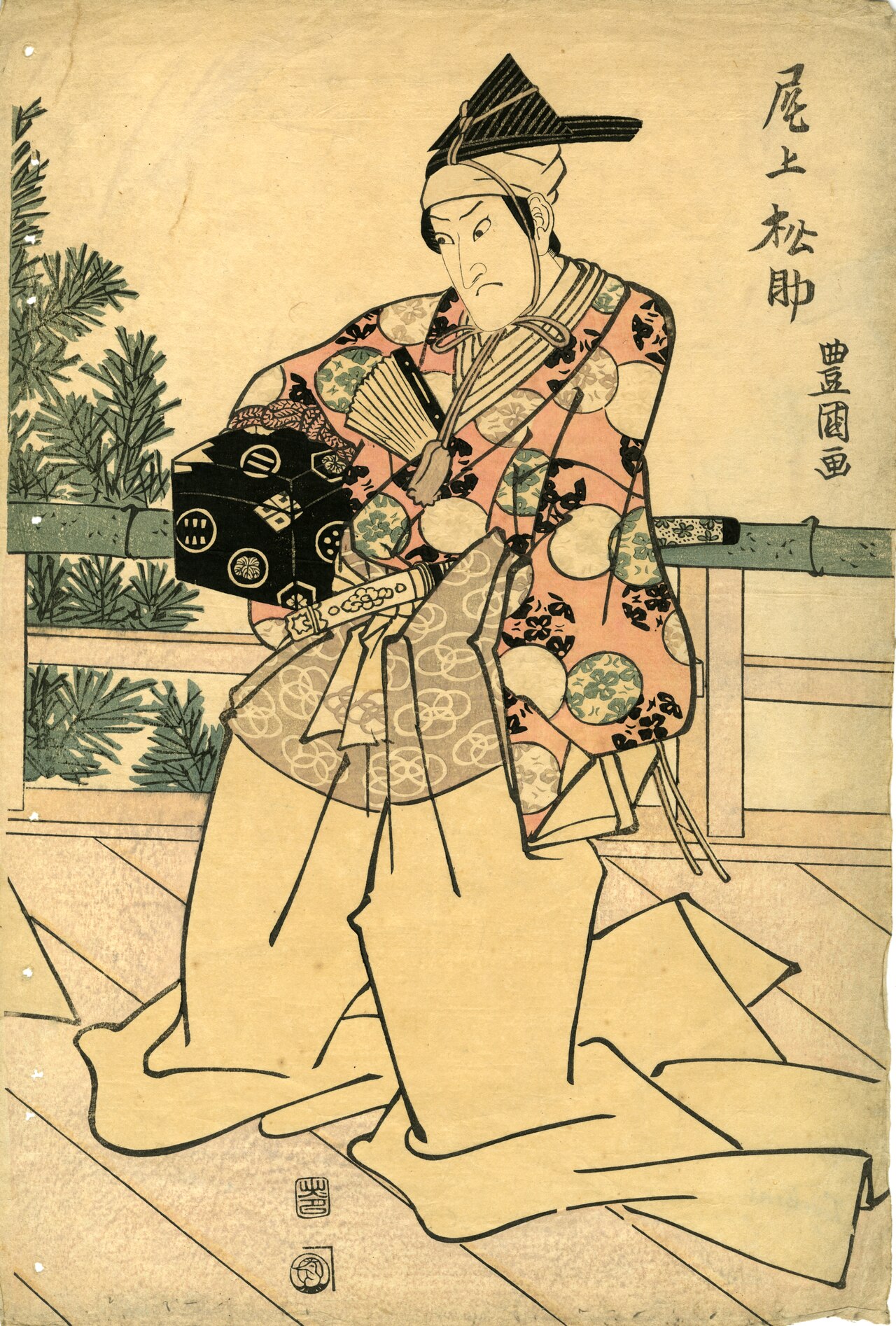
Early life Utagawa Toyokuni II was born in 1777 in Japan, though the precise location of his birth remains undocumented. He entered the world of ukiyo‑e through family connections: he became the pupil, son‑in‑law and later the adopted son of the celebrated Toyokuni I, the founder of the Utagawa school. This close relationship provided him with rigorous apprenticeship training in the studio, where he learned the technical and aesthetic foundations of woodblock printing that characterised the late‑eighteenth‑century Edo period.
Career and style Toyokuni II began his professional career under the artist name Toyoshige (豊重). For most of his early output he adhered to the stylistic conventions of his master, focusing on the vibrant, dynamic depictions of kabuki actors that had become the signature of the Utagawa workshop. In 1826, a year after Toyokuni I’s death, the school granted Toyoshige the right to use the illustrious Toyokuni name, and from that point forward his prints were signed Toyokuni (豊国). This change marked a subtle shift in his artistic identity, as he sought to balance reverence for his predecessor’s legacy with his own creative impulses.
His work is firmly situated within the ukiyo‑e tradition, a genre that catered to the tastes of the urban merchant class. The prints he produced were primarily intended for commercial circulation, appearing in popular series that illustrated famous actors, literary scenes, and celebrated landscapes. While the broader art movement of the period is often described as the Edo‑period woodblock print boom, Toyokuni II’s personal style is distinguished by a careful rendering of facial expressions and a keen eye for theatrical drama.
Signature techniques Toyokuni II’s prints are recognisable for several technical hallmarks. First, his line work is clean yet expressive, employing fine, continuous strokes to delineate costume details and the intricate patterns of kimono fabrics. Second, he made frequent use of a limited but vivid colour palette, often employing a dominant red or deep indigo to draw attention to the central figure. Third, his compositions frequently incorporate a shallow spatial depth, focusing on the foreground actor while allowing background elements to suggest a stage setting rather than a fully realised landscape. Finally, his signatures—whether Toyoshige or Toyokuni—are rendered in a bold, blocky script that stands out against the surrounding print, a practice common among Utagawa artists to assert authorship.
Major works Among Toyokuni II’s most celebrated pieces are the prints listed in the museum catalogue. *Eight Famous Views* (八景) is a series that captures iconic locations around Edo, each rendered with a balance of atmospheric perspective and decorative patterning. The series demonstrates his ability to move beyond actor portraiture and engage with the broader ukiyo‑e fascination with travel and scenery.
*The poetess Ono‑no Komachi in the rain* (1800) portrays the legendary Heian‑period poetess under a downpour, a subject that allows Toyokuni II to explore emotive storytelling through subtle brushwork and the suggestion of wetness via delicate stippling. The piece is notable for its melancholic mood, achieved through a restrained colour scheme and the careful placement of rain droplets.
*Fuwa Banzaemon* (1834) is a portrait of a popular kabuki character, executed near the end of the artist’s life. The print captures the flamboyant costume and dynamic pose of the actor, illustrating Toyokuni II’s continued mastery of theatrical representation even in his later years.
*The Kabuki Actors Seki Sanjuro as Tomohei and the Servant of Isogai* (1830) showcases a dramatic scene from a well‑known play. Here, Toyokuni II displays his skill in arranging multiple figures within a confined stage space, using contrasting colours to separate the protagonists and convey narrative tension.
Finally, the *Kabuki actor* triptych, a three‑panel work, demonstrates his capacity to create large‑scale compositions that maintain visual coherence across separate sheets. Each panel focuses on a different actor, yet the overall design is unified through consistent background motifs and a harmonious colour rhythm.
Influence and legacy Toyokuni II’s legacy is intertwined with the complex succession of the Utagawa school. After his death in Edo in 1835, the family sought to secure the continuity of the Toyokuni name. In 1844 they persuaded Kunisada—Toyokuni I’s most famous pupil—to adopt the name Toyokuni, thereby becoming Toyokuni III. Kunisada never acknowledged Toyokuni II’s claim to the name, a dispute that has coloured art‑historical scholarship ever since. Nonetheless, Toyokuni II’s prints remain valuable exemplars of early‑nineteenth‑century ukiyo‑e, offering insight into the transitional period between the late works of Toyokuni I and the prolific output of Kunisada.
Modern scholars regard Toyokuni II as a competent, if sometimes overlooked, practitioner whose work bridges the stylistic evolution of the Utagawa school. His prints are collected by museums worldwide and continue to be studied for their technical proficiency, their portrayal of Edo‑period theatrical culture, and their contribution to the visual lexicon of Japanese woodblock printing.
In summary, Utagawa Toyokuni II occupies a pivotal position in the lineage of ukiyo‑e artists. Though his name was contested, the body of work he left behind—especially his actor portraits and scenic series—provides a vivid snapshot of Edo’s vibrant popular culture and the artistic standards of his time.
Frequently asked questions
Who was Utagawa Toyokuni II?
Utagawa Toyokuni II (1777–1835) was a Japanese ukiyo‑e woodblock print designer, the son‑in‑law and adopted son of Toyokuni I, known for his kabuki actor portraits and scenic prints.
What artistic style or movement is he associated with?
He worked within the ukiyo‑e tradition of Edo‑period Japan, producing prints that reflect the popular culture, theatre, and landscape aesthetics of the time.
What are his most famous works?
Key works include the *Eight Famous Views* series, *The poetess Ono‑no Komachi in the rain* (1800), *Fuwa Banzaemon* (1834), *The Kabuki Actors Seki Sanjuro as Tomohei and the Servant of Isogai* (1830), and a triptych of kabuki actors.
Why is Toyokuni II important in art history?
He represents a transitional figure in the Utagawa school, linking the legacy of Toyokuni I with later masters like Kunisada, and his prints document Edo’s theatrical and urban visual culture.
How can I recognise a Toyokuni II print?
Look for clean, expressive line work, a limited vivid colour palette (often red or indigo), a focus on kabuki actors with detailed costumes, and a bold blocky signature reading Toyoshige or Toyokuni.