Utagawa Sadahide
1807 – 1873
In short
Utagawa Sadahide (1807–1873) was a Japanese ukiyo‑e artist of the Utagawa school, renowned for his prolific prints of everyday life and, later, his vivid Yokohama‑e depictions of foreigners after Japan opened to the West.
Notable works

_Chokichi_LACMA_M.2007.152.52.jpg)


Early life Utagawa Sadahide was born in 1807 in the rural district of Fusa, a region that is now part of Chiba Prefecture. Little is recorded about his family background, but like many aspiring artists of the period he entered the apprenticeship system at a young age. He became a disciple of the Utagawa school, the dominant workshop of the Edo period, where he learned the fundamentals of woodblock printmaking, brushwork, and the commercial conventions that governed the production of ukiyo‑e.
Career and style Sadahide quickly established himself as a versatile printmaker, producing works across a wide range of genres – from landscapes and cityscapes to genre scenes and portraiture. His early output adhered to the conventional ukiyo‑e aesthetic: flat colour planes, bold outlines, and an emphasis on popular subjects such as actors, courtesans, and famous landmarks. Around the 1850s he began to explore more expansive compositions, incorporating multiple figures and detailed architectural settings.
The opening of the port of Yokohama in 1859 created a new market for images of foreigners and modern infrastructure. Sadahide seized this opportunity, becoming one of the leading practitioners of the emerging Yokohama‑e style. His prints from the 1860s document the arrival of Western traders, diplomats, and technology, offering Japanese audiences a visual record of a rapidly changing society. The commercial success of these works cemented his reputation as a best‑selling artist of the late Edo and early Meiji periods.
Signature techniques Sadahide’s prints are characterised by a meticulous line quality that balances precision with fluidity. He employed a fine carving technique that allowed intricate architectural details to be rendered clearly, especially in his depictions of temples and port scenes. Colourwise, he favoured a restrained palette in his early ukiyo‑e works, moving toward brighter, more varied hues in his Yokohama‑e series to capture the novelty of Western clothing and machinery. His compositions often place the viewer at a slightly elevated perspective, creating a sense of depth while still maintaining the flattened decorative surface typical of woodblock prints.
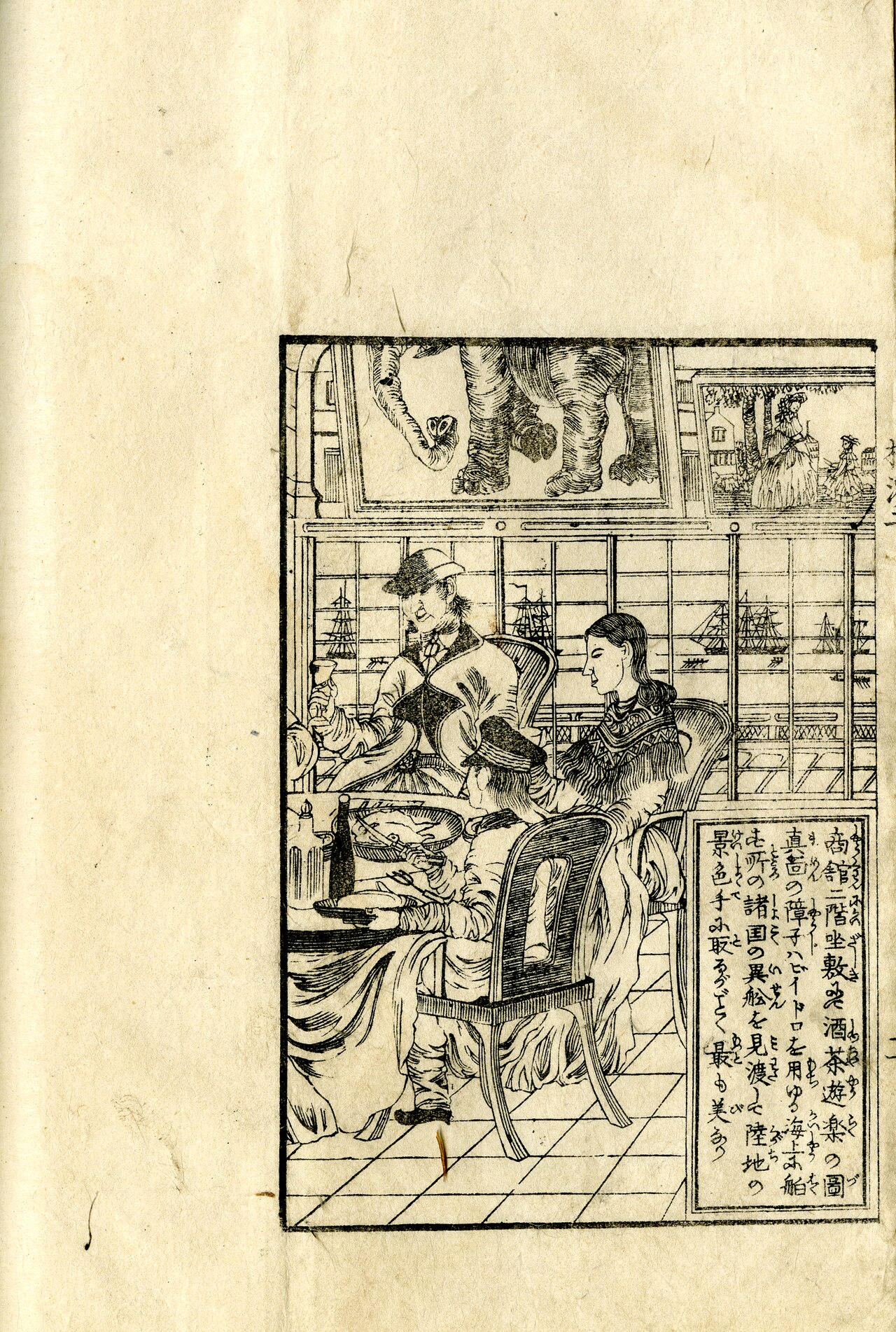
Major works - **Suehiro 53 tsugi** – Part of a popular series of prints that illustrated the sequential adventures of a fictional character named Suehiro. The work showcases Sadahide’s narrative skill, combining humor with detailed background settings. - **Flowers of Edo and Views of Famous Places** – A collection that blends botanical illustration with landscape, reflecting the Edo period’s fascination with both natural beauty and urban landmarks. The series demonstrates his ability to harmonise delicate floral motifs with more robust architectural forms. - **Two Women Admiring the Sights from a Vantage Point Overlooking the Zenpukuji Temple (1843)** – This print captures a serene moment of contemplation, using a high viewpoint to frame the temple against a sweeping cityscape. The composition highlights Sadahide’s command of perspective and his interest in everyday leisure activities. - **Foreigners in the Drawing Room of Foreign Merchant's House in Yokohama** – One of his most celebrated Yokohama‑e images, it portrays Western merchants inside a Japanese‑styled interior, juxtaposing cultural attire and furnishings. The work is notable for its accurate rendering of foreign dress and interior décor, providing a rare glimpse into cross‑cultural encounters. - **Yokohama Kaiko Kenbunshi (Information about the opening of the Port of Yokohama) (1862)** – Produced shortly after the port’s official opening, this print serves both as a visual record and a promotional pamphlet. It combines textual information with vivid imagery of ships, cranes, and bustling waterfront activity, encapsulating the optimism of the early Meiji era.
Influence and legacy Sadahide’s output bridged the final years of the Tokugawa shogunate and the early Meiji Restoration, making him a key figure in the transition of Japanese visual culture. His Yokohama‑e prints were selected by a Tokugawa delegation for display at the International Exposition of 1867 in Paris, introducing Western audiences to Japanese woodblock art and influencing the burgeoning Japonisme movement.
Later artists and scholars have cited Sadahide’s detailed documentation of foreign presence as a valuable historical resource. While many of his contemporaries faded from public memory after the Meiji period, Sadahide’s work has been re‑examined in recent decades for its role in mediating cultural exchange and for its technical mastery within the ukiyo‑e tradition. His prints continue to appear in museum collections worldwide, and reproductions are frequently used in academic publications on 19th‑century Japanese art.
In sum, Utagawa Sadahide remains an exemplar of an artist who adeptly navigated commercial demands, artistic innovation, and the profound societal shifts of his time, leaving a legacy that enriches both art historical scholarship and popular appreciation of Japanese printmaking.
Frequently asked questions
Who was Utagawa Sadahide?
Utagawa Sadahide (1807–1873) was a Japanese ukiyo‑e artist of the Utagawa school, famed for his prints of everyday life and later for his Yokohama‑e images of foreigners after Japan opened its ports.
What artistic movement or style is he associated with?
He worked within the ukiyo‑e tradition and, in the 1860s, helped develop the Yokohama‑e sub‑genre that portrayed Western people and modern infrastructure.
What are his most famous works?
Key works include *Suehiro 53 tsugi*, *Flowers of Edo and Views of Famous Places*, *Two Women Admiring the Sights from a Vantage Point Overlooking the Zenpukuji Temple* (1843), *Foreigners in the Drawing Room of Foreign Merchant's House in Yokohama*, and *Yokohama Kaiko Kenbunshi* (1862).
Why is Sadahide important in art history?
His prints documented Japan’s rapid opening to the West, were exhibited internationally at the 1867 Paris Exposition, and influenced the Japonisme craze that shaped Western modern art.
How can I recognise a Sadahide print?
Look for finely carved lines, detailed architectural settings, a balanced use of colour that shifts from muted ukiyo‑e tones to brighter Yokohama‑e palettes, and often a slightly elevated perspective that gives depth to the scene.