Tomioka Tessai
1837 – 1924
In short
Tomioka Tessai (1837–1924) was a Japanese painter and calligrapher, recognised as the last major artist of the Bunjinga (Nanga) tradition and an early practitioner of the modern Nihonga style.
Notable works



Early life Tomioka Tessai was born in 1837 on Sanjō Street in Edo (now Tokyo). His birth name was Yusuke; he later adopted the art name Hyakuren before finally settling on the pseudonym Tomioka Tessai, under which he achieved fame. Growing up in a period of political turbulence, Tessasai received a classical education that combined Confucian studies with exposure to Chinese literati painting, an influence that would shape his artistic trajectory. He began practising calligraphy at a young age, an art form that was highly valued among the educated elite of the Tokugawa shogunate.
Career and style Tessai’s career unfolded during the final decades of the Edo period and the early Meiji era, a time when Japan was opening to the West and re‑examining its artistic heritage. He became a leading figure in the Bunjinga, or Nanga, movement—a Japanese interpretation of Chinese literati painting that prized personal expression, brushwork spontaneity and a scholarly aesthetic. While remaining rooted in the ideals of the literati, Tessai also embraced the emerging Nihonga style, which sought to revitalise traditional Japanese painting techniques in response to Western influence. His work therefore bridges two important currents: the classical, scholarly Nanga approach and the modernising impulse of Nihonga.
Tessai was active as both a painter and a calligrapher, and his reputation grew through exhibitions, commissions from the imperial court, and the circulation of his prints. He travelled widely across Japan, drawing inspiration from historic sites, gardens and temples, which he rendered with a blend of lyrical brushwork and meticulous detail. Despite the changing artistic climate, he retained a strong commitment to the moral and philosophical underpinnings of the literati tradition, often incorporating poems or classical references into his visual compositions.
Signature techniques Tessai’s technique is characterised by a harmonious synthesis of ink wash and colour, achieved through layered washes that convey depth without sacrificing the immediacy of the brushstroke. In his paintings, he frequently employed a "splashed ink" method (hatsubokusei), allowing the ink to flow naturally across the paper before adding controlled outlines. This approach creates a sense of spontaneity that is balanced by precise, deliberate detailing in areas such as foliage, architecture or facial features.
In calligraphy, Tessai favoured the seal style (togaki) and grass script (sōsho), both of which demand a fluid, expressive hand. His calligraphic works are often executed on unconventional supports, such as printed pocket folders, demonstrating his willingness to merge fine art with everyday objects. The brush pressure, speed and rhythm in his calligraphy echo the same aesthetic values found in his paintings, reinforcing his identity as a true literati artist.
Major works - **Releasing the Oar in the Plum Valley** – This composition depicts a solitary figure lowering an oar into a tranquil river surrounded by plum trees. The work exemplifies Tessai’s ability to convey narrative through minimal visual cues, using soft ink washes to suggest mist and the delicate blossoms of the plum trees to evoke a fleeting moment of calm.
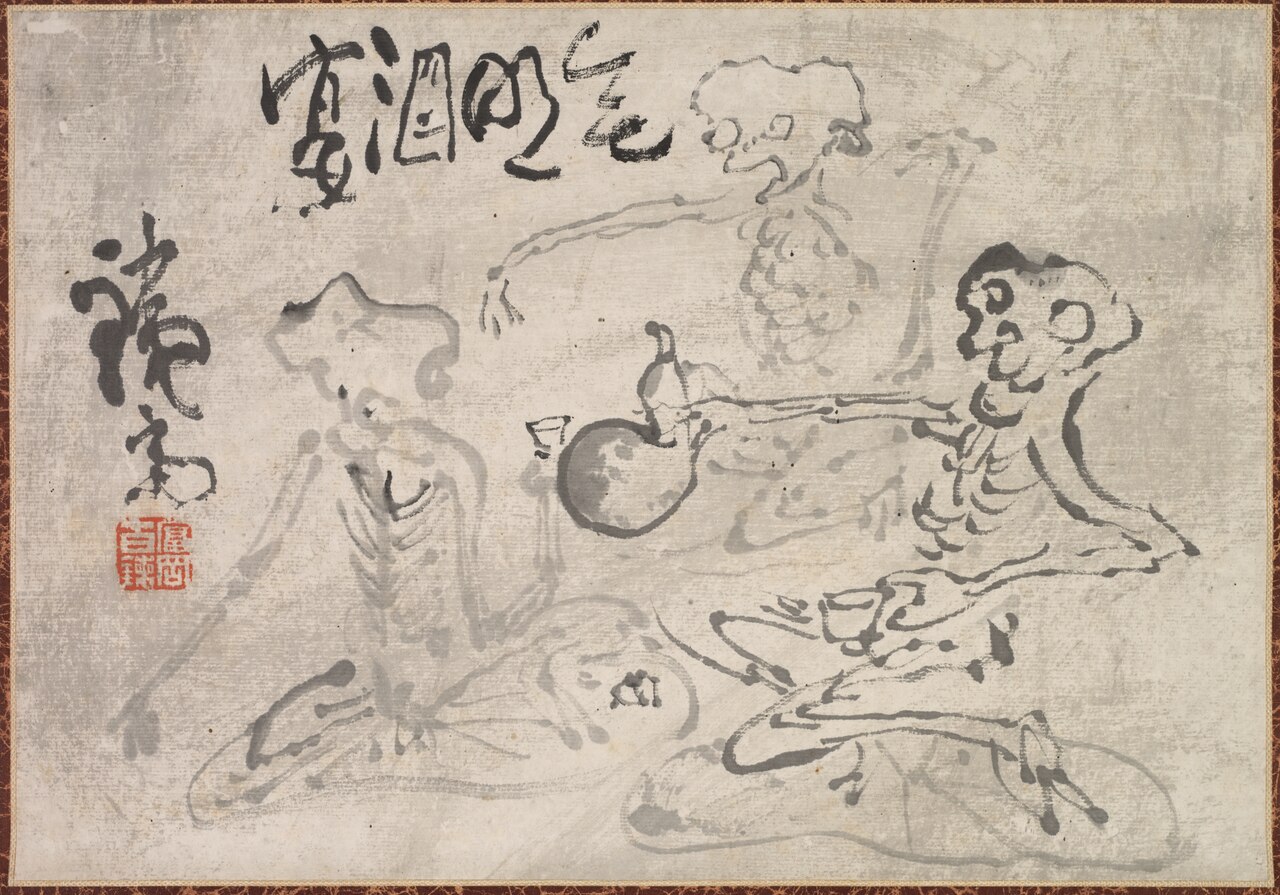
- Sake Party with No Light (1890) – Created in the early Meiji period, this painting captures a nocturnal gathering where participants drink sake by the glow of a single lantern. The subdued palette and careful rendering of light and shadow reflect Tessai’s mastery of atmosphere, while the subject matter underscores his interest in the everyday lives of the literati.
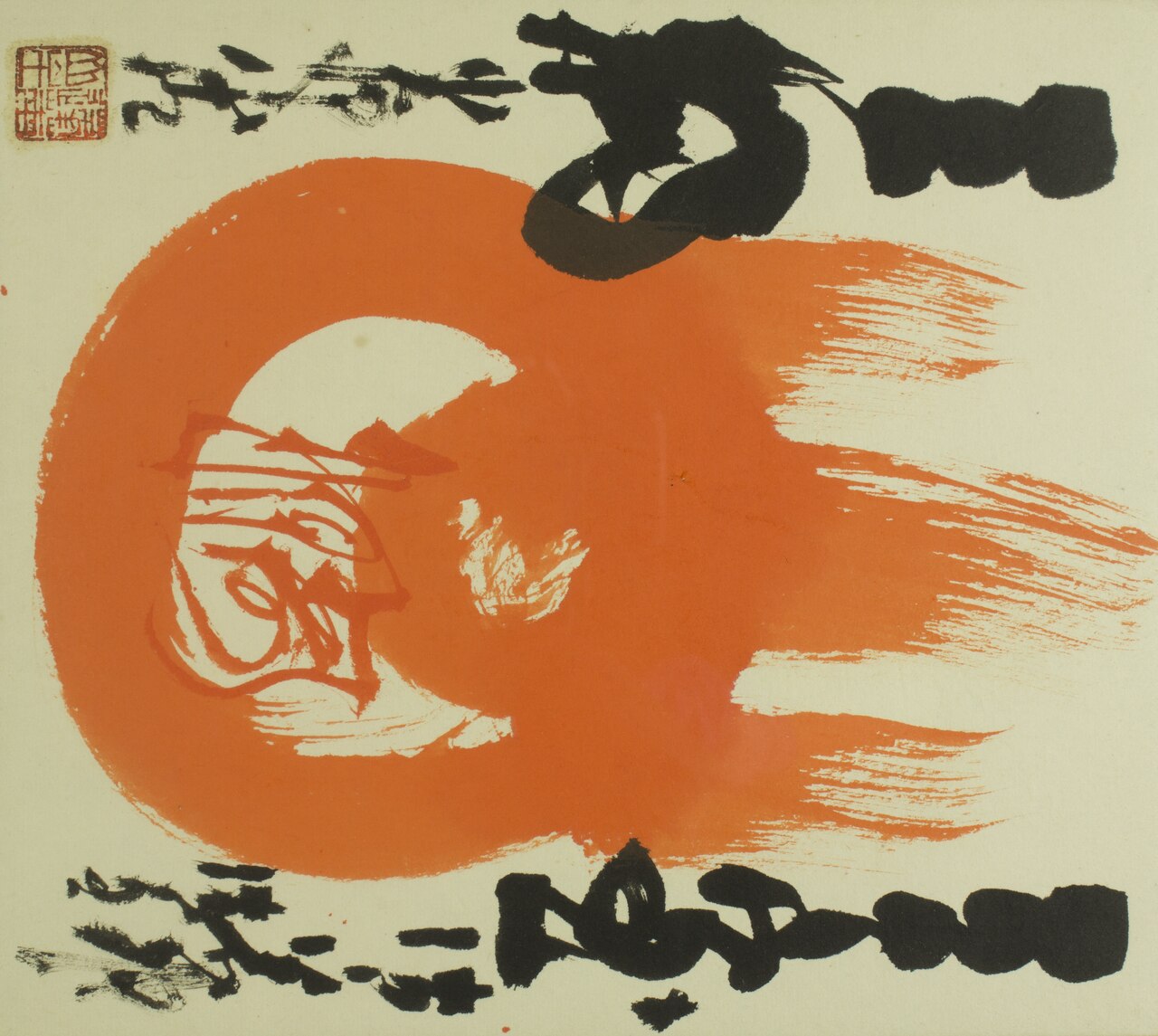
- Calligraphy in printed pocket folder – An innovative work that places elegant calligraphic characters on a utilitarian pocket folder. By integrating high art with a commonplace object, Tessai challenges the boundaries between fine art and daily practice, a hallmark of the Nanga spirit.
- Landscape – Though untitled, this landscape showcases Tessai’s characteristic blend of ink wash and colour. Mountains recede into mist, while foreground trees are rendered with crisp, confident strokes, illustrating his capacity to balance abstraction with representational detail.
- Portraits of Ike Taiga and His Calligraphies in Seal and Grass Styles – In these portraits, Tessai pays homage to the 18th‑century painter‑scholar Ike Taiga, a seminal figure in the Nanga movement. The works not only depict Taiga’s likeness but also reproduce his calligraphic samples, reinforcing the close relationship between painting and writing in the literati tradition.
Influence and legacy Tomioka Tessai is widely regarded as the last major exponent of the Bunjinga tradition, a role that positions him as a bridge between classical Japanese painting and the modern Nihonga movement. His willingness to incorporate Western techniques—such as perspective and shading—while preserving the philosophical core of the literati aesthetic made his oeuvre a template for later artists seeking to negotiate tradition and modernity.
Through official commissions for the imperial household and participation in national exhibitions, Tessai helped legitise the Nihonga style as a respectable counterpart to Western oil painting. His works continue to be exhibited in major museums across Japan and abroad, and they serve as primary sources for scholars studying the transition from Edo‑era art to Meiji‑era modernity. Moreover, his integration of calligraphy with painting, and his use of everyday objects as artistic media, have inspired contemporary artists who explore the intersection of fine art and design.
Tessai’s legacy endures not only in the preservation of his paintings and calligraphic pieces but also in the pedagogical lineage he established. Several of his students went on to become influential teachers themselves, ensuring that his techniques and aesthetic principles were transmitted to subsequent generations. In this way, Tomioka Tessai remains a pivotal figure in the narrative of Japanese art, embodying both the culmination of a centuries‑old tradition and the innovative spirit of a nation in transformation.
Frequently asked questions
Who was Tomioka Tessai?
Tomioka Tessai (1837–1924) was a Japanese painter and calligrapher, known as the last major artist of the Bunjinga (Nanga) tradition and an early figure in the modern Nihonga style.
What artistic movement or style is he associated with?
He is associated with Nanga (Bunjinga), a Japanese literati painting style, and he also helped pioneer the Nihonga movement that revived traditional Japanese techniques in the Meiji era.
What are his most famous works?
Among his well‑known works are *Releasing the Oar in the Plum Valley*, *Sake Party with No Light* (1890), his calligraphy on a printed pocket folder, a celebrated *Landscape*, and the *Portraits of Ike Taiga and His Calligraphies in Seal and Grass Styles*.
Why is Tomioka Tessai important in art history?
He represents the culmination of the centuries‑old Bunjinga tradition while simultaneously bridging to modern Nihonga, influencing both his contemporaries and later generations in how Japanese art could evolve without abandoning its scholarly roots.
How can I recognise a Tomioka Tessai painting?
Look for a blend of ink wash and subtle colour, spontaneous brushstrokes combined with precise detailing, often accompanied by calligraphic inscriptions and themes drawn from classical literature or everyday Japanese life.