Thomas Somerscales
1842 – 1927
In short
Thomas Somerscales (1842–1927) was a British‑born painter, teacher and former sailor who built his artistic reputation in Chile, becoming known for marine and landscape works that celebrate historic naval battles and coastal scenes.
Notable works
_-_Off_Valparaiso_-_N01773_-_Tate.jpg)
_-_A_Barque_Running_Before_a_Gale_-_BHC1343_-_Royal_Museums_Greenwich.jpg)


Early life Thomas Jacques Somerscales was born in 1842 in Kingston upon Hull, a bustling port city in the United Kingdom of Great Britain and Ireland. Growing up in a maritime environment, he developed an early fascination with ships and the sea. Details of his family background are sparse, but records indicate that he received a basic education before embarking on a career that combined teaching, seafaring, and eventually, art. By his early twenties he had qualified as a schoolmaster, a profession that would later provide the financial stability needed to pursue his artistic ambitions.
Career and style Somerscales’ professional life took a decisive turn when he accepted a teaching post in Chile during the late 19th century. The move exposed him to the dramatic coastal geography of the Pacific and to a nation eager to commemorate its recent naval victories. While in Chile he joined the local art circles and began to paint seriously, drawing on his nautical experience and the vivid maritime history surrounding him. His style does not fit neatly into a single recognised movement; rather, it blends realistic detail with a romantic sensibility, reflecting both academic training and an emotive engagement with his subjects. The painter’s works are characterised by careful observation of light, water, and atmospheric effects, creating scenes that are both documentary and evocative.
Signature techniques Somerscales employed a fairly traditional oil painting technique, often working on canvas with a layered approach. He would sketch the composition in charcoal or pencil before applying a thin underpainting to establish tonal values. His handling of water is particularly noteworthy: he achieved a sense of movement through fluid brushstrokes and subtle colour modulation, using a palette dominated by deep blues, muted greys, and occasional highlights of amber to capture sunrise or sunset glints on the sea. In his battle scenes, he incorporated precise ship silhouettes and rigging details, a skill likely honed from his own time at sea. The painter also used glazing to deepen shadows and to render atmospheric haze, lending his works a luminous depth that distinguishes them from more straightforward illustrative depictions.
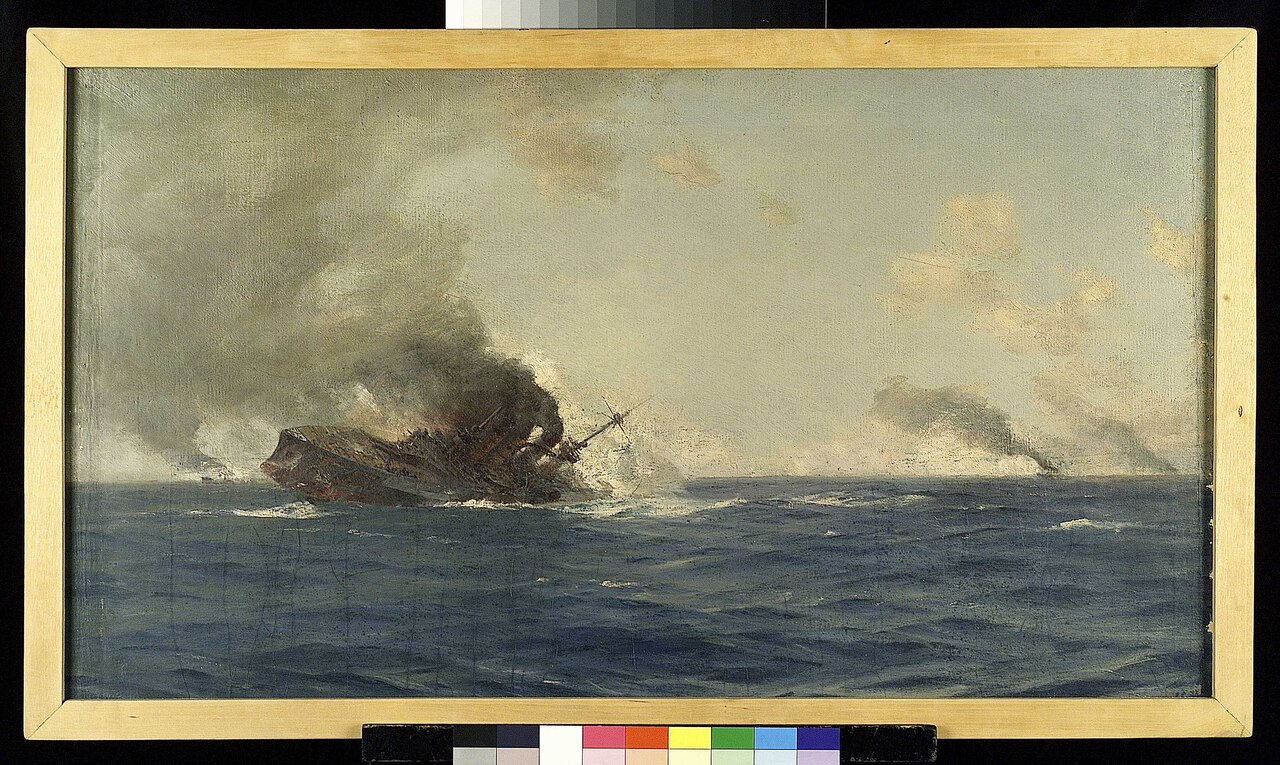
Major works Among Somerscales’ most celebrated paintings are several that commemorate Chilean naval history. **Off Valparaiso (1899)** portrays a tranquil harbor scene with ships anchored under a calm sky, highlighting the strategic importance of the port. **Battle of Angamos (1888‑1889)** captures the decisive clash between Chilean and Peruvian forces during the War of the Pacific, depicting the Chilean ironclad *Huáscar* in a dynamic, smoke‑filled tableau. **Sinking of the Esmeralda during the battle of Iquique (1900)** offers a poignant view of the Chilean corvette *Esmeralda* being overwhelmed, its masts broken and sails torn, while the sea churns with fire‑lit debris. **A Barque Running Before a Gale (1910)** shifts focus to the raw power of nature, showing a solitary sailing vessel battling a fierce wind, a study in human perseverance against the elements. Finally, **Sinking of the ‘Scharnhorst’ at the Battle of the Falkland Islands, 8 December 1914 (1915)** commemorates a World War I engagement, rendering the German cruiser in a dramatic plunge, its hull illuminated by the fire of British shells. Each of these works combines historical narrative with meticulous marine rendering, making them enduring symbols of Chilean national pride.
Influence and legacy Although Somerscales spent much of his adult life abroad, he returned to his birthplace of Kingston upon Hull later in life, where he died in 1927. In Chile, however, his legacy endures through the continued display of his paintings in museums and public buildings, where they are used to teach both art history and national heritage. His ability to fuse personal seafaring experience with a painterly eye set a precedent for later maritime artists in South America, who looked to his works as models for combining accuracy with emotional resonance. Moreover, his landscapes—though less frequently cited—contribute to a visual record of Chile’s coastal geography at the turn of the century. Today, scholars regard Thomas Somerscales as a bridge between British artistic traditions and Chilean patriotic iconography, a figure whose work remains a touchstone for discussions of cross‑cultural artistic exchange.
Frequently asked questions
Who was Thomas Somerscales?
Thomas Somerscales (1842–1927) was a British‑born teacher, sailor and painter who made his artistic career in Chile, becoming renowned for marine and landscape paintings that depict historic naval battles.
What artistic style or movement is he associated with?
Somerscales does not belong to a single defined movement; his work blends realistic detail with a romantic, atmospheric approach, reflecting academic training and a personal connection to maritime subjects.
What are his most famous works?
His best‑known paintings include *Off Valparaiso* (1899), *Battle of Angamos* (1889), *Sinking of the Esmeralda during the battle of Iquique* (1900), *A Barque Running Before a Gale* (1910), and *Sinking of the ‘Scharnhorst’ at the Battle of the Falkland Islands* (1915).
Why does Thomas Somerscales matter in art history?
He is important for bridging British painting traditions with Chilean national identity, providing both accurate naval documentation and emotionally resonant images that have become iconic symbols of Chilean heritage.
How can I recognise a Thomas Somerscales painting?
Look for meticulously rendered ships, dramatic sea and sky lighting, a palette of deep blues and muted greys, and subjects that often portray historic Chilean naval battles or solitary vessels confronting powerful weather.