Thomas Blanchet
1614 – 1689
In short
Thomas Blanchet (1614–1689) was a French painter, draughtsman, architect, sculptor and printmaker of the Classicist tradition. Born in Paris and active mainly in Lyon, he produced works that combined rigorous drawing with a restrained, idealised style.
Notable works


Early life Thomas Blanchet was born in Paris in 1614, at a time when the French capital was a centre for artistic exchange between Italy and the Low Countries. Little is known of his family background, but archival records indicate that he entered a Parisian workshop as an apprentice in his early teens, where he received training in drawing, painting and the decorative arts. The curriculum of the period emphasized the study of classical sculpture and the works of Italian masters, an influence that would shape Blanchet’s lifelong commitment to Classicism. By his early twenties he had acquired a reputation for precise draughtsmanship, a skill that later supported his work across multiple media.
Career and style In the 1630s Blanchet moved to Lyon, a city that offered a thriving market for religious commissions, civic decoration and private portraiture. The move coincided with a broader shift in French art toward a more restrained, classical aesthetic, championed by artists such as Nicolas Poussin and Charles Le Brun. Blanchet’s style reflects this trend: his compositions are characterised by clear, harmonious arrangements, a muted colour palette, and an emphasis on idealised human forms. He worked both as a painter and as an architect, designing decorative schemes for churches and civic buildings that integrated frescoes, sculptural reliefs and sculpted interiors. His printmaking, largely executed in etching, served to disseminate his designs and to reinforce his reputation among collectors and fellow artists.
Signature techniques Blanchet’s technical signature rests on three interrelated practices. First, his drawing is marked by a meticulous line that balances anatomical accuracy with a graceful stylisation; this is evident in both his painted figures and his preparatory sketches. Second, he employed a restrained colour scheme, favouring earth tones and subdued blues that echo the palette of classical marble. Third, his architectural designs often incorporated trompe‑l’œil effects, using perspective to create the illusion of depth on flat surfaces. In printmaking, Blanchet favoured fine hatching to model volume, a technique that allowed his prints to retain the softness of his painted works while still delivering crisp detail.
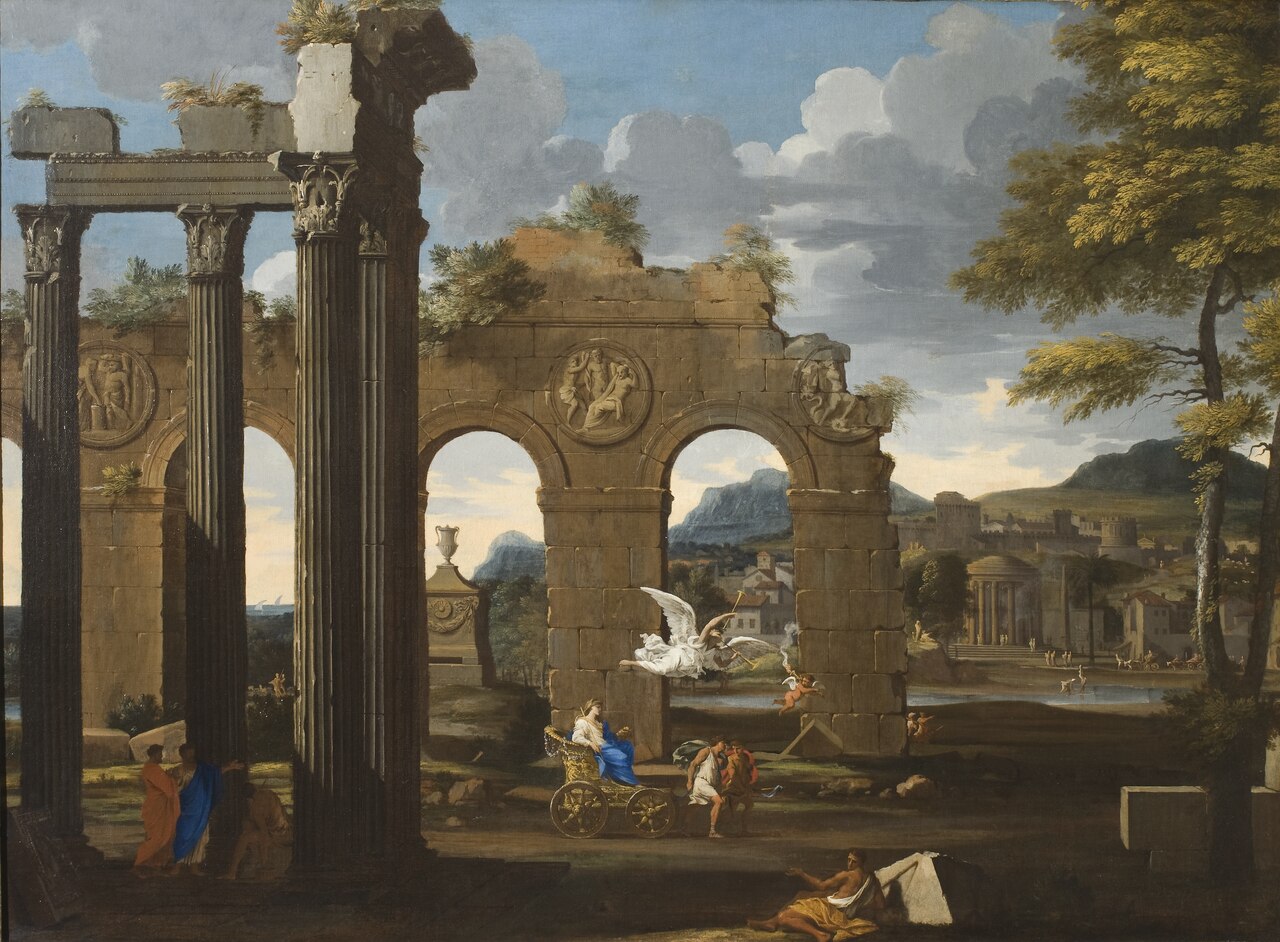
Major works Blanchet’s oeuvre includes several works that illustrate his classicising approach. *Cleobis and Biton* (1620) is an early canvas depicting the legendary Greek brothers; the composition demonstrates his command of narrative drama and his ability to render muscular figures within a balanced, almost sculptural setting. *Landscape with sarcophagus* (1650) showcases Blanchet’s talent for integrating architecture into natural scenery; the sarcophagus, rendered with precise linear perspective, anchors the composition while the surrounding foliage is rendered with delicate washes. *Mercury and Herse* (1650) reflects his interest in mythological subjects, portraying the messenger god in a calm, contemplative pose beside the nymph Herse, a scene that underscores his restrained palette and elegant figuration. *The Deposition* (1670) is perhaps his most ambitious religious work, depicting Christ’s removal from the cross with a solemn, measured arrangement that avoids overt emotionalism in favour of dignified restraint. Finally, *Ryktet*—a title whose meaning remains obscure—appears in several contemporary inventories; its surviving sketches suggest a genre scene rendered with the same compositional clarity that defines Blanchet’s larger commissions.
Influence and legacy Thomas Blanchet’s career bridges the late Renaissance and the early Baroque in France, and his synthesis of painting, architecture and printmaking anticipates the multidisciplinary practices of later French academicians. While he never achieved the fame of his more celebrated contemporaries, his work contributed to the diffusion of classicist ideals beyond Paris, particularly in the artistic circles of Lyon. His prints circulated among collectors and served as pedagogical models for younger draughtsmen, reinforcing the importance of line and proportion in French academic training. Modern scholarship recognises Blanchet as a representative figure of the mid‑seventeenth‑century French Classicism, illustrating how regional artists negotiated the tensions between local patronage and the dominant Parisian aesthetic. His surviving paintings and prints continue to be studied for their disciplined composition and for the way they embody the intellectual currents of their time.
Frequently asked questions
Who was Thomas Blanchet?
Thomas Blanchet (1614–1689) was a French painter, draughtsman, architect, sculptor and printmaker associated with the Classicist movement.
What artistic style or movement is he linked to?
He worked within the Classicist tradition, favouring balanced compositions, restrained colour and idealised figuration.
What are his most famous works?
Key works include *Cleobis and Biton* (1620), *Landscape with sarcophagus* (1650), *Mercury and Herse* (1650), *The Deposition* (1670) and the lesser‑known piece titled *Ryktet*.
Why does Thomas Blanchet matter in art history?
Blanchet exemplifies the spread of Classicist ideals beyond Paris, and his multidisciplinary practice influenced the training of later French artists.
How can I recognise a work by Thomas Blanchet?
Look for precise, elegant drawing, a muted palette, clear architectural perspective and a calm, balanced arrangement of figures.