Thomas Baines
1820 – 1875
In short
Thomas Baines (1820–1875) was a British artist and explorer who documented the landscapes and peoples of southern Africa and Australia through watercolour and sketch. His works, created during extensive travels, are valued both as artistic records and as historical visual sources.
Notable works

_-_Action_Between_HMS_%27Blanche%27_and_the_%27Pique%27,_5_January_1795_-_BHC0478_-_Royal_Museums_Greenwich.jpg)

_-_The_74th_above_Waterkloof,_1851_-_M.1949.45_-_National_War_Museum.jpg)
Early life Thomas Baines was born in 1820 in the market town of King\'s Lynn, Norfolk, England. Little is recorded about his family background, but contemporary accounts suggest he received a solid basic education and an early exposure to drawing, a common pastime among the middle classes of the period. By his late teens, Baines had developed a proficiency with watercolour, a medium that would become his principal tool for recording the distant lands he would later explore.
Career and style In the early 1840s Baines embarked on his first overseas venture, joining a survey expedition to the Cape Colony. The experience sparked a lifelong fascination with the frontier regions of the British Empire, especially the southern African interior and the Australian continent. Over the next three decades he travelled extensively, often accompanying colonial officials, military units, and scientific parties. His role was that of a visual chronicler: he produced sketches, topographical drawings, and genre scenes that captured both the natural environment and the activities of European settlers and indigenous peoples.
Baines\' artistic style reflects the dual purpose of his work. The compositions are generally realistic, with an emphasis on accurate depiction of terrain, flora, fauna, and architecture. At the same time, his watercolours display a keen eye for atmospheric effects—light, shadow, and colour are used to convey the heat of the African savanna or the crispness of an Australian coastline. While he never aligned himself with a specific avant‑garde movement, his oeuvre shares affinities with the 19th‑century British landscape tradition, particularly the works of J. M. W. Turner and John Constable, in its focus on natural detail and the sublime qualities of untamed land.
Signature techniques Baines favoured a portable set‑up: a small sketchbook, a palette of water‑soluble pigments, and a brush suitable for quick washes. His technique involved rapid, gestural outlines to capture the overall form of a scene, followed by layered washes that built depth and tonal variation. He often employed a limited palette dominated by ochres, umbers, and siennas for earth tones, punctuated by brighter blues or greens to highlight water and vegetation. In many of his works, the foreground is rendered with finer detail, gradually softening toward the horizon—a method that heightens the sense of distance and scale.
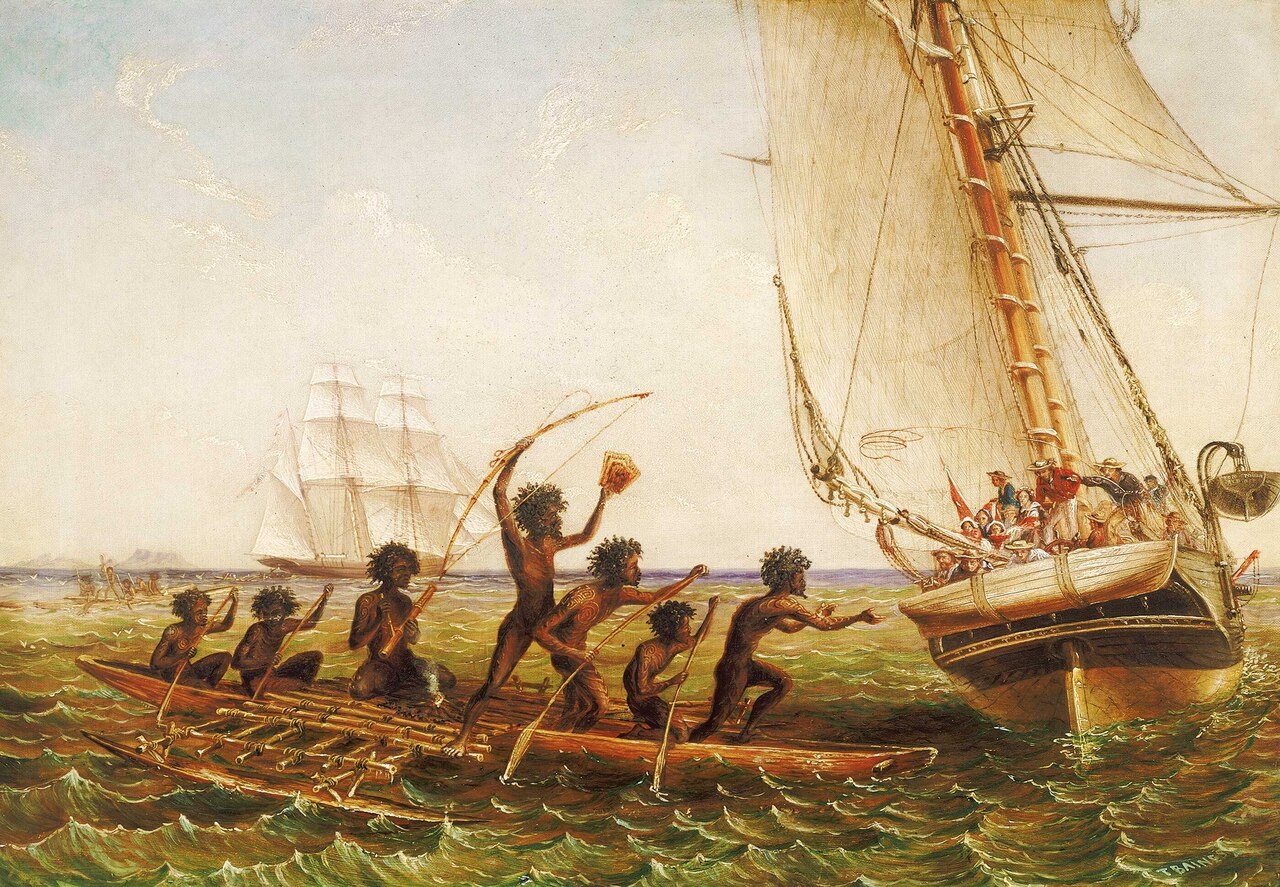
Another hallmark of Baines\' practice is his inclusion of human activity as narrative devices. Whether depicting a hunting party, a naval engagement, or indigenous canoes, he integrates figures in a way that both illustrates the event and provides a sense of scale for the surrounding landscape. This narrative approach distinguishes his visual records from pure topographical sketches.
Major works - **The greatest hunt in history near Bloemfontein 1860 (1861)** – This watercolour portrays a large hunting party on the Highveld, with riders on horseback, hounds, and a sprawling herd of antelope. Baines captures the drama of the chase through dynamic composition and the contrast of light on the plains. - **Aboriginal Canoes Communicating with the 'Monarch' and the 'Tom Tough', 28 August 1855 (1868)** – In this piece, Baines records a rare encounter between Aboriginal Australians and a European vessel. The canoes are rendered with meticulous detail, while the distant ship, referred to as the 'Monarch', is shown as a faint silhouette, emphasizing the cultural juxtaposition. - **Action between HMS 'Blanche' and the 'Pique', 5 January 1795** – Although the event predates Baines\' lifetime, his later illustration reconstructs the naval battle with careful attention to ship rigging and sea conditions. The work demonstrates his ability to translate historical accounts into vivid visual narratives. - **Wagon Crossing a Drift - Natal (1874)** – This composition depicts a convoy of wagons negotiating a shallow river crossing in the Natal region. Baines uses subtle colour shifts to convey the wet ground and the dust raised by the wagons, highlighting the logistical challenges of colonial expansion. - **The 74th above Waterkloof, 1851 (1851)** – The painting shows the British 74th Regiment positioned on a ridge overlooking Waterkloof. The soldiers are rendered with uniform precision, while the surrounding landscape is painted in broad washes that suggest the rugged terrain of the area.
Each of these works is notable not only for its artistic quality but also for its documentary value; they provide contemporary viewers with visual evidence of mid‑19th‑century colonial life, military movements, and indigenous interactions.
Influence and legacy Thomas Baines died in Durban in 1875, having spent his final years in South Africa. His watercolours were widely circulated among colonial administrators and later incorporated into publications on African and Australian exploration. Although he never achieved the fame of some of his British contemporaries, his drawings remain a valuable resource for historians, geographers, and curators. Modern scholars cite Baines as a primary visual source for studying the environmental and sociopolitical landscape of the British Empire\'s southern frontiers.
In recent decades, museums in the United Kingdom, South Africa, and Australia have mounted exhibitions featuring Baines\' work, often alongside photographs and written journals from the same expeditions. These displays underscore his role as a bridge between artistic practice and empirical observation. Moreover, his technique of integrating narrative human elements into landscape painting has influenced later artists who seek to document cultural encounters with a similar balance of accuracy and artistic expression.
Overall, Thomas Baines occupies a distinctive niche in 19th‑century art history: a traveler‑artist whose visual records continue to enrich our understanding of a transformative period in global history.
Frequently asked questions
Who was Thomas Baines?
Thomas Baines (1820–1875) was a British artist and explorer who recorded the landscapes and peoples of southern Africa and Australia during the mid‑19th century.
What artistic style or movement is he associated with?
Baines did not belong to a formal movement; his work aligns with the British landscape tradition, emphasizing realistic detail, atmospheric light, and narrative elements.
What are his most famous works?
His most noted pieces include *The greatest hunt in history near Bloemfontein 1860*, *Aboriginal Canoes Communicating with the 'Monarch' and the 'Tom Tough'* (1855), *Action between HMS 'Blanche' and the 'Pique'* (1795), *Wagon Crossing a Drift – Natal* (1874), and *The 74th above Waterkloof* (1851).
Why does Thomas Baines matter in art history?
His paintings combine artistic skill with documentary precision, offering rare visual insight into colonial expeditions, military actions, and indigenous cultures of the era.
How can I recognise a Thomas Baines painting?
Look for watercolours with detailed topographical rendering, a limited earthy palette, layered washes for depth, and figures that narrate a specific event within the landscape.