Sonsai
1736 – 1802
In short
Sonsay (1736–1802) was a Japanese painter from the late Edo period, known for his landscape works such as Landscape of Fishing Enjoyment (1791) and Landscape with Boaters (1781). Though his artistic movement is not recorded, his paintings are valued for their delicate brushwork and contribution to Japanese landscape tradition.
Notable works

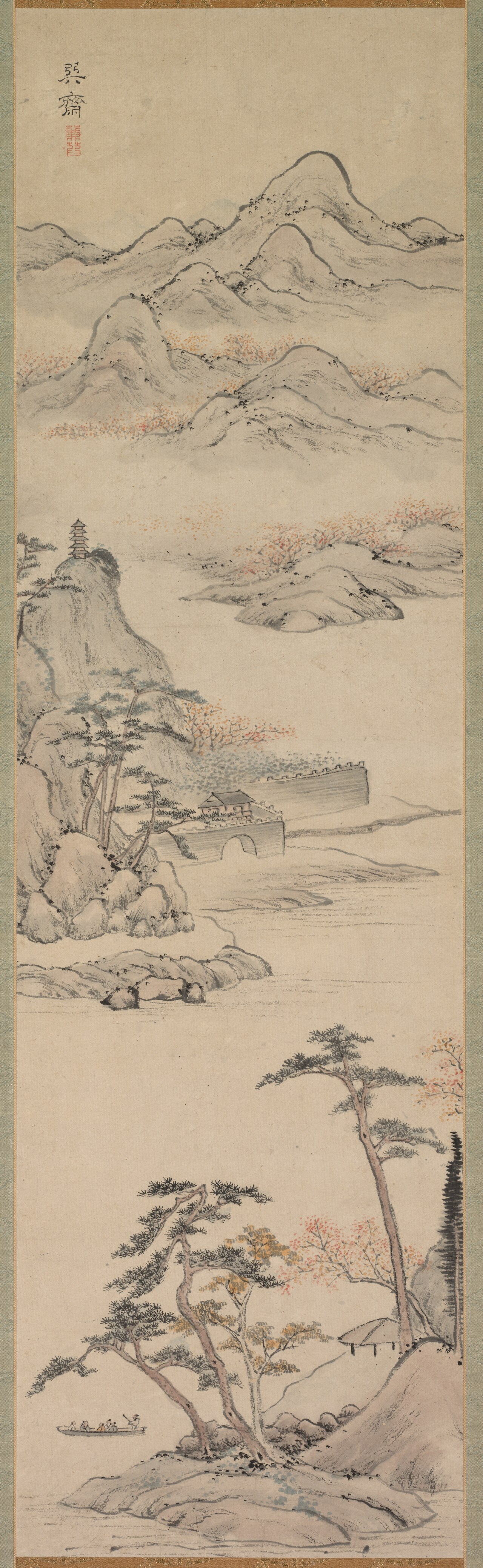


Early life Sonsay was born in 1736 in the village of Horie, a modest settlement in what is now part of central Japan. Little is recorded about his family background, but like many provincial artists of the Edo period he would have been exposed to the local visual culture of woodblock prints, temple murals, and the emerging market for landscape paintings. The mid‑18th century saw increasing interest among the samurai and merchant classes in depictions of nature, a trend that provided a fertile environment for a young artist with an eye for scenery.
Career and style Sonsay’s professional activity spanned the latter half of the 18th century, a time when Japanese painting was diversifying beyond the courtly styles of the Kanō school. Although he is not formally linked to any specific artistic movement, his work aligns with the broader *ukiyo‑e* and *nanga* currents that celebrated everyday life and the natural world. Sonsay specialised in landscape subjects, often portraying riverbanks, fishing villages, and mountainous vistas. His compositions balance a lyrical sense of space with a disciplined approach to perspective, reflecting the influence of Chinese literati painting while remaining rooted in Japanese aesthetic conventions.
Signature techniques Sonsay is distinguished by a subtle ink‑wash technique that merges delicate line work with broader tonal washes. He employed a brushstroke that varied from fine, almost calligraphic lines for distant foliage to bold, sweeping strokes for cliffs and water surfaces. Colour, when used, is restrained—typically a muted palette of indigo, rust, and muted greens—allowing the composition’s structure to dominate. His handling of water is particularly noteworthy: he layered transparent washes to suggest movement and depth, a method that gives his rivers a luminous quality. The artist also favoured asymmetrical arrangements, placing focal elements off‑centre to create a sense of natural imbalance that mirrors the unpredictability of the landscape.
Major works - **Landscape with Boaters (1781)** – This early masterpiece depicts a tranquil river scene where a small fleet of boats glides beneath a canopy of trees. The composition is anchored by a distant mountain range rendered in faint ink washes, while the foreground boats are detailed with precise line work. The painting exemplifies Sonsay’s skill in juxtaposing intimate human activity with expansive natural settings.
- Landscape of Fishing Enjoyment (1791) – Created a decade later, this work expands on the themes of work and leisure in a coastal village. Fishermen are shown casting nets from the shore, their figures rendered in a lively, animated style. The sea is portrayed with layered blues and greys, suggesting both the calm of early morning and the underlying vigor of the tide. The piece is celebrated for its ability to capture the rhythm of daily life within a harmonious natural framework.
- Landscape – Though untitled, this painting reflects Sonsay’s typical approach: a panoramic view of rolling hills punctuated by a winding path. The composition employs a high viewpoint, allowing the viewer to survey the terrain while still feeling the presence of the artist’s hand through the careful placement of trees and rock formations.
- Red Cliff – In this work, Sonsay interprets a dramatic rocky outcrop bathed in the warm glow of sunset. The red hues are achieved through a delicate mixture of vermilion pigment and ink, creating a striking contrast against darker foreground elements. The piece demonstrates his capacity to convey atmospheric effects and emotional resonance through colour, a departure from his more restrained palette elsewhere.
Influence and legacy Sonsay’s oeuvre, though modest in size, contributed to the evolving language of Japanese landscape painting in the late Edo period. By integrating Chinese literati techniques with native sensibilities, he helped bridge the gap between scholarly painting and popular *ukiyo‑e* aesthetics. Later artists who sought to depict the subtleties of Japanese scenery—particularly those active in the early Meiji era—found a precedent in Sonsay’s balanced compositions and nuanced brushwork. Scholarly attention to his work remains limited, partly because archival records are sparse and his name appears infrequently in contemporary catalogues. Nevertheless, collectors and curators appreciate his paintings for their refined execution and their embodiment of a transitional moment in Japanese art history. Sonsay’s legacy endures in the continued study of Edo‑period landscape painting, where his pieces are cited as exemplars of the period’s shift toward a more personal, nature‑centred visual vocabulary.
Frequently asked questions
Who was Sonsay?
Sonsay was a Japanese painter (1736–1802) from the late Edo period, known for his landscape paintings that blend Chinese literati influences with Japanese aesthetic traditions.
What style or movement is Sonsay associated with?
Sonsay is not linked to a specific movement; his work reflects the broader Edo‑period trends of *ukiyo‑e* and *nanga*, focusing on natural scenery and subtle brushwork.
What are Sonsay's most famous works?
His most recognized paintings include Landscape with Boaters (1781), Landscape of Fishing Enjoyment (1791), a generic Landscape, and the Red Cliff.
Why is Sonsay important in art history?
He contributed to the development of Japanese landscape painting by merging Chinese ink‑wash techniques with native motifs, influencing later artists who sought a more personal approach to nature.
How can I recognise a painting by Sonsay?
Look for delicate ink washes, restrained colour, asymmetrical compositions, and a focus on river or coastal scenes where brushwork varies from fine lines in the distance to bold strokes for cliffs and water.