Rockwell Kent
1882 – 1971
In short
Rockwell Kent (1882–1971) was an American painter, printmaker, illustrator and writer noted for his stark, graphic style and adventurous spirit. He produced iconic book illustrations, murals and prints that combined modernist abstraction with a deep appreciation for landscape and narrative.
Notable works



_SAAM-1982.86.2_1.jpg)
Early life Rockwell Kent was born on June 12, 1882, in Tarrytown, New York. His father, a carpenter and boat-builder, introduced him to the practical skills of woodworking and sailing, while his mother encouraged his early interest in drawing. Kent attended the Art Students League of New York, where he studied under teachers who emphasized both technical discipline and the emerging modernist trends of the early 20th century. His formative years were marked by a blend of rural up‑bringing and exposure to the bustling art scene of New York City, giving him a unique perspective that would later inform his work.
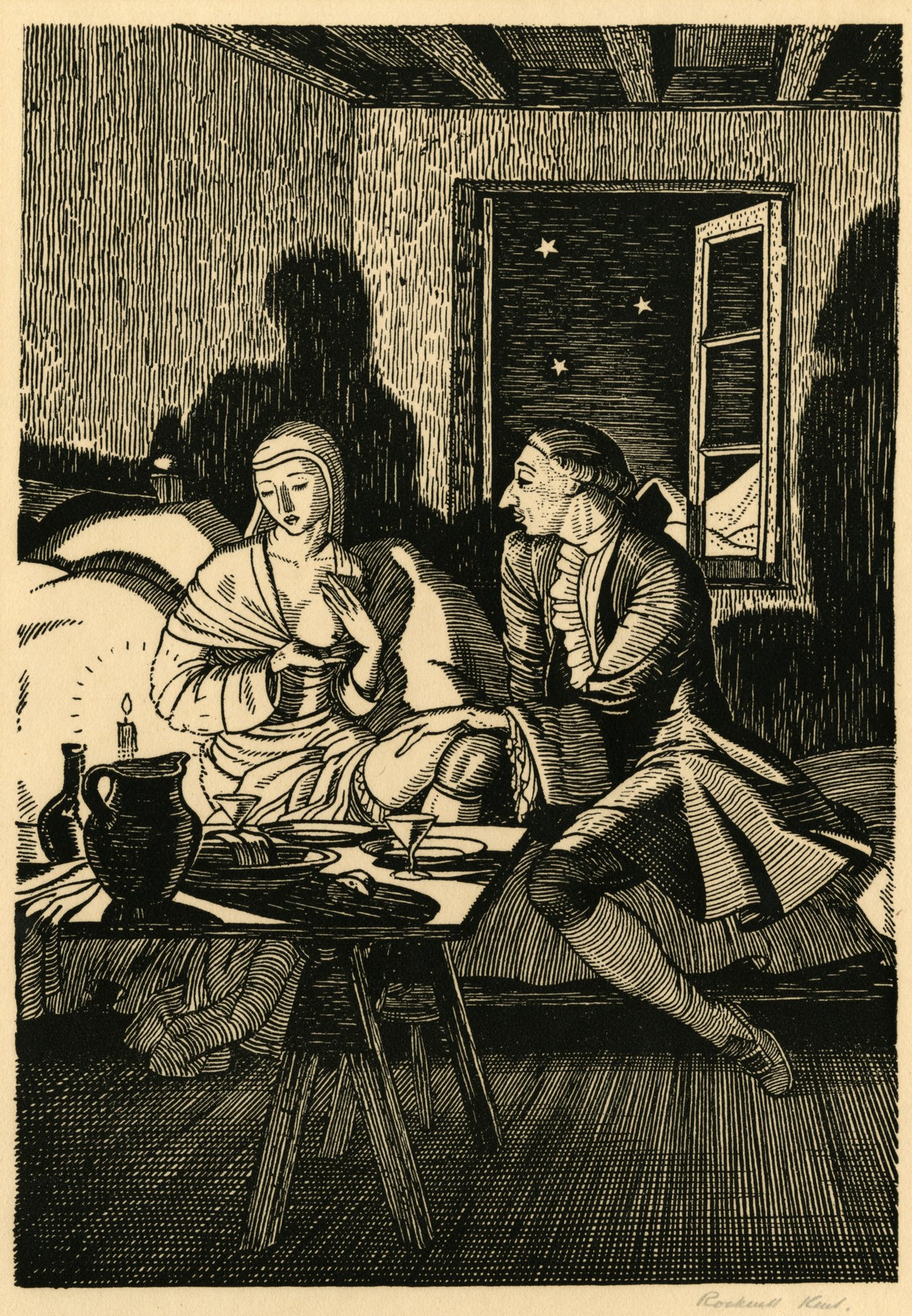
Career and style Kent’s career unfolded across several media. He first gained recognition as a book illustrator, producing stark, black‑and‑white drawings for classic texts such as *The Memoirs of Jacques Casanova de Seingalt* (1925). His illustrations were praised for their economy of line and ability to convey narrative depth without excess detail. Around the same time, Kent began experimenting with woodcuts and lithographs, developing a style characterised by bold, simplified forms, strong contrasts, and a sense of monumental scale. He was drawn to the modernist emphasis on abstraction, yet he maintained a commitment to representational content, especially in his depictions of wilderness and human endeavour.
In the 1930s, Kent’s reputation as a muralist grew, leading to commissions from the U.S. Treasury Department’s Section of Painting and Sculpture. His mural studies for the Mail Service in the Tropics (1935) illustrate his capacity to merge social themes with his characteristic graphic language. Throughout his career, Kent also travelled extensively—sailing to remote coasts, exploring Arctic landscapes, and living for periods in Norway and the Caribbean. Those experiences deepened his fascination with the interplay of light, sea, and sky, themes that recur throughout his paintings and prints.
Signature techniques Kent’s work is distinguished by several recurring technical approaches:
1. Wood engraving and linocut – Kent preferred hand‑cut wood blocks, using a combination of fine‑point tools and broader gouges to achieve crisp edges and deep shadows. He often printed on textured paper, allowing the grain to enhance the visual impact. 2. Simplified compositional geometry – Whether in a landscape or a figure study, Kent reduced forms to basic geometric shapes, creating a sense of order and timelessness. 3. Monochromatic palettes – While he occasionally employed colour, his most powerful images rely on stark black‑on‑white or limited tonal ranges, emphasizing contrast and mood. 4. Narrative integration – Even in abstracted forms, Kent retained a narrative thread, often depicting solitary figures against vast environments, suggesting stories of exploration, endurance, or domestic life. 5. Mural scale adaptation – When working on large‑scale public murals, Kent scaled up his graphic language, employing broad brushstrokes and simplified motifs that could be read from a distance while retaining the intimacy of his smaller prints.
Major works Kent’s oeuvre includes a range of works that demonstrate his versatility:
- Portrait of the Mackinen Children – Though the precise date is uncertain, this portrait exemplifies Kent’s ability to render intimate family scenes with a restrained, almost sculptural quality. The composition balances the children’s individual personalities with a harmonious, unified background. - The Western Family – Another early work of uncertain dating, this piece conveys domestic stability through a simplified, block‑like representation of figures, echoing the artist’s later interest in social themes. - Illustration for *The Memoirs of Jacques Casanova de Seingalt* (1925) – Kent’s black‑and‑white drawings for this edition are celebrated for their atmospheric depth; each image captures the sensuality and intrigue of Casanova’s adventures while maintaining a disciplined, modernist aesthetic. - Down to the Sea (1910) – This painting, created early in Kent’s career, showcases his fascination with maritime subjects. A lone figure stands on a rocky shore, the sea stretching beyond in sweeping, stylised waves. The work foreshadows his lifelong connection to sailing and the sea. - Mail Service in the Tropics (mural study, U.S. Post Office Department, Washington, D.C.) (1935) – Produced as part of a New Deal mural program, the study reflects Kent’s ability to fuse public service themes with his graphic style. The composition features workers in tropical attire, rendered in bold, simplified forms that convey both the vitality of the environment and the efficiency of the postal service.
These works, taken together, illustrate Kent’s consistent engagement with narrative, environment, and a graphic, modernist sensibility.
Influence and legacy Rockwell Kent’s impact on American art is multifaceted. His prints and illustrations helped popularise modernist aesthetics among a broad readership, while his murals contributed to the visual vocabulary of New Deal-era public art. Artists such as Edward Hopper and later graphic designers have cited Kent’s stark compositional clarity as an inspiration. In addition to his visual output, Kent authored several books on sailing and travel, further cementing his reputation as an adventurous cultural figure.
Kent’s legacy also endures through institutional collections; his works are held by the Museum of Modern Art, the Library of Congress, and numerous regional museums. The continued exhibition of his prints and the scholarly interest in his synthesis of modernism and narrative ensure that his contributions remain relevant to both art historians and contemporary practitioners. By bridging fine art, illustration, and public mural work, Rockwell Kent exemplifies a uniquely American synthesis of artistic ambition and democratic accessibility.
Frequently asked questions
Who was Rockwell Kent?
Rockwell Kent (1882–1971) was an American painter, printmaker, illustrator and writer known for his graphic, modernist style and adventurous explorations of landscape.
What artistic style or movement is Kent associated with?
Kent is not tied to a single movement but his work reflects modernist tendencies—especially in his use of simplified forms, strong contrasts and a focus on graphic clarity.
What are his most famous works?
Key works include his illustrations for *The Memoirs of Jacques Casanova de Seingalt* (1925), the painting *Down to the Sea* (1910), the mural study *Mail Service in the Tropics* (1935), and notable portraits such as *Portrait of the Mackinen Children* and *The Western Family*.
Why is Rockwell Kent important in art history?
He helped popularise modernist visual language in American illustration, contributed to New Deal mural programs, and influenced later artists with his bold, narrative‑driven graphics.
How can I recognise a Rockwell Kent artwork?
Look for strong black‑and‑white contrast, simplified geometric forms, a focus on solitary figures within expansive landscapes, and a clear, narrative intent.