Robert Seldon Duncanson
1821 – 1872
In short
Robert Seldon Duncanson (1821–1872) was a pioneering American landscape painter of mixed European and African ancestry, associated with the second generation of the Hudson River School. Working mainly from Cincinnati, he achieved international recognition and is celebrated for his luminous depictions of the Ohio River Valley and for navigating the racial politics of ante‑bellum America.
Notable works


Early life Robert Seldon Duncanson was born in 1821 in Fayette, a small settlement in what is now West Virginia. He was of mixed European and African descent, a background that placed him in a complex social position in the United States of the early nineteenth century. Little is known about his childhood education, but contemporary accounts suggest that he received a basic schooling and showed an early aptitude for drawing. By his late teens he had moved to the burgeoning city of Cincinnati, Ohio, where a vibrant community of artists, abolitionists and merchants offered opportunities for a young talent of his background.
Career and style In Cincinnati Duncanson quickly entered the circle of landscape painters who were inspired by the dramatic visions of Thomas Cole and the broader Hudson River School. Although the school is most closely linked with the scenery of New York’s Hudson Valley, its aesthetic principles—emphasis on the Sublime, careful compositional balance and a moralising tone—found fertile ground in the Ohio River Valley. Duncanson adopted these ideals while developing a personal voice that reflected the atmospheric qualities of the Midwestern landscape.
His career flourished during the 1840s and 1850s, a period when the city’s art market was expanding and when the abolitionist movement was gaining momentum. As a free Black artist, Duncanson cultivated relationships with both American and British abolitionists, who helped to promote his work abroad. He exhibited regularly at the Cincinnati Academy of Fine Arts and later in Detroit, Montreal and London, gaining a reputation that extended well beyond the United States.
Signature techniques Duncanson’s paintings are distinguished by a luminous palette and a deft handling of light. He often employed a luminous, almost atmospheric, colour scheme that allowed clouds, water and foliage to glow from within the picture plane. His use of chiaroscuro—contrasting light and shadow—creates a sense of depth and drama, especially in works that depict weather‑laden skies. Compositionally, Duncanson favoured sweeping vistas that guide the viewer’s eye from the foreground to a distant horizon, a technique that reinforces the sense of the Sublime. He also incorporated subtle narrative elements, such as small figures or architectural ruins, that suggest human presence without detracting from the natural scene.
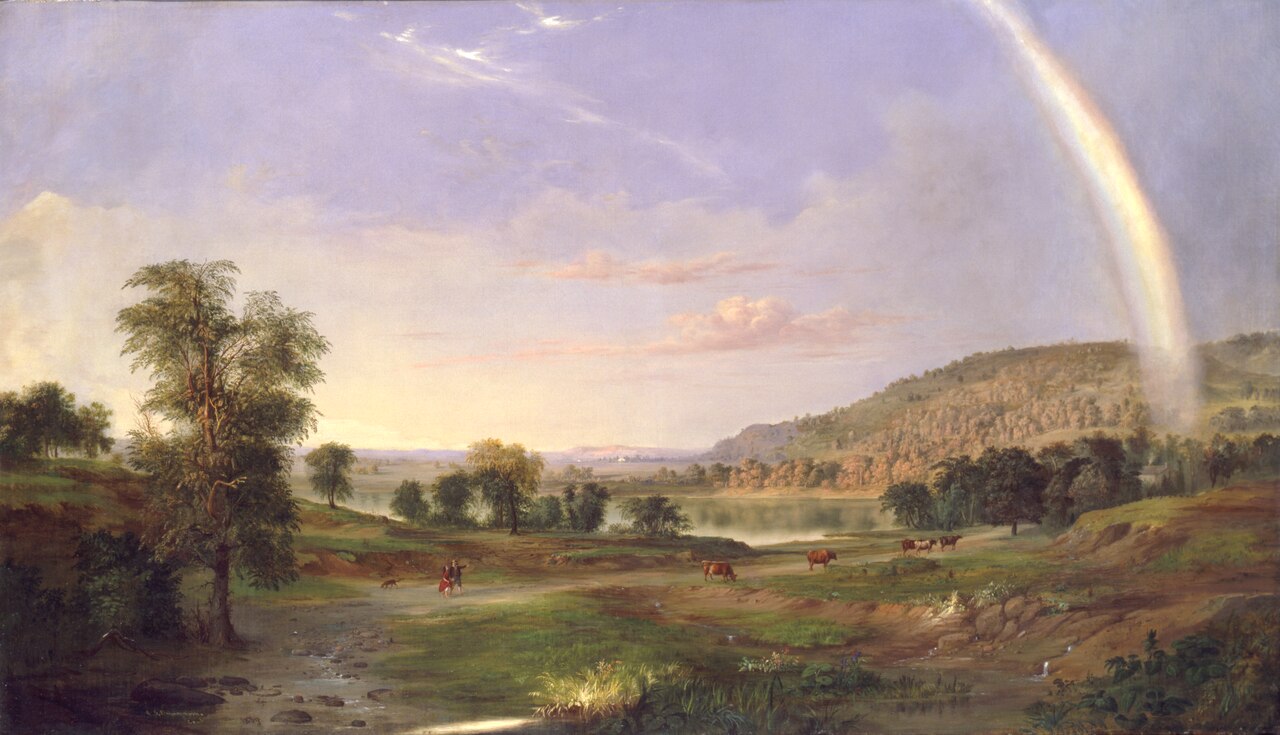
Major works - **Landscape with Rainbow (1859)** – This painting captures a tranquil river scene under a dramatic rainbow. The arc of colour provides a focal point, while the reflective water and soft foliage convey a sense of peace after a storm. Critics have noted the work’s harmonious balance between natural grandeur and intimate detail. - **Blue Hole, Flood Waters, Little Miami River (1851)** – In this work Duncanson portrays the turbulent aftermath of a flood on the Little Miami River. Dark, roiling waters dominate the foreground, while a bright blue pool— the “Blue Hole”—offers a visual respite. The contrast between chaos and calm exemplifies his ability to render both the power and the subtle beauty of the American landscape. - **A Dream of Italy (1865)** – Painted after a period of travel in Europe, this piece reflects Duncanson’s fascination with Italian scenery. Rolling hills, sun‑lit vineyards and classical ruins combine to evoke an idealised, nostalgic vision of the Mediterranean, demonstrating his versatility beyond American subjects. - **Still Life with Fruit and Nuts (1848)** – Though primarily a landscape painter, Duncanson also produced still‑life compositions. This early work displays a careful arrangement of fruit, nuts and a glass vessel, rendered with meticulous attention to texture and light. The painting reveals his mastery of rendering materiality and his skill in balancing colour harmony. - **Mount Healthy, Ohio (1844)** – One of his earliest dated works, this painting records the gentle rise of Mount Healthy overlooking the Ohio River. The piece is notable for its soft sky, delicate foliage and an almost lyrical treatment of the river’s surface, signalling Duncanson’s emerging command of the Hudson River School’s aesthetic.
Influence and legacy Robert Seldon Duncanson is recognised as the first African‑American artist to achieve international fame, and his career paved the way for later Black painters in the United States. By integrating the Hudson River School’s ideals with the distinct character of the Ohio River Valley, he helped to broaden the geographical scope of American landscape painting. His work has been the subject of scholarly debate: some historians argue that his paintings embed racial metaphors that comment on the conditions of his time, while others caution against imposing a solely racial reading on his art. Nonetheless, his paintings continue to be exhibited in major museums and are studied for their technical brilliance and cultural significance. Contemporary artists cite Duncanson’s ability to fuse personal identity with a universal visual language as an enduring inspiration.
Today, Duncanson’s legacy is celebrated through exhibitions, academic publications and public programs that highlight his role in American art history and his contribution to the discourse on race, representation and the landscape tradition.
Frequently asked questions
Who was Robert Seldon Duncanson?
He was a nineteenth‑century American landscape painter of mixed European and African ancestry, best known as a second‑generation Hudson River School artist.
What style or movement is he associated with?
Duncanson worked within the Hudson River School tradition, adapting its sublime, morally charged landscape approach to the Ohio River Valley.
What are his most famous works?
His best‑known paintings include Landscape with Rainbow (1859), Blue Hole, Flood Waters, Little Miami River (1851), A Dream of Italy (1865), Still Life with Fruit and Nuts (1848) and Mount Healthy, Ohio (1844).
Why does he matter in art history?
He was the first African‑American artist to gain international recognition and helped expand the geographical scope of American landscape painting while engaging with the abolitionist movement.
How can I recognise a Duncanson painting?
Look for luminous colour, atmospheric light, expansive vistas with meticulous detail, and a balanced composition that often includes subtle narrative elements such as small figures or ruins.