Robert Griffier
1675 – 1727
In short
Robert Griffier (1675–1727) was a Dutch‑Republic landscape painter born in England who spent his professional career in Amsterdam, producing topographical views of European scenery such as the Rhine, Windsor Castle and Greenwich.
Notable works

_-_Windsor_Castle_from_the_River_-_515628_-_National_Trust.jpg)
_-_Panoramic_View_of_Greenwich,_the_Thames,_and_London,_from_the_East_(One_Tree_Hill)_-_436075_-_National_Trust.jpg)
Early life Robert Griffier was born in 1675 in England, most likely in London, where a vibrant community of artists and patrons provided a fertile environment for a young talent interested in landscape painting. Little is recorded about his family background or early artistic training, but the period’s customary apprenticeship system suggests he would have spent his teenage years under the guidance of an established painter or within a workshop that specialised in topographical and pastoral subjects. By the turn of the century, Griffier had absorbed the prevailing English taste for picturesque scenery, a taste that would later inform his work in the Dutch Republic.
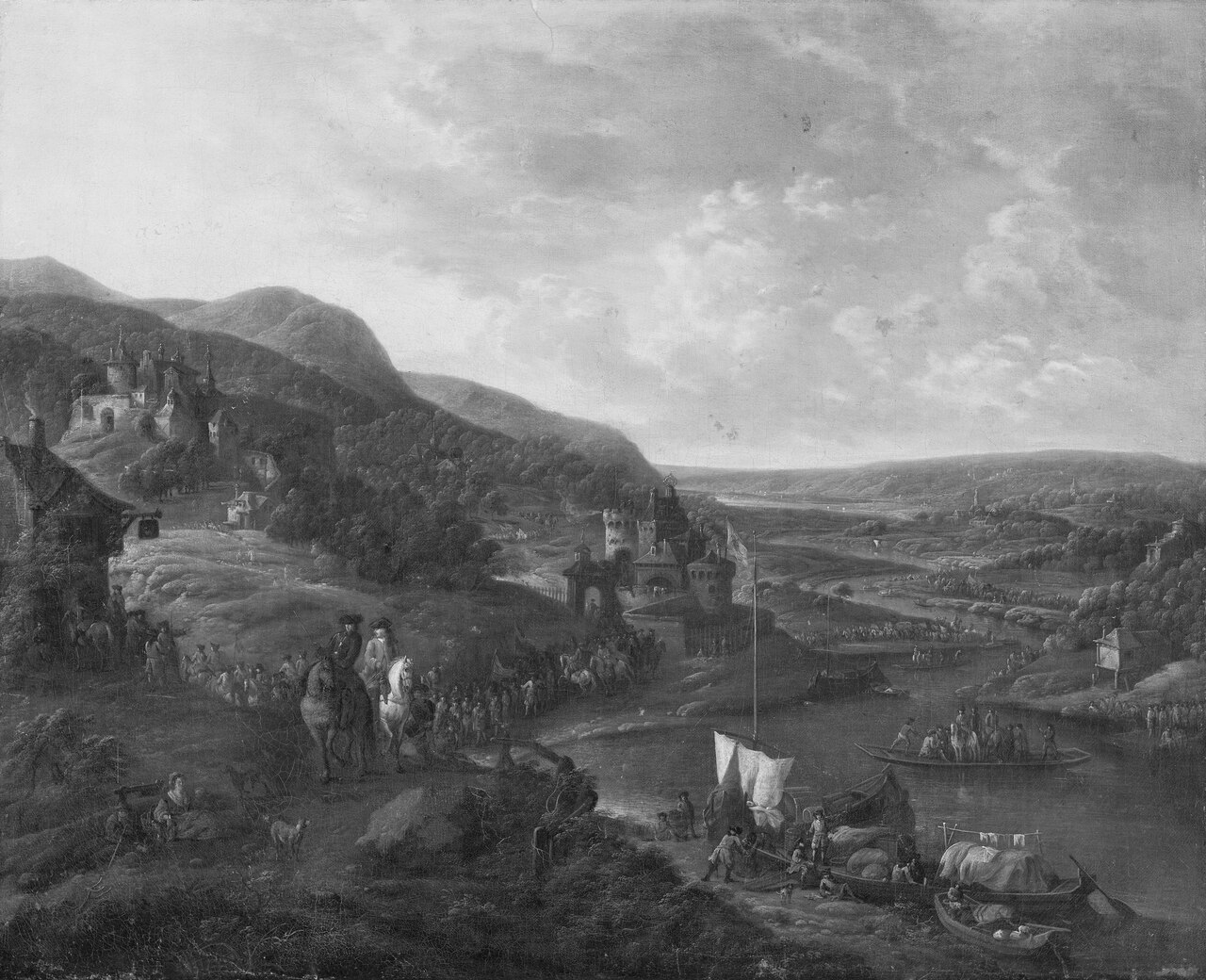
Career and style Around the early 1700s Griffier relocated to Amsterdam, a city that, despite the waning of its Golden Age, remained a hub for international trade and artistic exchange. In the Dutch capital he found a market eager for detailed, accurate depictions of foreign locales—particularly riverine and coastal scenes that appealed to merchants and travelers. Griffier’s style blended the meticulous observation typical of Dutch landscape painters with the more narrative, figure‑laden compositions favoured in England. His canvases often combine a clear foreground populated by figures or animals with a sweeping, atmospheric background, creating a sense of depth that guides the viewer’s eye across the landscape.
Signature techniques Griffier’s works are characterised by a restrained palette dominated by muted earth tones, soft greens and cool blues, which together evoke the natural light of northern Europe. He frequently employed a fine, almost linear brushstroke for architectural elements and distant horizons, contrasting with looser, more expressive handling of foliage and water. Atmospheric perspective is a hallmark of his technique: distant objects become progressively paler and less detailed, reinforcing the illusion of depth. In addition, Griffier often inserted modest groups of figures—travelers, fishermen or shepherds—to provide scale and narrative interest, a practice that aligns him with the tradition of topographical painters such as Jan van der Heyden.
Major works Among Griffier’s extant pieces, *View of the Rhine with Figures* showcases his ability to render a bustling river scene. The composition balances a detailed foreground of boats and passengers with a mist‑shrouded riverbank that recedes into a hazy horizon, illustrating his skill in atmospheric perspective. *Landscape with Animals* presents a more pastoral tableau, where domesticated cattle and sheep graze beneath a sky rendered in delicate pastel hues, highlighting his capacity to integrate genre subjects within a broader landscape.
Two works dated circa 1729—*Windsor Castle from the River* and *Panoramic View of Greenwich, the Thames, and London, from the East (One Tree Hill)*—are attributed to Griffier despite his death in 1727. Both paintings exemplify his topographical interest: the former captures the iconic silhouette of Windsor Castle reflected in water, while the latter offers a sweeping, almost panoramic, view of the Thames with London’s skyline delineated against a cloud‑strewn sky. In each case, Griffier combines precise architectural rendering with a lyrical treatment of sky and water, reinforcing his reputation as a painter of both accuracy and atmosphere.
Influence and legacy Robert Griffier occupies a modest yet distinct niche in the early‑eighteenth‑century art world. By bridging English and Dutch landscape traditions, he contributed to a cross‑cultural visual dialogue that enriched both schools. His topographical works served not only as decorative pieces but also as visual records for merchants, travelers and collectors interested in the geography of Britain and the continent. Later Dutch painters who specialised in marine and river scenes—such as Jan van Gool and later members of the Dutch marine school—found a useful precedent in Griffier’s balanced approach to narrative detail and atmospheric depth. Although his name is not as widely recognised as some of his contemporaries, scholarly interest in Griffier has grown in recent decades, particularly among specialists studying the transmission of landscape conventions between England and the Dutch Republic.
Today, Griffier’s paintings are held in several European collections, where they are valued for their historical documentation of early‑modern European scenery as well as for their aesthetic qualities. His work continues to inform exhibitions exploring the development of landscape painting and the interplay between national artistic identities in the early eighteenth century.
Frequently asked questions
Who was Robert Griffier?
Robert Griffier (1675–1727) was a landscape painter born in England who worked mainly in Amsterdam, known for detailed topographical views of European rivers and cityscapes.
What style or movement is he associated with?
Griffier’s style blends English picturesque sensibilities with Dutch topographical precision; he is not tied to a specific movement but reflects the early‑18th‑century landscape tradition.
What are his most famous works?
His best‑known paintings include *View of the Rhine with Figures*, *Landscape with Animals*, *Windsor Castle from the River* (c.1729) and *Panoramic View of Greenwich, the Thames, and London* (c.1729).
Why does Griffier matter in art history?
He serves as a cultural bridge between English and Dutch landscape painting, providing valuable visual records of early‑modern scenery and influencing later Dutch artists who painted rivers and coastal views.
How can I recognise a Griffier painting?
Look for modest figures or animals in the foreground, a muted colour palette, fine linear detail in architecture, and a soft atmospheric perspective that fades distant elements into a hazy sky.