Richard Brydges Beechey
1808 – 1895
In short
Richard Brydges Beechey (1808–1895) was an Anglo‑Irish painter and Royal Navy admiral known for his detailed marine paintings of ships and Arctic voyages. Born in London and dying in Hampshire, he combined a naval career with a prolific output of ship portraits and seascapes that remain valuable historical records.
Notable works
_-_HMY_Victoria_and_Albert_II_-_RCIN_406268_-_Royal_Collection.jpg)
_-_First_Come,_First_Served_-_BHC1270_-_Royal_Museums_Greenwich.jpg)
_-_Captain_Markham%27s_Most_Northerly_Encampment_-_BHC0640_-_Royal_Museums_Greenwich.jpg)

Early life Richard Brydges Beechey was born in London in 1808 into a family with strong artistic and military connections. His father, Sir William Beechey, was a celebrated portraitist, and his mother, Anne Beechey, was a talented amateur artist. This environment fostered an early appreciation for drawing and painting. As a youth, Bee Beechey received formal instruction in drawing from his father’s studio, while also being exposed to the naval world through his family's ties to the British armed forces. The young Beechey entered the Royal Navy as a mid‑shipman, a path that would shape both his career and artistic focus.
Career and style Beechey’s naval service progressed steadily; he rose through the ranks to become an admiral, a position that afforded him extensive experience at sea and a deep familiarity with ships, navigation, and maritime life. Throughout his naval postings, he continued to paint, often using his own sketchbooks to record voyages, ship movements, and coastal landscapes. His artistic style is best described as a realist marine tradition that emphasizes accurate depiction of vessels, rigging, and atmospheric conditions. Beechey’s works are characterized by a restrained palette, careful composition, and a focus on the interplay of light on water and sky. While he did not align himself with any avant‑garde movement, his paintings reflect the mid‑nineteenth‑century British interest in documenting imperial exploration and naval power.
Signature techniques Beechey developed several techniques that distinguish his marine paintings. He employed meticulous line work to render the complex geometry of ship hulls and rigging, ensuring that each mast, sail, and cannon was historically correct. His handling of water surfaces varies from calm, reflective stretches to tumultuous seas, achieved through layered washes of blues and greys that capture the subtle motion of waves. Light plays a central role; Beechey often positioned the sun low on the horizon to cast long, dramatic shadows, heightening the sense of depth. He also used a limited but precise color palette to emphasize the muted tones of the North Atlantic and Arctic environments, allowing the details of the vessels themselves to stand out.
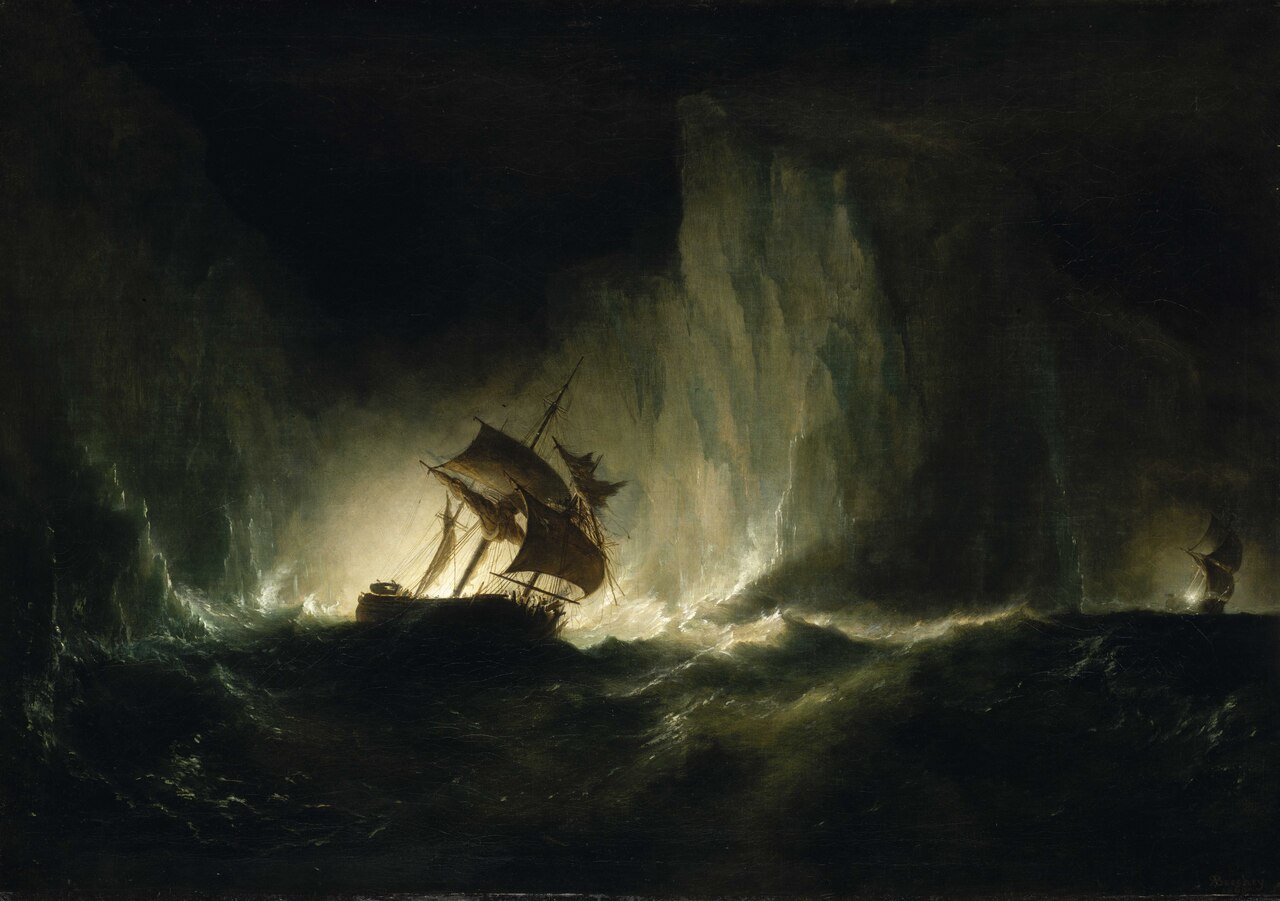
Major works - **HMY Victoria and Albert II (1887)** – This painting depicts the royal yacht as it navigates the English Channel. Beechey’s careful rendering of the yacht’s sleek hull and royal insignia demonstrates his ability to combine portraiture with marine precision. The work was commissioned by the royal household and remains a reference for the vessel’s appearance in its later service years. - **First Come, First Served (1873)** – A genre scene set on a bustling dock, this piece captures the hurried activity of sailors loading cargo onto a merchant ship. Beechey’s attention to the varied expressions of the crew, as well as the detailed rigging, provides insight into everyday naval life during the Victorian era. - **Captain Markham's most northerly encampment (1850)** – This canvas records the Arctic expedition led by Captain Markham, showing the encampment against an icy backdrop. Beechey’s use of cold blues and stark whites conveys the harsh environment, while the precise depiction of tents and supplies underscores the expedition’s logistical challenges. - **HMS ‘Erebus’ passing through the chain of bergs, 1842 (1860)** – Created after the loss of the Erebus in the Franklin expedition, this painting serves as a historical reconstruction. Beechey’s composition places the ship at the centre of a treacherous ice field, using dramatic lighting to highlight the looming bergs. The work is valued for its accuracy in portraying 19th‑century naval architecture and Arctic ice conditions. - **HM Mailboat Connaught (1868)** – This portrait of the mailboat illustrates Beechey’s skill in capturing smaller, utilitarian vessels. The painting shows the Connaught sailing under clear skies, with meticulous attention to the vessel’s markings and the subtle reflections on the water’s surface.
Influence and legacy Richard Brydges Beechey occupies a distinctive niche at the intersection of naval service and visual documentation. His paintings are frequently cited by maritime historians as reliable visual records of mid‑nineteenth‑century ship design, naval engagements, and polar exploration. By preserving the visual details of vessels that would otherwise survive only in written logs, Beechey contributed to the historiography of the Royal Navy and to the broader cultural memory of British maritime dominance.
Beyond their documentary value, Beechey’s works influenced subsequent generations of marine artists who sought to balance artistic expression with technical fidelity. His disciplined approach to rendering rigging and his atmospheric handling of sea and sky set a standard for realism in marine painting. Museums in the United Kingdom, particularly those with naval collections, continue to display his works, and his paintings are reproduced in scholarly publications on Arctic exploration and Victorian naval history.
Even though Beechey never aligned with a formal art movement, his oeuvre reflects the Victorian era’s fascination with progress, empire, and the sea as a conduit of power. Contemporary scholars regard his paintings as exemplars of the “documentary aesthetic” that emerged alongside the expansion of the British Empire. As a result, Beechey is remembered not only as an accomplished admiral but also as an essential chronicler of his nation’s maritime heritage.
Frequently asked questions
Who was Richard Brydges Beechey?
Richard Brydges Beechey (1808–1895) was an Anglo‑Irish painter and Royal Navy admiral renowned for his detailed marine paintings of ships and Arctic voyages.
What artistic style or movement is he associated with?
Beechey worked within a realist marine tradition, focusing on accurate ship depiction and atmospheric seascapes rather than aligning with a specific avant‑garde movement.
What are his most famous works?
His notable paintings include *HMY Victoria and Albert II* (1887), *First Come, First Served* (1873), *Captain Markham's most northerly encampment* (1850), *HMS ‘Erebus’ passing through the chain of bergs, 1842* (1860), and *HM Mailboat Connaught* (1868).
Why is Beechey important in art history?
Beechey’s works serve as valuable visual records of 19th‑century naval vessels and Arctic expeditions, influencing later marine artists and providing historians with reliable depictions of British maritime heritage.
How can I recognise a painting by Beechey?
Look for meticulous ship details, a muted colour palette, precise rigging, and careful treatment of light on water—features that together create a historically accurate marine scene.