Randolph Caldecott
1846 – 1886
In short
Randolph Caldecott (1846–1886) was a British illustrator and painter best known for his groundbreaking children’s book illustrations, which combined lively narrative with dynamic composition. His work across watercolour, oil, and cartoon drawing reshaped Victorian visual culture and continues to influence illustrators today.
Notable works
_-_Two_Huntsmen_Riding_-_642000_-_National_Trust.jpg)
_-_Cattle_in_the_Italian_Alps_(recto)_-_641991.1_-_National_Trust.jpg)


Early life Randolph Caldecott was born in 1846 in the historic city of Chester, England. Little is recorded about his family background, but the industrial and maritime environment of the northwest likely provided a visual vocabulary that later appeared in his depictions of bustling scenes and rural pursuits. Caldecott received a conventional education before turning to art, a path that was typical for middle‑class youths seeking professional careers in the mid‑nineteenth century. By his late teens he had begun to develop a facility with drawing that would later be recognized by the Royal Academy, where he first exhibited as a student.
Career and style Caldecott’s professional career unfolded during the Victorian era, a time when illustrated publications were expanding rapidly thanks to advances in printing technology. He initially worked as a commercial illustrator, producing cartoons, sketches of parliamentary architecture, and humorous hunting scenes for periodicals. These early commissions honed his ability to convey narrative quickly, a skill that became a hallmark of his later book work.
In the 1860s Caldecott turned his attention to fine art, exhibiting both oil paintings and watercolours at the Royal Academy. His style merged the loose, expressive brushwork of the English watercolour tradition with a keen eye for anecdotal detail. He favoured lively compositions that placed the viewer within the action, whether a chase across the countryside or a quiet moment in a garden. Though he never aligned himself with a formal movement, his work bears affinities with the Pre‑Raphaelites’ emphasis on narrative and the emerging naturalist trend in illustration.
The turning point in his career came with his involvement in children’s literature. Publishers recognised that his energetic line and ability to suggest motion could make stories for young readers more engaging. Caldecott’s illustrations began to appear in popular juvenile editions, where his approach—combining humor, motion, and a sense of story continuity—replaced the static, ornamental designs that had dominated the genre.
Signature techniques Caldecott’s illustrations are distinguished by several recurring technical choices:
1. Dynamic line work – He employed swift, confident strokes that gave figures a sense of movement, often using a single, continuous line to suggest a narrative progression. 2. Narrative sequencing – Rather than isolating a single scene, Caldecott frequently placed multiple actions within one illustration, allowing the eye to travel across the picture as a story unfolded. 3. Humorous exaggeration – Facial expressions and postures were often exaggerated for comic effect, a technique that resonated strongly with younger audiences. 4. Watercolour washes – In his fine‑art pieces he used transparent washes to build atmospheric depth, a method that also informed the softer tonal backgrounds of his book illustrations. 5. Attention to everyday detail – Whether portraying a hunting party, a garden, or a seaside town, Caldecott incorporated precise architectural and costume details that anchored his whimsical scenes in recognizable reality.
These methods combined to produce illustrations that felt both immediate and timeless, a blend that set a new standard for visual storytelling.
Major works Caldecott’s oeuvre includes a variety of subjects, but several pieces stand out for their representation of his evolving style.
- Two Huntsmen Riding (1865) – An early work that showcases his fascination with sport and movement. The composition captures two riders in mid‑gallop, their horses rendered with fluid line and a sense of kinetic energy that anticipates his later illustrative vigor.
- Cattle in the Italian Alps (recto); The Artist's Garden in Surrey (verso) – This double‑sided watercolor demonstrates Caldecott’s versatility. The Alpine scene presents rugged terrain and grazing cattle with atmospheric washes, while the Surrey garden contrasts with a cultivated, intimate view of domestic flora, underscoring his ability to shift between grand landscape and personal setting.
- Trouville-sur-Mer (1879) – A seaside view of the French resort town, this painting reflects Caldecott’s travel experiences and his interest in coastal leisure. The work combines light‑filled watercolour techniques with a lively depiction of boats and promenaders, illustrating his capacity to capture the spirit of place.
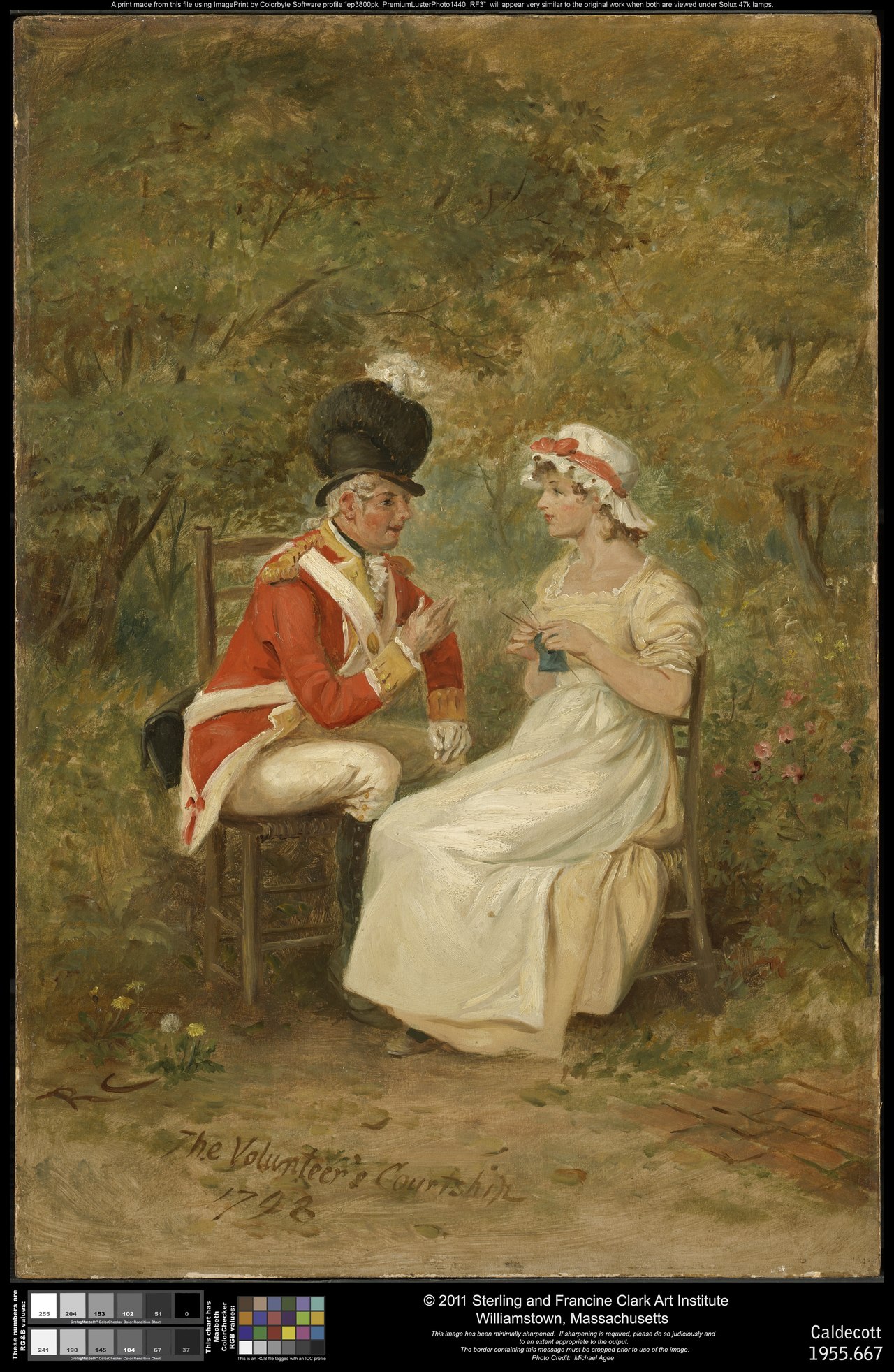
- The Volunteer's Courtship, 1798 (1870) – Though dated 1798 in its title, the work itself was produced in 1870. It portrays a historical scene of a young man courting a volunteer, rendered with meticulous period costume and a narrative tension that hints at Caldecott’s storytelling instincts.
- Self Portrait (1884) – One of the few self‑referential pieces, this portrait offers insight into his self‑perception near the end of his career. Rendered in oil, it balances the artist’s characteristic confidence with a modest, introspective tone.
These works collectively illustrate Caldecott’s breadth: from sporting subjects to domestic scenes, from travel sketches to personal portraiture.
Influence and legacy Randolph Caldecott’s most enduring contribution lies in his transformation of children’s book illustration. By integrating motion, humor, and sequential storytelling, he established a visual language that future illustrators—such as Beatrix Potter, Arthur Rackham, and later American cartoonists—would adopt and adapt. The Caldecott Medal, instituted by the American Library Association in 1938, continues to honour outstanding picture books, a testament to his lasting impact.
Beyond the realm of children’s literature, his watercolours and oil paintings remain valued examples of late‑Victorian genre painting. Institutions that hold his work note his skill in rendering both the grandeur of the natural world and the intimacy of everyday life. His cartoons and sketches of parliamentary interiors also provide a visual record of Victorian civic architecture, useful to historians studying that period.
Caldecott’s legacy is therefore twofold: he broadened the possibilities of illustration as a narrative art form, and he contributed to the visual documentation of his era through a diverse body of work. Contemporary illustrators still reference his compositional daring and his ability to convey story through a single, cohesive image, ensuring that his influence endures across centuries and continents.
Frequently asked questions
Who was Randolph Caldecott?
Randolph Caldecott (1846–1886) was a British painter and illustrator best known for pioneering dynamic, narrative illustrations in children’s books.
What style or movement is Caldecott associated with?
He did not belong to a formal art movement, but his work combines Victorian illustration, naturalist detail, and a lively narrative style that prefigured modern picture‑book art.
What are his most famous works?
Key pieces include Two Huntsmen Riding (1865), the paired watercolours Cattle in the Italian Alps / The Artist's Garden in Surrey, Trouville‑sur‑Mer (1879), The Volunteer's Courtship, 1798 (1870), and his Self Portrait (1884).
Why does Caldecott matter in art history?
He reshaped the visual language of children’s literature, influencing generations of illustrators and earning a lasting legacy through the Caldecott Medal that celebrates excellence in picture‑book illustration.
How can I recognise a Caldecott illustration?
Look for energetic line work, sequential storytelling within a single image, humorous exaggeration of characters, and a blend of detailed setting with a sense of motion.