Rai San'yo
1780 – 1832
In short
Rai San'yo (1780–1832) was a Japanese Confucianist philosopher, historian, poet and visual artist of the late Edo period, known for his calligraphic inscriptions, seal carving and poetic paintings such as *Cherry Blossoms at Yoshino*.
Notable works



Early life Rai San'yo was born in 1780 in the small town of Edobori, Japan, under the family name Rai Noboru. His upbringing was steeped in the Confucian tradition, as his father served as a low‑ranking scholar‑official who emphasized the study of the classics. From a young age Rai received a rigorous education in Chinese literature, calligraphy and the moral philosophy of Confucius, which formed the intellectual backbone of his later work. The late eighteenth‑century environment of Edobori, a modest trading port, exposed him to a variety of regional artistic practices, from wood‑block printing to lacquerware, fostering an early appreciation for the visual arts.
Career and style In his twenties Rai moved to the cultural centre of Edo, where he entered the circles of learned men and literati who combined scholarship with artistic production. He adopted the pen‑name "San'yo" to signal his alignment with the "three teachings" (Confucianism, Buddhism and Shinto) and began to publish essays on history and ethics. Simultaneously, he cultivated a reputation as a calligrapher whose brushwork balanced the disciplined rigor of Confucian script with the spontaneity of the Zen‑inspired *kara‑shodō* style. His paintings were primarily monochrome ink works that paired poetic verses with delicate landscapes, a genre known as *haiga*.
Rai’s artistic output was not tied to a formal school; rather, he operated within the broader tradition of scholar‑artists (bunjin) who valued the integration of literary and visual expression. His work reflects the transitional character of the late Edo period, where traditional forms coexisted with emerging popular tastes. He often employed restrained colour palettes, preferring the tonal subtleties of ink wash to convey atmosphere, and his compositions frequently feature solitary figures or natural motifs that evoke a contemplative mood.
Signature techniques Rai San'yo’s signature techniques can be grouped into three areas:
1. Brushwork that merges regularity with fluidity – He trained his hand to produce consistent, well‑spaced strokes typical of classical script, but would deliberately break the pattern at the end of a line to suggest a moment of personal expression. This approach allowed his inscriptions to read as both scholarly and intimate. 2. Seal carving – Rai designed two distinct seals that appear on many of his later works, notably the 1829 *Inscription and Two Seals*. The seals are characterised by a bold, square‑rooted script carved in a single, confident motion, reflecting his belief that the seal should be an extension of the brush. 3. Integration of poetry and image – In pieces such as *Cherry Blossoms at Yoshino* (1816) he placed a short waka poem in the upper margin, allowing the text to echo the visual rhythm of the falling blossoms. This synthesis of text and image reinforces the Confucian ideal of harmonious learning.
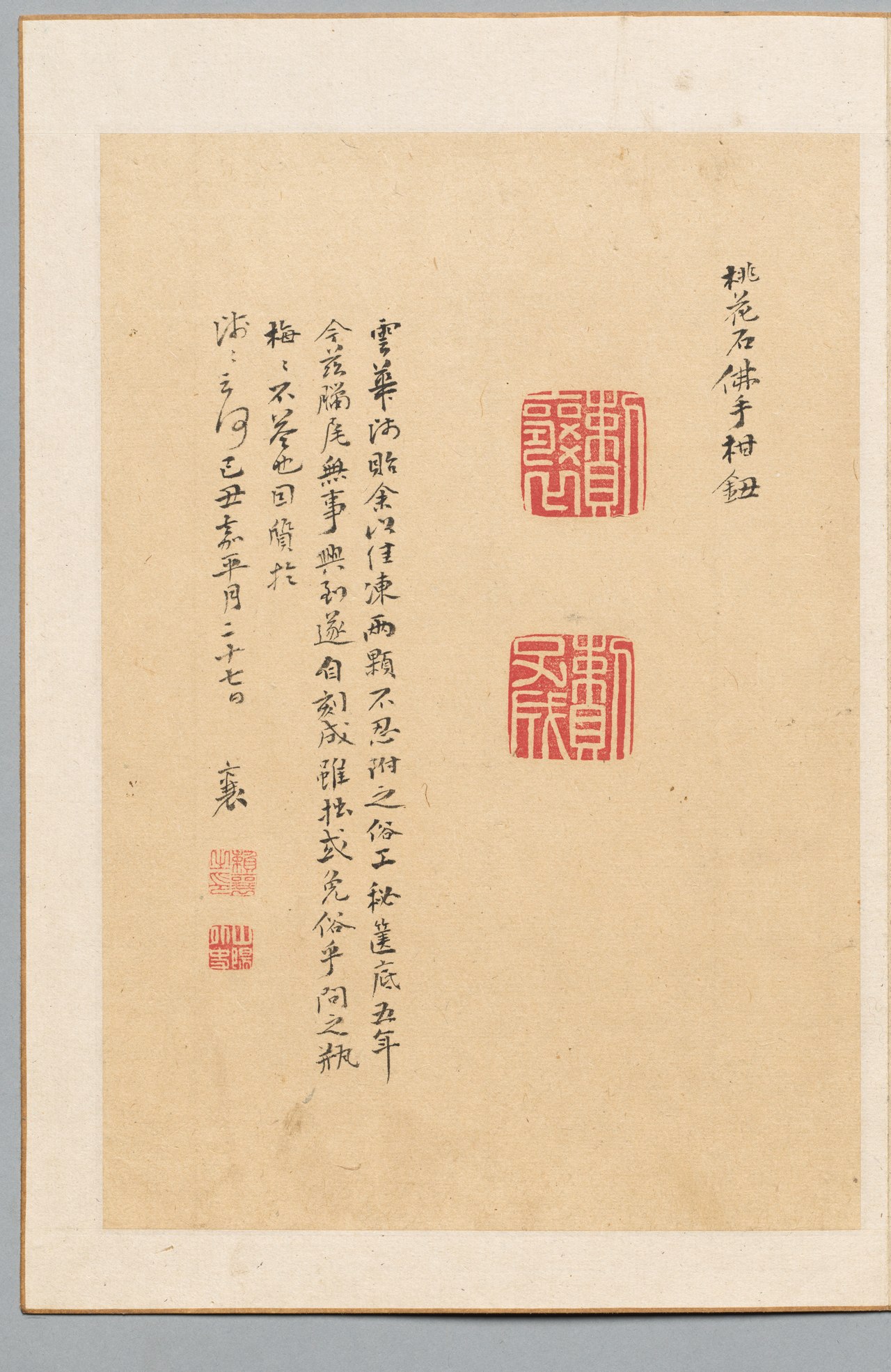
Major works - **Inscription, from Album of Precious Works from Famous Early Modern Calligraphers and Painters (1817)** – This piece exemplifies Rai’s mastery of the *kaisho* (regular script) style. The inscription, rendered in dark ink on fine rice paper, records the date of the album’s compilation and includes a brief dedication to a fellow scholar‑artist. The work is celebrated for its balanced composition and the subtle variation in stroke thickness that conveys both authority and elegance.
- Inscription and Two Seals (1829) – Created later in Rai’s career, this work pairs a concise philosophical statement with his two personal seals. The seals, placed symmetrically beneath the text, serve both as a signature and as a visual anchor, illustrating his belief that the seal should possess the same artistic weight as the calligraphy itself.
- Poem (1816) – Though the text of this poem is modest, its presentation on a single sheet of silk demonstrates Rai’s skill in arranging characters to complement the material’s sheen. The poem reflects the seasonal motif common in Edo‑period literature, expressing a fleeting appreciation of spring’s transience.
- Cherry Blossoms at Yoshino (1816) – This ink painting depicts the famed Yoshino hills awash with blooming sakura. Rai’s use of light washes to suggest the canopy, combined with a few bold, dark strokes to delineate the trunks, creates a sense of depth while maintaining a delicate, almost ethereal quality. A short poem runs along the right edge, reinforcing the visual theme.
- Alone in the Cold Mountains – Though the exact date is not recorded, this work is widely cited as a hallmark of Rai’s later period. It portrays a solitary figure standing amid stark, snow‑capped peaks, rendered in monochrome with occasional touches of muted grey. The composition conveys both physical isolation and inner contemplation, aligning with the Confucian emphasis on self‑cultivation.
Influence and legacy Rai San'yo occupies a respected niche in Japanese art history as a scholar‑artist who embodied the intellectual ideals of the late Edo period. His calligraphic style influenced a generation of bunjin who sought to reconcile classical learning with personal expression. The integration of poetry and painting that he refined became a model for later haiga practitioners, and his seal designs are still studied by contemporary seal carvers for their clarity and balance.
Beyond the visual arts, Rai’s historical writings on the Tokugawa administration contributed to a more nuanced understanding of early modern Japanese governance. Modern historians cite his essays when examining the moral discourse that underpinned the period’s bureaucratic culture. Although he never founded a formal movement, his works are regularly exhibited in museums dedicated to Edo‑period culture, and his name appears in academic curricula that explore the intersection of literature, philosophy and visual art.
Rai San'yo’s legacy endures through the continued appreciation of his calligraphy, the scholarly value of his historical treatises, and the poetic resonance of his paintings, which together illustrate the harmonious blend of intellect and aesthetics that defined the scholar‑artist tradition.
Frequently asked questions
Who was Rai San'yo?
Rai San'yo (1780–1832) was a Japanese Confucianist philosopher, historian, poet and visual artist of the late Edo period, known for his calligraphic inscriptions, seal carving and poetic paintings.
What artistic style or movement is he associated with?
He worked within the scholar‑artist (bunjin) tradition, blending classical calligraphy, haiga painting and Confucian philosophy rather than belonging to a formal movement.
What are his most famous works?
Key works include the 1817 *Inscription* from the Album of Precious Works, the 1829 *Inscription and Two Seals*, the 1816 *Poem* and *Cherry Blossoms at Yoshino*, and the landscape *Alone in the Cold Mountains*.
Why does Rai San'yo matter in art history?
He exemplifies the Edo‑period synthesis of literary and visual art, influencing later haiga painters, seal carvers and scholars who valued the harmonious integration of text, image and moral thought.
How can I recognise a work by Rai San'yo?
Look for a restrained ink palette, balanced brush strokes that combine regular script with subtle variations, the presence of his distinctive two‑seal motif, and short poetic verses that complement the visual scene.