Rachel Ruysch
1664 – 1750
In short
Rachel Ruysch (1664–1750) was a Dutch painter of the Rococo period, celebrated for her highly detailed flower still‑lifes. Her work achieved international fame in her lifetime and she remains the best documented female artist of the Dutch Golden Age.
Notable works


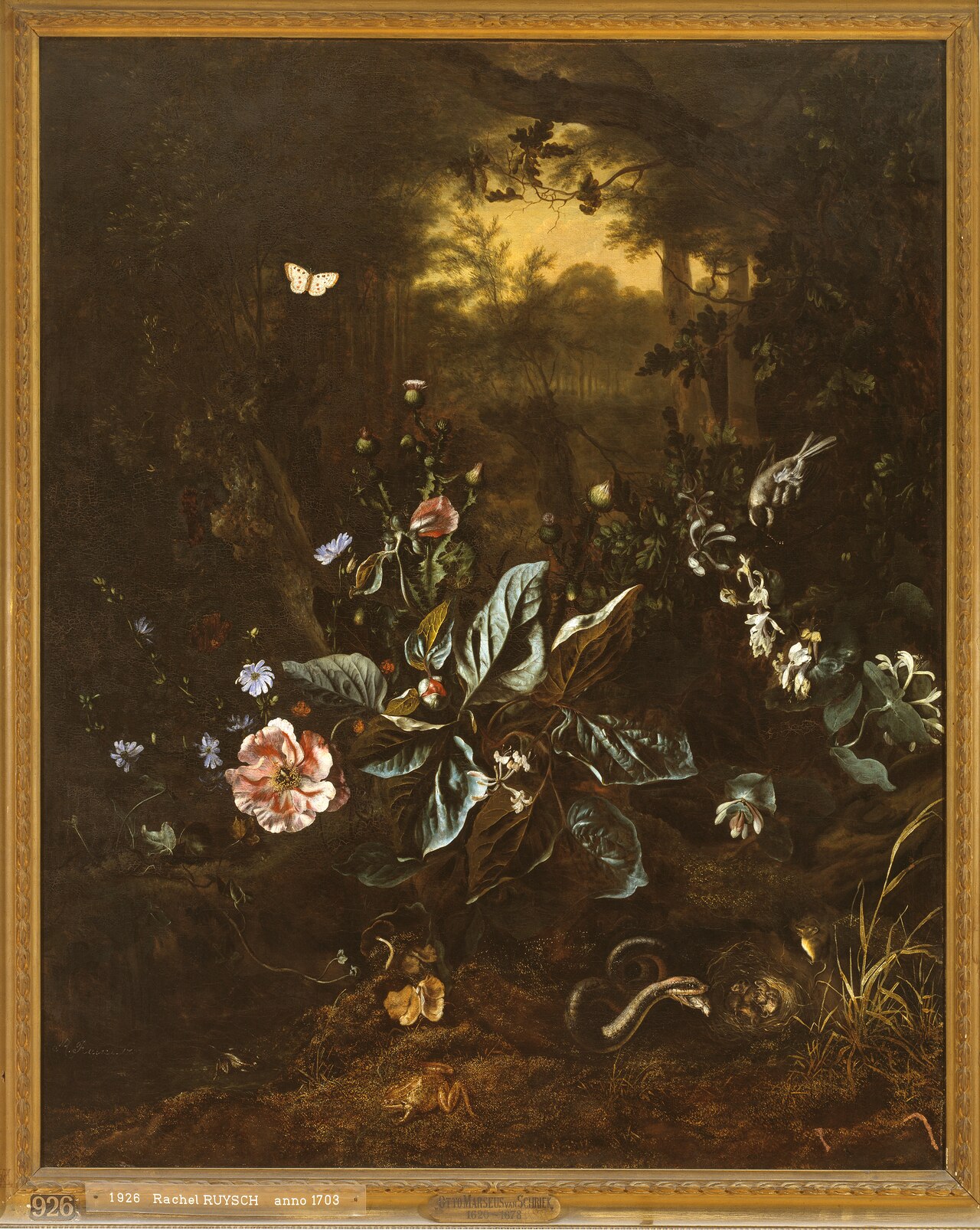
Early life Rachel Ruysch was born in 1664 in The Hague, a thriving centre of artistic activity in the Dutch Republic. She was the daughter of Frederik Ruysch, a noted physician and anatomist, whose scientific interests fostered an early fascination with natural forms. Growing up in a cultured household, Rachel received a comprehensive education that included drawing from life—a rare opportunity for women at the time. By her early teens she was already practising the meticulous observation of plants and insects that would later define her paintings.
Career and style At the age of fifteen Ruysch entered the workshop of the prominent still‑life painter Abraham Mignon, where she refined the Dutch tradition of floral composition. In 1685 she married the portraitist Juriaen Pool, whose support allowed her to continue working after marriage—a notable departure from the expectations placed on women artists. Throughout the late 17th and early 18th centuries she established a reputation that extended beyond the Netherlands, attracting commissions from aristocratic patrons in England, France and the German states.
Ruysch’s style evolved alongside the broader shift from the Dutch Golden Age towards the lighter, more decorative Rococo aesthetic. While retaining the exacting realism of her predecessors, she introduced a softer colour palette and a heightened sense of movement. Her bouquets often combine a profusion of blossoms—tulips, roses, lilies, and exotic species—with delicate insects and occasional small fauna, creating a narrative of fleeting beauty. The compositions balance scientific accuracy with artistic elegance, reflecting both her father's anatomical precision and the period’s taste for ornamental luxury.
Signature techniques Ruysc h’s paintings are distinguished by several technical hallmarks. First, she employed a layered glazing method that achieved luminous depth; thin translucent pigment layers over a finely rendered underpainting allowed light to penetrate the surface, producing a jewel‑like sheen on petals. Second, her brushwork varies deliberately: tight, almost stippled strokes render the texture of petals, while broader, fluid strokes convey the translucency of leaves and the delicate sheen of water in glass vessels. Third, she mastered the use of chiaroscuro to model three‑dimensional forms, often positioning the floral arrangement on a darkened background that accentuates colour contrast. Finally, Ruysch incorporated minute details—such as the dewdrop on a blossom or the tiny wing of a fly—to demonstrate her observational skill and to imbue each work with a sense of lived naturalism.
Major works * **Flowers in a Vase (1685)** – One of her earliest signed pieces, this work showcases a dense bouquet of roses, tulips and lilies arranged in a simple stone vase. The meticulous rendering of each petal and the subtle play of light across the composition exemplify her mastery of colour and texture. * **Roses, Convolvulus, Poppies, and Other Flowers in an Urn on a Stone Ledge (1688)** – In this painting Ruysch expands the spatial setting, placing the urn on a rugged stone ledge that creates a dramatic contrast between the delicate flowers and the austere rock. The inclusion of a small beetle and a spider adds an element of natural observation. * **Still life of flowers and small animals at the edge of a forest (1703)** – This work departs from the indoor studio setting, integrating a forest edge with birds and insects. The composition demonstrates her ability to blend botanical detail with a broader landscape context, hinting at the Rococo fascination with pastoral scenes. * **Still Life with Flowers in a Glass Vase (1700)** – The transparent glass vessel allows Ruysch to explore reflections and refractions, while the bouquet combines exotic and native species. The painting’s balanced asymmetry reflects contemporary French influences while retaining Dutch realism. * **Still Life with Flowers on a Marble Slab (1716)** – Created later in her career, this piece features a lavish arrangement atop a polished marble slab, with a subtle play of shadow that enhances the three‑dimensional effect. The work illustrates the mature synthesis of her scientific precision and Rococo elegance.
These works collectively illustrate Ruysch’s development from a Dutch naturalist painter to an internationally recognised master of the Rococo still‑life genre.
Influence and legacy Rachel Ruysch’s long career—spanning more than six decades—made her the most extensively documented female painter of the Dutch Golden Age. Her technical innovations in glazing and compositional balance influenced subsequent generations of still‑life artists across Europe. In the 18th century her paintings were prized by collectors, and she enjoyed royal patronage, notably from the court of England’s Queen Anne.
Modern scholarship recognises Ruysch not only for her artistic achievements but also for breaking gender barriers in a male‑dominated field. Her success demonstrated that women could command both critical and commercial respect, paving the way for later female artists. Today her works are held in major museums such as the Rijksmuseum, the Mauritshuis and the Royal Collection, and they continue to be studied for their blend of scientific observation and aesthetic refinement. Her legacy endures as a testament to the power of meticulous craftsmanship and the enduring appeal of floral beauty.
Frequently asked questions
Who was Rachel Ruysch?
Rachel Ruysch (1664–1750) was a Dutch painter renowned for her exquisitely detailed flower still‑lifes, and she is the best documented female artist of the Dutch Golden Age.
What style or movement did she belong to?
She worked within the Dutch still‑life tradition and, as her career progressed, incorporated the lighter, decorative elements of the Rococo movement.
What are her most famous works?
Key paintings include *Flowers in a Vase* (1685), *Roses, Convolvulus, Poppies, and Other Flowers in an Urn on a Stone Ledge* (1688), *Still life of flowers and small animals at the edge of a forest* (1703), *Still Life with Flowers in a Glass Vase* (1700) and *Still Life with Flowers on a Marble Slab* (1716).
Why does she matter in art history?
Ruysch’s technical mastery, international fame during her lifetime, and role as a pioneering female professional artist make her a central figure in the study of Baroque and Rococo still‑life painting.
How can I recognise a Rachel Ruysch painting?
Look for a densely packed bouquet rendered with luminous glazing, meticulous botanical detail, subtle chiaroscuro, and often the inclusion of tiny insects or small animals that add a naturalistic touch.