Pieter van Avont
1600 – 1652
In short
Pieter van Avont (1600–1652) was a Flemish Baroque painter, draughtsman and printmaker from the Habsburg Netherlands, noted for his religious cabinet paintings that often feature nude children and putti. He worked mainly in Antwerp, collaborating with leading artists of his time, and produced works such as Floating Angels with Image of the Virgin (1633).
Notable works

_-_Flora_in_the_Garden.jpg)

_-_Madonna_and_Child,_St_John_the_Baptist_and_Angels.jpg)
Early life Pieter van Avont was born in 1600 in Mechelen, a city in the Habsburg Netherlands that was part of the thriving artistic region of Flanders. Little is recorded about his family background, but the city’s vibrant workshop culture would have offered ample opportunity for a young talent to apprentice. By the early 1620s he had moved to Antwerp, the commercial and artistic hub of the Southern Netherlands, where he began to establish himself among a network of painters, draughtsmen and printmakers.
Career and style In Antwerp, van Avont quickly became known for his small‑scale, highly finished cabinet paintings. These works were typically intended for private devotion or collection, and they combined the dramatic chiaroscuro and dynamic composition characteristic of the Baroque with a delicate, almost lyrical handling of figures. Religious subjects dominate his oeuvre: the Virgin, the Christ Child, saints and biblical narratives are rendered with a tenderness that contrasts with the more monumental altarpieces of his contemporaries. A distinctive feature of van Avont’s style is the frequent inclusion of nude children and putti, often placed in lush natural settings. These figures serve both allegorical and decorative purposes, embodying innocence, divine love, or the pastoral ideal.
Van Avont was also a prolific collaborator. It was common in Antwerp for specialists to combine their talents on a single canvas—one artist might paint the landscape, another the figures, and a third the still‑life elements. Van Avont supplied the figures, particularly the delicate children and angels, while other leading painters contributed the architectural or landscape backgrounds. This collaborative practice not only broadened his exposure but also reinforced his reputation as a reliable figure specialist.
Signature techniques Van Avont’s technique is distinguished by a fine, almost filigree drawing style that translates well into his painted surfaces. He employed a layered approach: an initial sketch in charcoal or ink, followed by a thin underpainting that established light and shadow. Over this, he built up colour with translucent glazes, allowing the underlying drawing to remain visible. This method produced a luminous quality, especially in the skin tones of his children and the soft feathers of his putti. His handling of foliage and floral elements shows an attentive observation of nature, rendered with a precise yet painterly brushstroke. In printmaking, he favoured etching, using delicate lines to echo the softness of his painted figures.
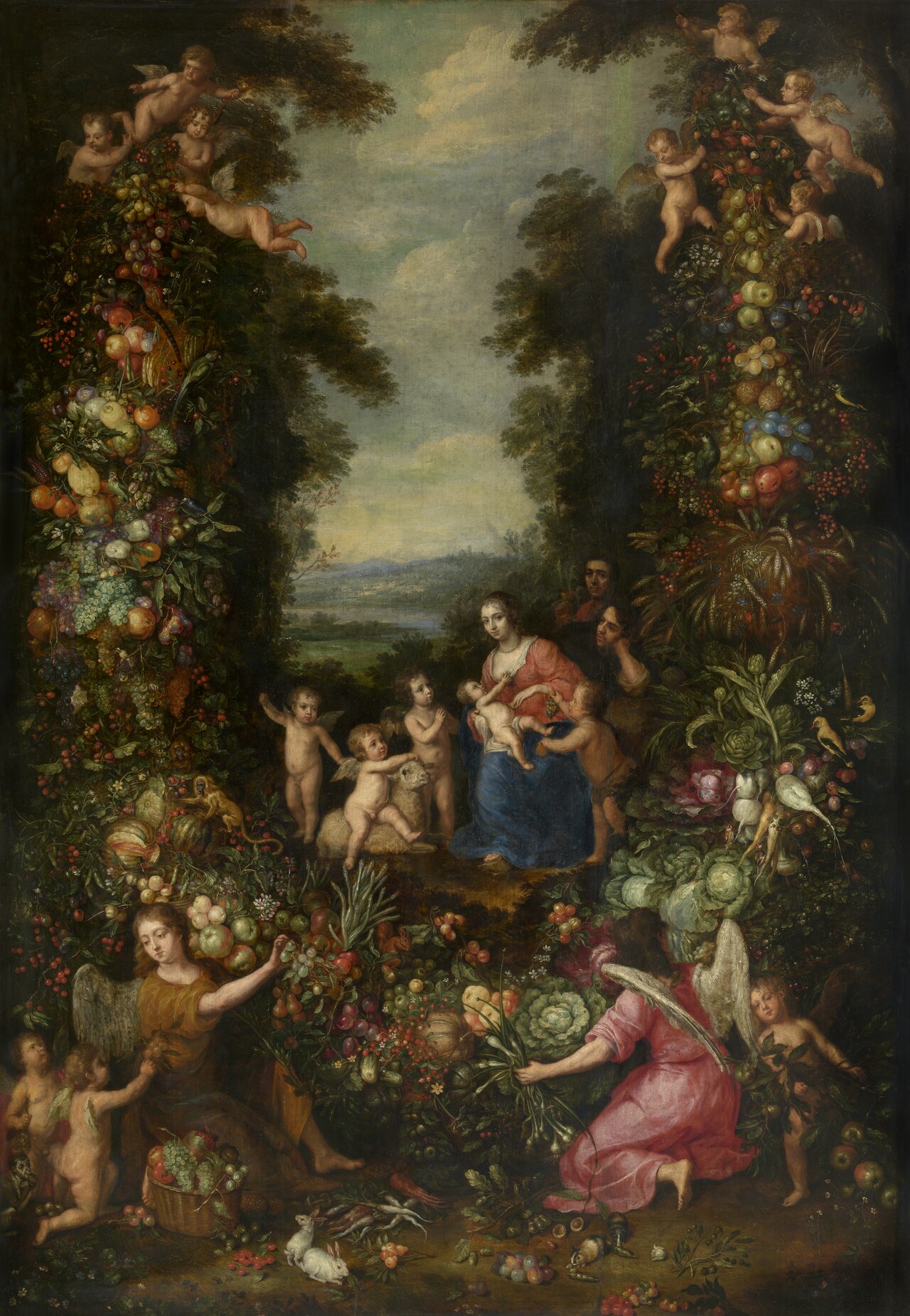
Major works - **Floating Angels with Image of the Virgin (1633)** – This composition places a serene image of the Virgin on a cloud, surrounded by a group of ethereal angels. The angels are rendered with the characteristic lightness of van Avont’s putti, their drapery catching a subtle, golden light. The work exemplifies his ability to blend devotional iconography with a sense of heavenly movement. - **Holy Family in a Garland with Flowers, Vegetables, and Fruit** – Though undated, this painting illustrates van Avont’s talent for integrating still‑life elements into a religious narrative. The Holy Family is set within a lush garland, where each flower and fruit is painted with botanical accuracy, highlighting his interest in natural detail. - **Flora in the Garden (1630)** – A secular piece that nonetheless reflects his Baroque sensibility, this work shows a young, partially nude figure amid a garden teeming with blooms. The composition balances the sensuality of the figure with the orderliness of the garden, a motif that recurs in his later collaborations. - **Madonna and Child, St John the Baptist as a Boy and Angels in a Woodland Landscape (1700)** – This later attribution, dated after van Avont’s death, is believed to be a workshop piece or a posthumous copy that continued his stylistic legacy. It retains the hallmark soft lighting and the inclusion of putti, indicating the lasting influence of his figure style. - **Madonna and Child, St John the Baptist and Angels (1650)** – One of his final known works, it demonstrates a mature synthesis of his figure work with a more complex spatial arrangement. The composition is tighter, the colours deeper, and the emotional resonance stronger, suggesting an artist at the height of his expressive capabilities.
Influence and legacy Pieter van Avont’s contribution to Flemish Baroque painting lies in his mastery of the intimate, devotional cabinet piece and his skillful rendering of nude children and putti. While he never achieved the fame of Rubens or van Dyck, his collaborative approach placed him at the centre of Antwerp’s artistic network, allowing his figure work to appear in many high‑profile commissions. Later generations of Flemish and Dutch painters drew on his delicate handling of light and his integration of naturalistic still‑life elements within religious scenes. His prints, especially his etchings, circulated widely and provided models for artists seeking to balance narrative clarity with decorative elegance. Today, van Avont is recognised by scholars for his role in the diffusion of Baroque aesthetics into private art markets and for the subtle emotional tone that distinguishes his figures from the more grandiose depictions of his contemporaries.
Frequently asked questions
Who was Pieter van Avont?
Pieter van Avont (1600–1652) was a Flemish Baroque painter, draughtsman and printmaker known for his religious cabinet paintings featuring nude children and putti.
What artistic style and movement did he belong to?
He worked within the Baroque movement, combining dramatic lighting with delicate, intimate compositions typical of Flemish cabinet painting.
What are his most famous works?
His best‑known works include *Floating Angels with Image of the Virgin* (1633), *Flora in the Garden* (1630), and *Madonna and Child, St John the Baptist and Angels* (1650).
Why is Pieter van Avont important in art history?
He contributed a distinctive, softer figure style to Flemish Baroque art, collaborated widely with leading Antwerp painters, and helped popularise devotional cabinet paintings for private collectors.
How can I recognise a Pieter van Avont painting?
Look for small‑scale religious scenes with finely drawn, often nude children or putti, soft, luminous lighting, and meticulous natural details such as flowers or fruit.