Pieter Neefs the Younger
1620 – 1675
In short
Pieter Neefs the Younger (1620–1675) was a Flemish painter from Antwerp who specialised in highly detailed interior views of churches, continuing the architectural tradition established by his father, Pieter Neefs the Elder.
Notable works

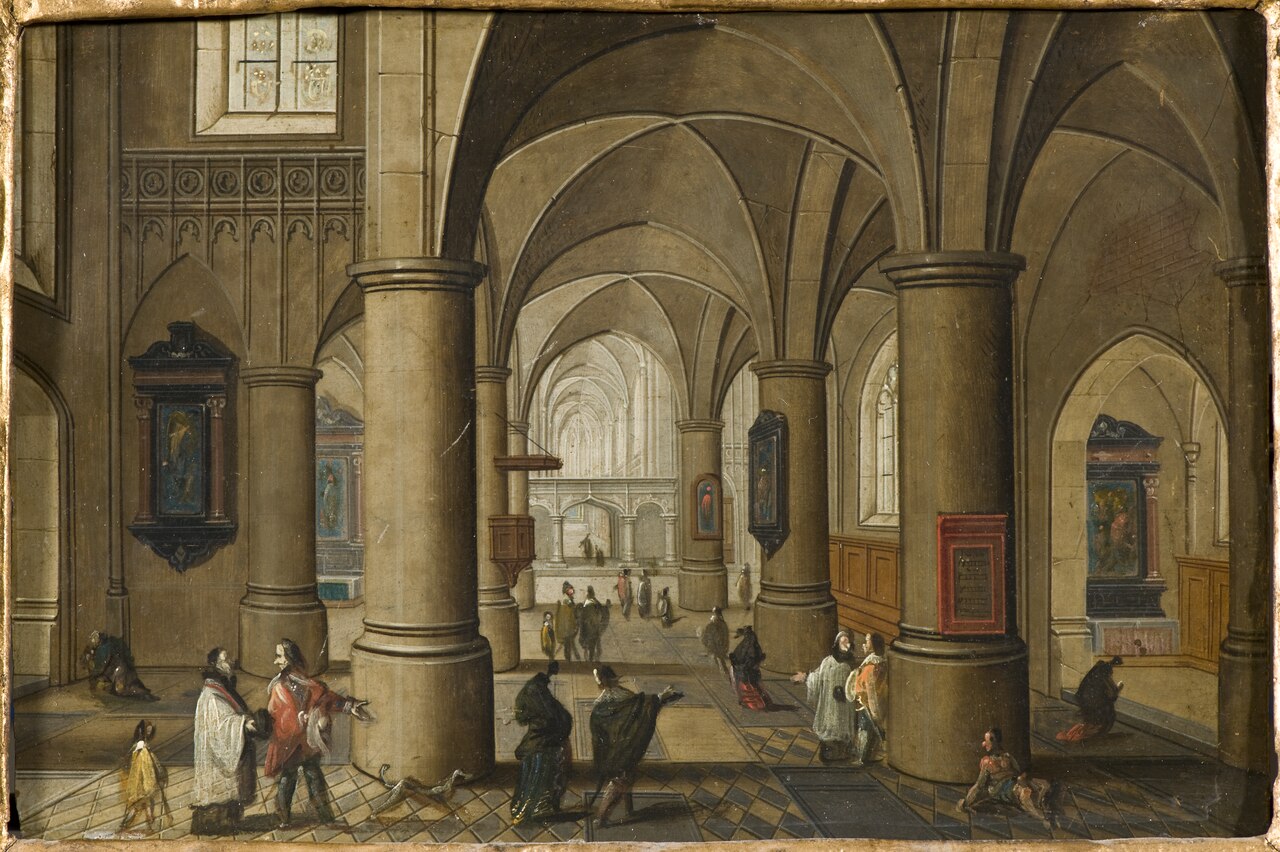

_-_Interior_of_the_Antwerp_Cathedral_-_WGA16481.jpg)
_and_Frans_Francken_(III)_-_Interior_of_a_Gothic_Church.jpg)
Early life Pieter Neefs the Younger was born in 1620 in Antwerp, a thriving centre of artistic production in the Habsburg Netherlands. He was the son of Pieter Neefs the Elder, a well‑known painter of architectural interiors. Growing up in his father’s workshop, the younger Neefs received a rigorous training in drawing, perspective and the handling of light, skills that would become the hallmarks of his own oeuvre. Little is recorded about his formal education beyond the family studio, but the environment provided him with direct exposure to the market for devotional and genre paintings that flourished in Antwerp during the early seventeenth century.
Career and style By the 1630s Neefs the Younger had begun to work independently, although he continued to share a studio with his father for several years. His career was centred on the production of large‑scale church interiors, a niche that catered to both local patrons and the international collectors who admired the precise rendering of sacred spaces. The younger Neefs adhered to the Flemish tradition of architectural painting, combining accurate linear perspective with a warm, naturalistic colour palette. Unlike some of his contemporaries who preferred grandiose, theatrical lighting, Neefs often employed a more restrained illumination that highlighted the structural elegance of Gothic and Baroque interiors while allowing staffage figures to animate the scenes.
Signature techniques Neefs the Younger distinguished his work through several recurring technical approaches. First, he employed a rigorous system of orthogonal lines to achieve a mathematically correct perspective, a skill inherited from his father’s workshop. Second, he used chiaroscuro subtly, allowing shafts of daylight to filter through stained‑glass windows and illuminate marble columns, vaults and floor tiles. Third, his paintings are noted for their meticulous architectural detailing—tracery, buttresses, and vaulted ceilings are rendered with a near‑architectural exactness. Finally, he frequently collaborated with specialist staffage painters who added figures, animals and genre details, creating a lively narrative within the otherwise static architectural framework.
Major works - **Church interior (1650)** – This work exemplifies Neefs’s mature style. A spacious nave is depicted with a deep recession of space, illuminated by diffused daylight that enters through high windows. The composition balances the vertical thrust of the columns with the horizontal spread of the floor tiles, guiding the eye toward the altar. - **Interior of a Gothic Church** – In this painting, Neefs captures the characteristic ribbed vaults and pointed arches of a Gothic sanctuary. The emphasis on verticality and the delicate tracery of the windows showcase his ability to render the intricacies of medieval architecture. - **Interior of a Gothic Church at Night (1660)** – This nocturnal scene demonstrates Neefs’s skill with artificial lighting. Candlelight and moonlight create a dramatic contrast, casting deep shadows that accentuate the sculptural qualities of the interior while the muted glow of the stained glass adds colour. - **Interior of the Antwerp Cathedral (1660)** – A celebration of his native city’s most important church, this canvas presents the cathedral’s lofty nave, towering columns and richly decorated choir. Neefs’s careful observation of the cathedral’s unique Baroque elements, combined with his characteristic perspective, makes the work a valuable visual record of the building’s 17th‑century appearance. - **Interior of St Charles Borromeo Church in Antwerp (1636)** – One of his earliest dated works, it shows a more intimate interior with a focus on the altar and the surrounding chapels. The painting reflects a youthful confidence in handling complex spatial relationships and foreshadows the compositional choices that would define his later career.
Influence and legacy Pieter Neefs the Younger sustained the architectural painting tradition that his father had helped to codify, ensuring its continuation throughout the mid‑seventeenth century. His works contributed to the broader Flemish interest in the interior of sacred spaces, a genre that informed both devotional practice and the emerging appreciation for architectural heritage. Later Flemish painters, such as the brothers Jan and Jacob van der Heyden, drew upon Neefs’s precise perspective and compositional balance when depicting ecclesiastical interiors. Today, his paintings are held in major European museums and continue to serve as reference material for scholars studying the visual culture of the Habsburg Netherlands. By documenting the interiors of prominent Antwerp churches, Neefs also provided a visual archive that aids historians in understanding the city’s religious architecture before later alterations and restorations.
Frequently asked questions
Who was Pieter Neefs the Younger?
He was a Flemish painter (1620–1675) from Antwerp who specialised in detailed interior views of churches, continuing the architectural tradition of his father.
What artistic style or movement is he associated with?
Neefs worked within the Flemish tradition of architectural painting, focusing on precise perspective, naturalistic lighting and collaborative staffage figures.
What are his most famous works?
Key works include *Church interior* (1650), *Interior of a Gothic Church*, *Interior of a Gothic Church at Night* (1660), *Interior of the Antwerp Cathedral* (1660) and *Interior of St Charles Borromeo Church in Antwerp* (1636).
Why is Pieter Neefs the Younger important in art history?
He helped preserve and develop the genre of church‑interior painting in the 17th‑century Netherlands, providing valuable visual records of Antwerp’s sacred architecture and influencing later Flemish artists.
How can I recognise a painting by Pieter Neefs the Younger?
Look for a meticulously rendered church interior with accurate linear perspective, subtle chiaroscuro, detailed Gothic or Baroque architecture, and often collaborative figures that animate the space.