Pieter Mulier the Elder
1600 – 1659
In short
Pieter Mulier the Elder (1600–1659) was a Dutch Golden Age painter from Haarlem who specialised in marine subjects. He is noted for dynamic depictions of ships and stormy seas, with several works held in major European collections.
Notable works


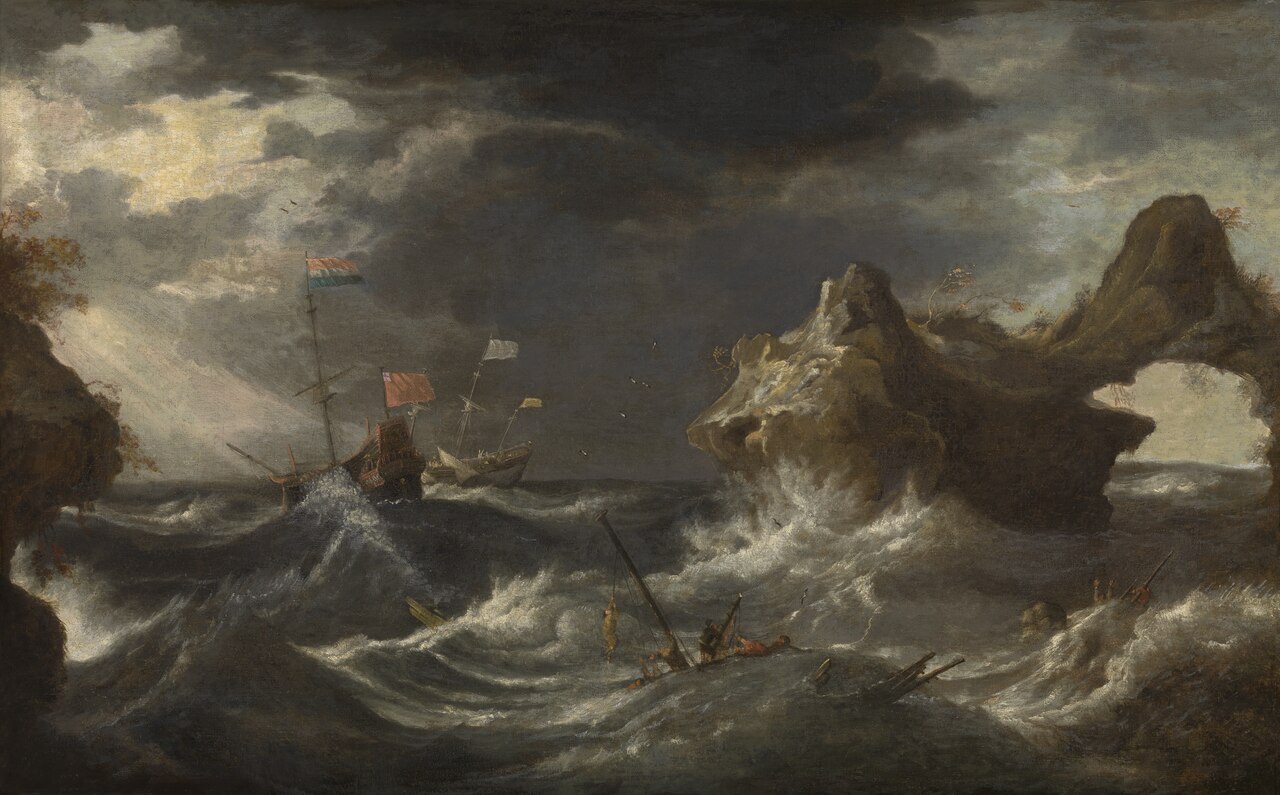

_Het_Scheepvaartmuseum.jpg)
Early life Pieter Mulier the Elder was born in Haarlem in 1600, a city that was a vibrant centre of artistic activity during the Dutch Golden Age. Little is recorded about his family background, but Haarlem’s thriving guild system and its proximity to the bustling ports of the North Sea would have provided a fertile environment for a young artist interested in the maritime world. He likely began his training in the workshop of a local master, absorbing the fundamentals of drawing, composition and the handling of oil paint that were standard in the Dutch guilds of the period.
Career and style Mulier established himself as a marine painter at a time when the Dutch Republic’s maritime power was at its zenith. The demand for paintings that celebrated naval prowess, trade, and the drama of the sea was high, and Mulier’s work responded to this market with a focus on the interaction between wind, water and vessel. His style reflects the broader Dutch marine tradition, characterised by a keen observation of light, atmospheric effects and a narrative approach to seascapes. While the precise details of his artistic affiliations remain unclear, his paintings share affinities with contemporaries such as Jan van de Cappelle and Hendrick Dubbels, particularly in the use of muted colour palettes and a balanced treatment of sky and sea.
Signature techniques Mulier’s paintings are distinguished by several recurring technical choices. He employed a restrained colour scheme dominated by grays, blues and earthy tones, allowing the subtle shifts of light to dominate the visual impact. A hallmark of his technique is the dramatic rendering of wind‑driven clouds, which he built up with layered glazes to create depth and movement. In his depictions of water, Mulier used fine brushwork to suggest the choppiness of the sea, often accentuating the cresting waves with white highlights that catch the light. He also favoured a low horizon line, a compositional device that expands the sky and amplifies the sense of an expansive, unsettled atmosphere. The interplay of light and shadow on the sails and hulls of ships further demonstrates his skill in creating three‑dimensional forms within a largely two‑dimensional medium.
Major works **Fishing boat with the wind in the sails (1632)** – This early work showcases Mulier’s ability to capture the tension of a vessel battling a strong breeze. The composition places the boat slightly off centre, its rigging straining against the wind, while a sky filled with rolling clouds dominates the upper half of the canvas. The muted palette and careful modelling of the boat’s hull convey both realism and a sense of impending movement.
Four Vessels Running Before a Gale (1630) – In this larger seascape, Mulier presents a fleet of ships caught in a fierce storm. The ships are rendered with precise anatomical accuracy, yet their placement within the turbulent sea creates a narrative of collective struggle. The artist’s use of diagonal lines formed by the masts and the wave crests intensifies the feeling of chaos, while the darkening sky hints at an approaching tempest.
Storm at Sea (1642) – One of his later works, *Storm at Sea* exemplifies Mulier’s mature handling of atmospheric drama. The painting features a solitary vessel confronting a towering wave, the sky heavy with ominous clouds. The contrast between the deep, almost black water and the thin sliver of light breaking through the clouds underscores the perilous nature of sea travel during the period.
Shipping in choppy waters (1642) – This piece depicts multiple ships navigating a rough sea under an overcast sky. Mulier’s skillful rendering of the water’s surface, with its intricate brushstrokes suggesting foam and spray, creates a tactile sense of motion. The muted colour scheme reinforces the overall mood of subdued tension rather than outright panic.
Choppy Sea (1640) – In *Choppy Sea* Mulier focuses on the sea itself, with only a small vessel suggested at the horizon. The painting’s emphasis on the water’s texture, the rippling surface and the subtle reflections of light demonstrates his fascination with the sea as an autonomous subject, rather than merely a backdrop for human activity.
These works collectively illustrate Mulier’s consistent interest in the forces of nature, his capacity to portray both the grandeur and the vulnerability of maritime endeavours, and his technical proficiency in rendering light, atmosphere and movement.
Influence and legacy Although Pieter Mulier the Elder never achieved the fame of some of his contemporaries, his paintings contributed to the development of Dutch marine art in the 17th century. By focusing on the dynamism of wind and water, he helped expand the visual vocabulary available to later marine painters, who built upon his atmospheric techniques and compositional strategies. His works are represented in several European collections, including the Rijksmuseum in Amsterdam and the Kunsthalle in Hamburg, where they continue to inform scholarly assessments of Dutch seascape painting. Modern art historians regard Mulier as a reliable documentarian of the Dutch Republic’s maritime culture, and his paintings are frequently cited in discussions of how the sea was visualised as a site of both economic activity and existential risk. In contemporary exhibitions, his works are often paired with those of Jan van de Cappelle and Willem van de Velde the Elder to illustrate the breadth of marine painting during the Golden Age. Overall, Mulier’s legacy endures through the continued appreciation of his masterful depictions of wind‑torn sails, choppy waters and the ever‑present drama of the sea.
Frequently asked questions
Who was Pieter Mulier the Elder?
Pieter Mulier the Elder (1600–1659) was a Dutch Golden Age painter from Haarlem who specialised in marine subjects, depicting ships and stormy seas.
What artistic style or movement is he associated with?
He worked within the Dutch marine painting tradition of the 17th century, a style noted for realistic seascapes, careful light effects and narrative compositions.
What are his most famous works?
His most recognised paintings include *Fishing boat with the wind in the sails* (1632), *Four Vessels Running Before a Gale* (1630), *Storm at Sea* (1642), *Shipping in choppy waters* (1642) and *Choppy Sea* (1640).
Why does Pieter Mulier the Elder matter in art history?
Mulier contributed to the evolution of Dutch marine art by emphasizing atmospheric drama and the dynamic interaction of wind, water and vessels, influencing later seascape painters.
How can I recognise a painting by Pieter Mulier the Elder?
Look for low horizons, muted blue‑gray palettes, detailed ship rigging, and expressive cloud formations that convey wind and storm, often with a focus on the texture of choppy water.