Pieter Cornelisz van Rijck
1567 – 1628
Notable works


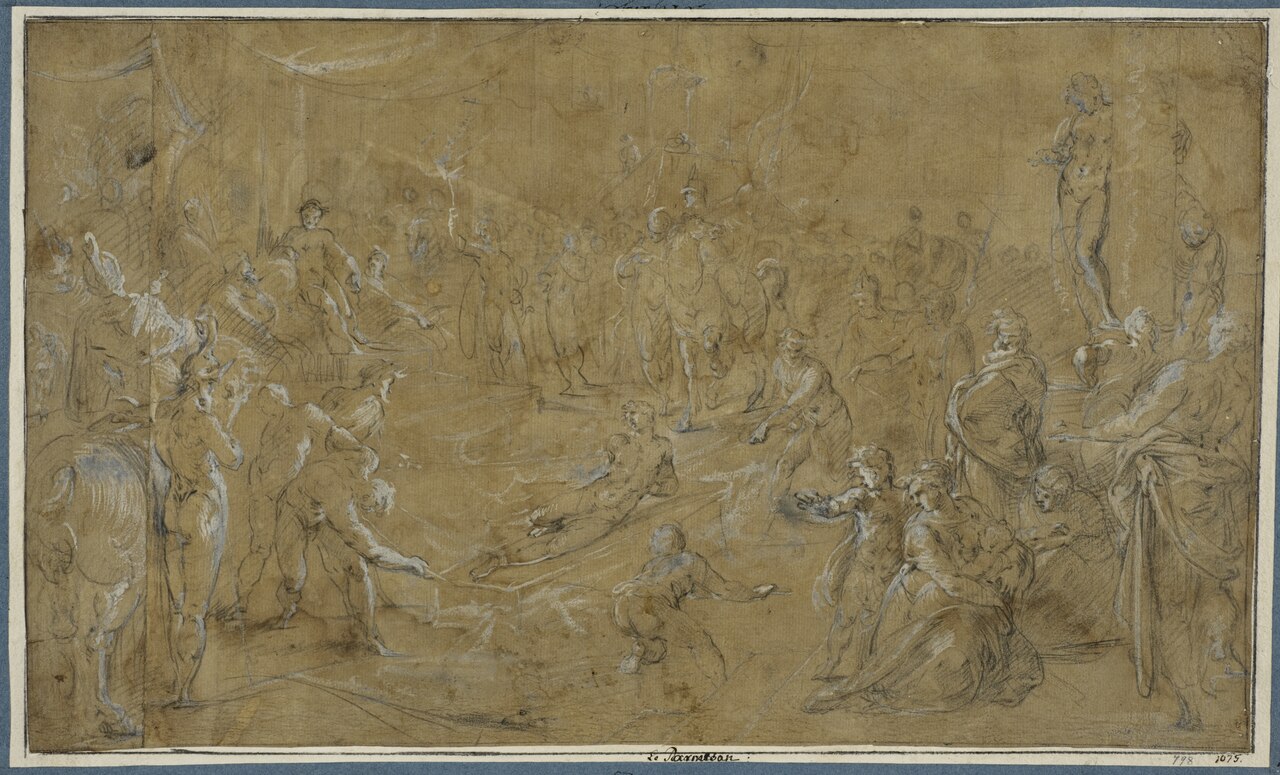
Early life Pieter Cornelisz van Rijck was born in 1567 in Delft, a thriving artistic centre of the Dutch Republic. Little is recorded about his family background, but the city’s vibrant guild environment suggests that he would have been exposed to the visual culture of the time from an early age. Delft’s painters’ guild (the Guild of Saint Luke) provided apprenticeships for young artists, and it is probable that van Rijck entered such a workshop in his teenage years, receiving training in drawing, composition and the handling of oil paint. The city’s proximity to Haarlem and Leiden, where genre painting was beginning to flourish, would later inform his artistic interests.
Career and style By the turn of the 17th century van Rijck had established himself as an independent practitioner. He began to produce works that reflected the emerging Dutch Baroque sensibility: a heightened emphasis on narrative, dramatic lighting and a richer colour palette than the earlier, more restrained Netherlandish tradition. His early output focused on domestic interiors—kitchens, markets and taverns—where he rendered everyday objects with a meticulous eye for texture and material. These scenes were populated by figures engaged in ordinary activities, yet they often carried moral or allegorical undertones, a characteristic shared with contemporaries such as Pieter Aertsen and Joachim Beuckelaer.
In the 1610s van Rijck travelled to Italy, a journey that many Dutch artists of his generation undertook to study the works of Caravaggio, the Carracci and other Roman masters. The Italian experience deepened his appreciation for chiaroscuro and introduced a more dynamic compositional rhythm into his paintings. Upon returning to the Low Countries he continued to work in a hybrid style that combined the Dutch predilection for detailed observation with the dramatic lighting and spatial constructions encountered in Italy. This synthesis placed him among the early practitioners of a distinctly Dutch Baroque idiom.
Signature techniques Van Rijck’s paintings are recognisable for several technical hallmarks. First, his handling of light and shadow creates a subtle yet powerful chiaroscuro that models forms without obscuring surface detail. He often illuminated the central action with a warm, directional light source, while peripheral areas recede into softer, cooler tones. Second, his texture rendering is exceptionally fine; the glint of copper pots, the sheen of fabric and the grain of wooden tables are depicted with delicate brushwork that conveys materiality. Third, his compositions employ a layered approach: foreground objects lead the eye toward a narrative centre, while background architecture or landscape elements provide depth. Finally, van Rijck frequently incorporated symbolic objects—such as a loaf of bread, a spilled mug or a painted still‑life—into his scenes to reinforce moral messages.
Major works - **Kitchen Scene with the Parable of the Rich Man and Poor Lazarus (1610)** – This early work illustrates van Rijck’s skill at integrating biblical narrative into a domestic setting. A bustling kitchen occupies the foreground, while a small tableau in the upper right corner depicts the parable of the rich man and Lazarus. The contrast between the sumptuous food and the humble figure of Lazarus underscores the moral lesson. - **Kitchen Piece (1621)** – A later kitchen interior, this painting showcases a more confident use of light. A bright window floods the room, highlighting a spread of produce, copperware and a solitary figure preparing a meal. The work exemplifies van Rijck’s mature handling of texture and his continued interest in the moral symbolism of everyday objects. - **Market scene with two figures (1622)** – In this composition the viewer is placed among a crowded market stall. Two central figures negotiate over goods, while the surrounding crowd provides a lively backdrop. Van Rijck’s attention to the varied merchandise—spices, fish, textiles—demonstrates his observational acuity and his ability to capture the vibrancy of urban commerce. - **The Martyrdom of St Lawrence** – Diverging from genre subjects, this religious painting depicts the saint’s martyrdom on a grill. The composition is dramatic, with stark contrasts of light and dark that heighten the emotional intensity. Though less is known about its precise date, the work reflects the influence of Italian Baroque drama and confirms van Rijck’s versatility in handling both secular and sacred themes.
Influence and legacy Pieter Cornelisz van Rijck occupies a transitional position in Dutch art history. His synthesis of Dutch genre realism with Italian Baroque drama anticipated the later flourishing of Dutch still‑life and domestic scenes in the mid‑17th century. While he never achieved the fame of contemporaries such as Rembrandt or Frans Hals, his meticulous technique and narrative integration influenced younger painters who sought to embed moral content within everyday settings.
His works also contributed to the broader European exchange of artistic ideas. By incorporating Italian chiaroscuro into a distinctly Northern visual language, van Rijck helped to disseminate Baroque aesthetics across the Dutch Republic. Collectors and guilds of the period valued his paintings for both their decorative appeal and their didactic potential, a duality that reinforced the cultural role of art as a vehicle for moral instruction.
In modern scholarship, van Rijck is recognised as an exemplar of early Dutch Baroque genre painting. His surviving oeuvre, though relatively small, provides insight into the evolving tastes of the early 17th century and the cross‑regional influences that shaped the Golden Age. Contemporary exhibitions of Dutch Baroque art often include his kitchen and market scenes to illustrate the period’s interest in the intersection of daily life and ethical narrative.
Overall, Pieter Cornelisz van Rijck’s legacy endures through his skillful marriage of detailed observation, narrative depth and dramatic lighting—a combination that helped lay the groundwork for the rich visual culture of the Dutch Golden Age.
FAQs
1. Who was Pieter Cornelisz van Rijck? Pieter Cornelisz van Rijck (1567–1628) was a Dutch Baroque painter from Delft, known for genre scenes, market interiors and religious works that blend Dutch realism with Italianate lighting.
2. What artistic movement did he belong to? He worked within the Baroque tradition, incorporating dramatic chiaroscuro and narrative composition while maintaining the detailed observation characteristic of Dutch Golden Age painting.
3. What are his most famous works? His best‑known paintings include *Kitchen Scene with the Parable of the Rich Man and Poor Lazarus* (1610), *Kitchen Piece* (1621), *Market scene with two figures* (1622) and the religious *Martyrdom of St Lawrence*.
4. Why is he important in art history? Van Rijck helped bridge Dutch genre painting with Italian Baroque techniques, influencing later Dutch artists and contributing to the development of narrative realism that defined the Golden Age.
5. How can I recognise a van Rijck painting? Look for meticulously rendered domestic settings, a warm directional light that creates subtle chiaroscuro, and symbolic objects that convey moral messages within everyday scenes.