Pieter Codde
1599 – 1678
In short
Pieter Codde (1599–1678) was a Dutch Baroque painter from Amsterdam, celebrated for his elegant genre scenes, guardroom groups and refined portraits. His work bridges the lively realism of early Dutch genre painting and the more polished, courtly style that followed.
Notable works



Early life Pieter Jacobsz Codde was born in Amsterdam in 1599, into a period of rapid economic growth and cultural flourishing in the Dutch Republic. Little is known about his family background, but archival records indicate that he spent his formative years in the bustling artistic environment of Amsterdam’s city centre, where workshops of established painters were abundant. Codde likely received his initial training in a local guild workshop, a common route for aspiring artists of the time, where he would have learned the fundamentals of drawing, composition and the handling of oil paint.
Career and style Codde established himself as an independent painter in the early 1620s, gaining membership in the local guild of St. Luke. His career unfolded against the backdrop of the Dutch Golden Age, a period when demand for domestic interiors, portraiture and civic group portraits was high. He quickly attracted commissions from wealthy merchants and civic organisations, producing works that combined a calm, refined atmosphere with a keen eye for the details of contemporary dress and interior décor.
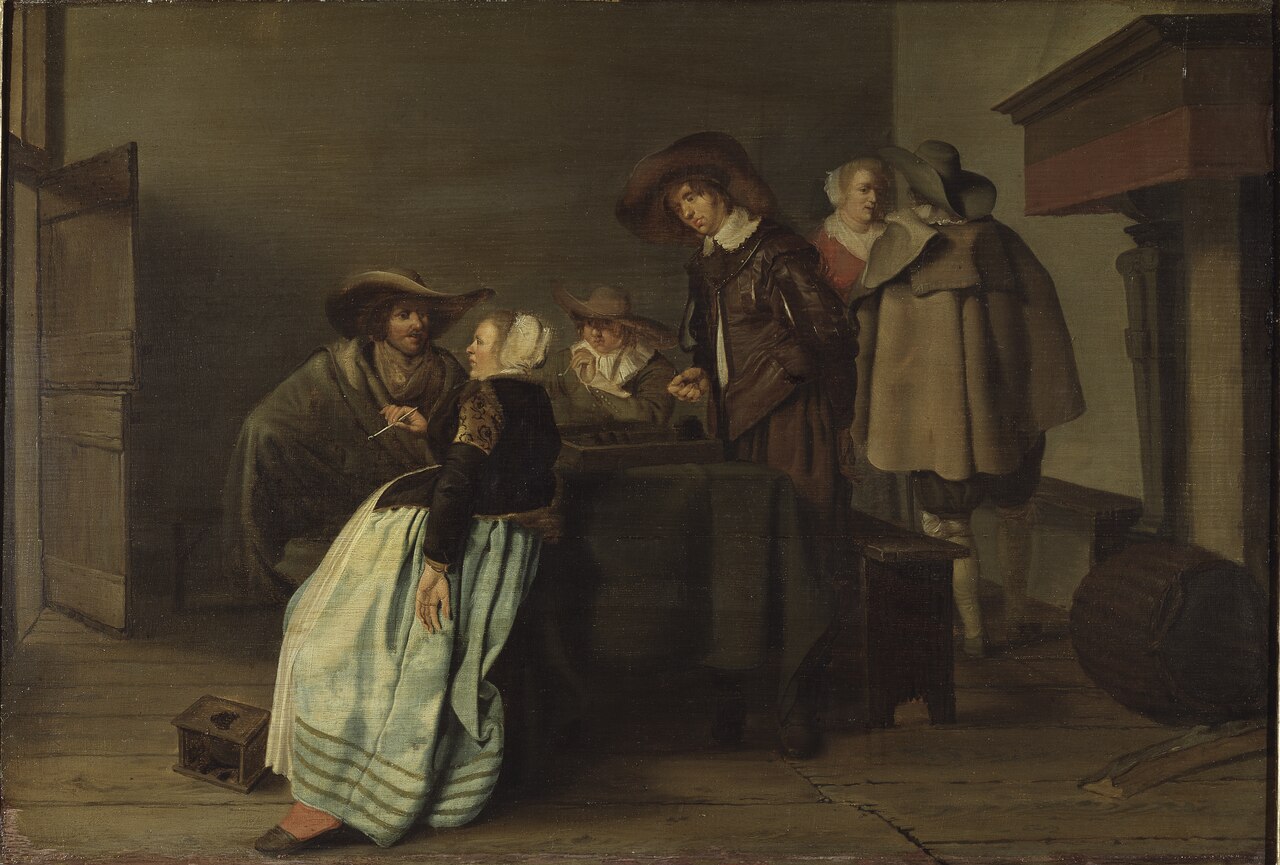
Stylistically, Codde’s paintings are characterised by a restrained colour palette dominated by muted blues, warm ochres and soft greys. He favoured balanced, often symmetrical compositions that convey a sense of order and decorum. While his subjects are drawn from everyday life—musicians, card players, masked revelers—he rendered them with a subtle elegance that elevates the scene beyond mere genre representation. This approach places him within the broader Baroque movement, yet his work retains a distinctly Dutch sensibility: an emphasis on realism tempered by a gentle, almost lyrical treatment of light.
Signature techniques Codde’s technical hallmarks include: - **Soft, diffused lighting** that gently models forms without dramatic chiaroscuro, creating a serene ambience. - **Meticulous rendering of textiles**, especially silk and satin, where the play of light on fabric is captured with delicate brushwork. - **Fine, almost invisible brushstrokes** that give his surfaces a smooth finish, allowing the viewer’s eye to focus on the overall composition rather than individual marks. - **Controlled colour harmonies**, often built around a limited palette that reinforces the calm mood of the scene. - **Attention to interior architecture**, with doorways, windows and tiled floors rendered accurately, grounding his figures in a believable setting.
These techniques combine to produce paintings that feel both intimate and polished, a quality that made his work popular among patrons seeking tasteful depictions of refined domestic life.
Major works - **Militia Company of District XI under the Command of Captain Reynier Reael (1633)** – This guard‑room portrait presents a group of civic guardsmen gathered under their captain’s leadership. Codde arranges the figures in a semi‑circular formation, each individual rendered with careful attention to uniform details and facial expressions. The work exemplifies his ability to convey collective authority while preserving individual character.
- A Conversation (1628) – In this genre scene, two well‑dressed figures engage in quiet dialogue. The composition is centred around a small table, with the subjects’ gestures and glances suggesting an intimate, private exchange. Codde’s subtle lighting highlights the textures of their clothing and the polished surface of the table, underscoring the painting’s narrative focus.
- Portrait of a Man with a Watch (1630) – This portrait captures a gentleman holding a pocket watch, a common symbol of the fleeting nature of time. The sitter’s pose is relaxed yet dignified, and the watch is rendered with a high degree of realism, showcasing Codde’s skill in depicting metallic surfaces. The background is a muted, neutral tone that draws attention to the figure’s face and the intricate details of the watch.
- Merry Company with Masked Dancers (1636) – A lively interior scene, this painting depicts a group of masked revelers engaged in dance and conversation. The composition is dynamic, with figures arranged in multiple planes that guide the viewer’s eye around the room. Codde’s handling of light on the masks and the reflective surfaces of the dancers’ costumes demonstrates his mastery of texture and atmosphere.
- Tric‑Trac Players (1628) – This work portrays two men absorbed in a game of tric‑trac, a popular board game of the era. The painting is notable for its detailed depiction of the game board, the players’ focused expressions, and the subtle interplay of light on the wooden surface and the surrounding furnishings. Codde’s ability to capture a moment of concentrated leisure adds a narrative depth to the genre scene.
Influence and legacy Codde occupies a pivotal position in Dutch art history, bridging the vigorous realism of early 17th‑century genre painters such as Frans Hals with the more polished courtly aesthetic that characterised later artists like Gerard ter Borch. His refined handling of texture, compositional balance and subdued lighting influenced a generation of painters who sought to portray elegant domestic interiors without sacrificing naturalism.
Although he never achieved the fame of some of his contemporaries, Codde’s works are held in major collections, including the Rijksmuseum in Amsterdam and the Mauritshuis in The Hague. Scholars regard his paintings as valuable documentation of Dutch middle‑class life, fashion and interior design in the early Baroque period. Modern exhibitions continue to feature his pieces alongside those of his peers, highlighting his role in the evolution of genre painting and his contribution to the visual culture of the Dutch Republic.
Today, Pieter Codde is recognised for his subtle synthesis of realism and refinement, a legacy that endures in the continued appreciation of his calm, meticulously crafted scenes of 17th‑century Dutch society.
Frequently asked questions
Who was Pieter Codde?
Pieter Codde (1599–1678) was a Dutch painter from Amsterdam, known for his elegant genre scenes, guardroom group portraits and refined portraits during the Baroque era.
What artistic style or movement is he associated with?
He worked within the Dutch Baroque tradition, combining realistic domestic subjects with a polished, restrained colour palette and balanced composition.
What are his most famous works?
Key works include the guard portrait *Militia Company of District XI under the Command of Captain Reynier Reael* (1633), *A Conversation* (1628), *Portrait of a Man with a Watch* (1630), *Merry Company with Masked Dancers* (1636) and *Tric‑Trac Players* (1628).
Why is Pieter Codde important in art history?
Codde bridges the lively realism of early Dutch genre painting and the later, more courtly style, influencing artists such as Gerard ter Borch and providing valuable insight into 17th‑century Dutch society and aesthetic preferences.
How can I recognise a Pieter Codde painting?
Look for smooth, almost invisible brushwork, a muted colour scheme, careful rendering of textiles, soft diffused lighting and composed, interior domestic scenes that convey a calm, elegant atmosphere.