Pieter Bout
1658 – 1719
In short
Pieter Bout (1658–1719) was a Flemish painter, draughtsman and printmaker from Brussels, noted for his landscapes, cityscapes and architectural scenes that echo the style of earlier Flemish masters. His work bridges the late 17th‑century Flemish tradition and the softer palette of the early 18th century.
Notable works


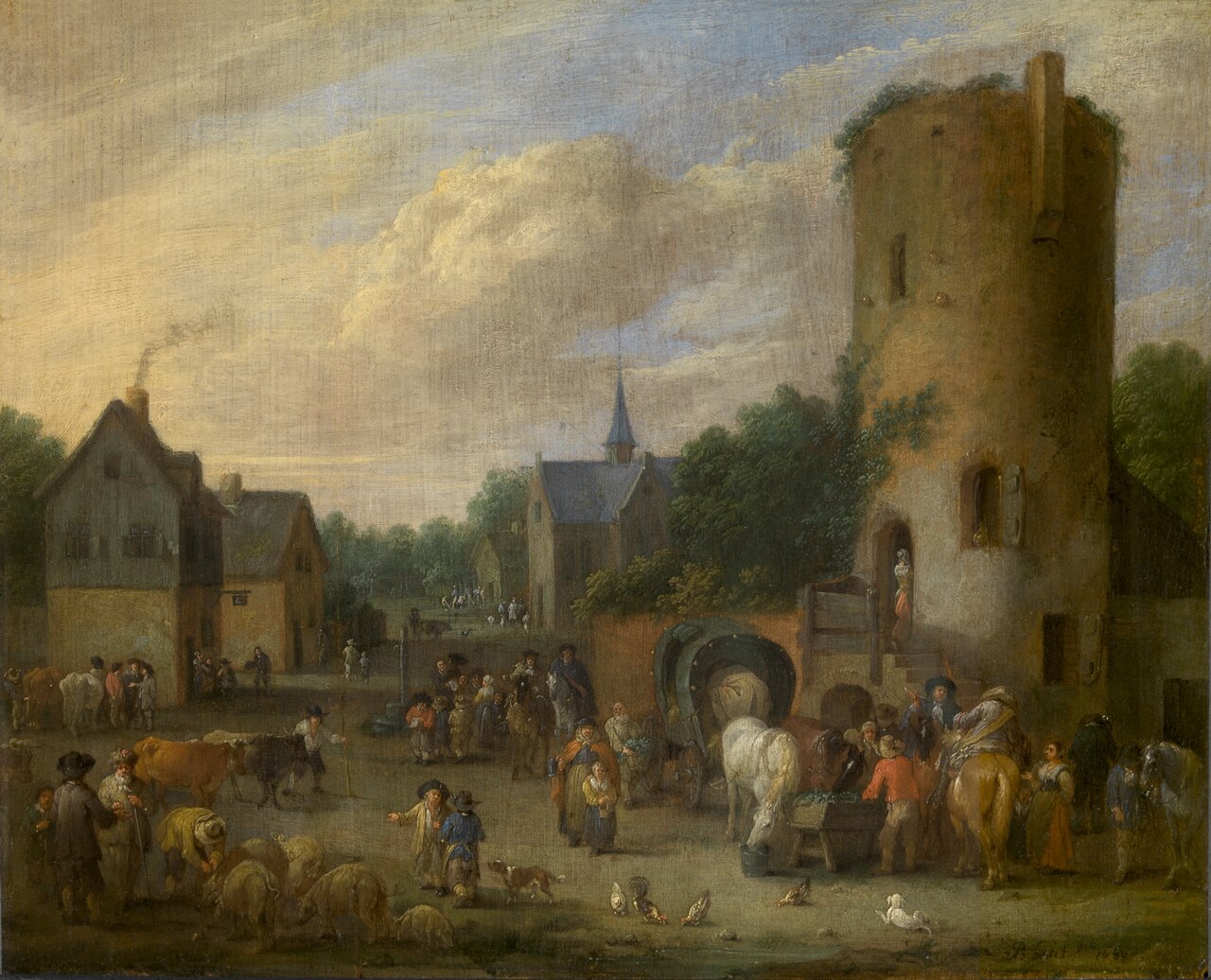
Early life Pieter Bout was born in Brussels in 1658, at a time when the city was part of the Habsburg Netherlands. Little is known about his family background, but contemporary records indicate that he was trained locally, likely within the thriving artistic guild structures that dominated Flemish artistic life. Brussels, with its bustling market squares and proximity to the court of the Spanish Netherlands, offered a fertile environment for a young artist to absorb both the commercial and courtly demands for decorative and narrative art.
Career and style Bout established himself as a versatile painter and printmaker, working primarily in oil and drawing media. His oeuvre is characterised by a clear, luminous palette that anticipates the softer tonalities of the early 18th century, yet his compositional structures remain firmly rooted in the late‑Baroque Flemish tradition. He frequently employed a bird‑eye perspective, arranging figures and architectural elements in a harmonious, almost theatrical layout. This approach mirrors the work of Jan Brueghel the Elder, whose influence is evident in Bout’s meticulous attention to detail and in the gentle, almost pastoral atmosphere that pervades his scenes.
While the precise artistic movement to which Bout belonged is not recorded, his paintings exhibit a synthesis of genre scenes, landscape traditions, and architectural capriccio. He catered to the tastes of both domestic collectors and the emerging market for prints, producing a range of works that could serve as decorative panels, devotional images, or illustrations of everyday life. His ability to blend narrative content with a refined visual language made his work popular among patrons seeking both aesthetic pleasure and moral instruction.
Signature techniques Bout’s technique is distinguished by several recurring features:
* Soft, layered colour – He applied thin glazes of pastel hues, creating a luminous surface that softens edges and imbues his scenes with a calm ambience. * Fine linear drawing – Even in fully painted works, the underlying drawing remains evident, especially in the delicate rendering of foliage, textiles and architectural details. * Balanced composition – Bout often arranged the primary focal point off‑centre, using diagonal lines and winding pathways to guide the viewer’s eye through the picture. * Printmaking skill – As a printmaker, he produced engravings and etchings that replicated his painted compositions, allowing his images to reach a broader audience. The prints retain the same attention to line and tonal modulation as his paintings.
These techniques together convey a sense of serenity and order, reflecting the artist’s aim to present an idealised vision of the world rather than a starkly realistic one.
Major works Bout’s surviving corpus includes several dated pieces that illustrate the range of his subject matter:
* Village fête (1676) – This lively genre scene depicts a rural celebration with villagers gathered around a central pavilion. The composition showcases Bout’s skill in rendering festive costumes and the interplay of light across a bustling crowd. * The adoration of the shepherds (1693) – A devotional work that blends a biblical narrative with a richly detailed landscape. The shepherds are placed within a gently rolling countryside, their gestures illuminated by a soft, golden light that underscores the spiritual theme. * The way station (1694) – A depiction of a roadside inn where travelers pause, this painting emphasizes architectural elements such as arched doorways and tiled roofs, rendered with the same meticulous line work that characterises Bout’s cityscapes. * View of an Italian harbour (1669) – Although the title suggests an Italian setting, the work reflects the Flemish tradition of imaginary harbour scenes, with a tranquil sea, distant ships and a skyline that balances realism with a decorative idealisation. * Village Scene (1686) – Similar to the earlier fête, this work presents a quieter moment in a provincial town, focusing on everyday activities such as market trading and domestic chores. The subdued colour scheme and careful placement of figures reveal Bout’s concern for narrative clarity.
These works, while diverse in subject, share a common visual language: a calm, orderly arrangement, a clear yet soft palette, and a dedication to fine detail that invites close viewing.
Influence and legacy Pieter Bout occupies a modest yet significant place in Flemish art history. By extending the visual vocabulary of the 17th‑century masters into the early 18th century, he helped to smooth the transition between the high Baroque and the more restrained Rococo sensibilities that would dominate later in the century. His prints disseminated his style beyond Brussels, influencing a generation of artists who sought to blend narrative genre painting with landscape and architectural subjects.
Although he did not found a formal school, Bout’s works were collected by both private patrons and the emerging bourgeois class, ensuring that his aesthetic ideals persisted in domestic interiors throughout the Low Countries. Modern scholars view his oeuvre as a valuable window into the tastes and artistic practices of a period often overlooked between the great Baroque peaks. His paintings continue to be exhibited in European museums, where they are appreciated for their technical finesse and their ability to convey a serene, idealised vision of everyday life.
In summary, Pieter Bout’s contribution lies in his synthesis of Flemish tradition with a softer tonal approach, providing a bridge between two artistic eras and leaving a legacy of finely crafted, harmonious compositions that remain admired for their clarity and charm.
Frequently asked questions
Who was Pieter Bout?
Pieter Bout (1658–1719) was a Flemish painter, draughtsman and printmaker from Brussels, known for his landscapes, cityscapes and genre scenes.
What style or movement is his work associated with?
His work reflects the late‑Baroque Flemish tradition, echoing Jan Brueghel the Elder, while employing a softer palette that anticipates early‑18th‑century tastes.
What are his most famous works?
Key works include Village fête (1676), The adoration of the shepherds (1693), The way station (1694), View of an Italian harbour (1669) and Village Scene (1686).
Why does Pieter Bout matter in art history?
Bout bridges the high Baroque and the emerging Rococo, spreading a refined, harmonious visual language through both paintings and prints that influenced later Flemish artists.
How can I recognise a Pieter Bout painting?
Look for a clear, soft colour palette, meticulous line work, balanced compositions with off‑centre focal points, and a tranquil, idealised depiction of everyday or biblical scenes.