Pierre Tetar van Elven
1828 – 1908
In short
Pierre Tetar van Elven (1828–1908) was a Dutch painter, draftsman, etcher and watercolorist known for architectural and landscape subjects, especially Italian cityscapes, as well as genre scenes for French high society. He worked across Europe, ending his career in Milan, and left a modest but respected body of work including notable paintings such as "Costumed Ball at Baron Lycklama's" (1874).
Notable works



Early life Pierre Henricus Theodorus Tetar van Elven was born in 1828 in the Brussels suburb of Molenbeek‑Saint‑Jean, then part of the United Kingdom of the Netherlands. Little is recorded about his family background, but it is clear that he received a solid artistic education typical of the mid‑nineteenth‑century Dutch tradition. He would have been exposed to the thriving artistic milieu of Brussels and nearby Antwerp, where the Academy emphasized drawing from life, mastery of perspective, and the study of classical architecture. These formative experiences shaped his lifelong interest in architectural subjects and careful rendering of interior spaces.
Career and style After completing his training, Tetar van Elven established himself as a versatile artist, working in oil, watercolor, etching and large‑scale panorama formats. The mid‑nineteenth century saw a surge of interest in veduta painting—detailed cityscapes that catered to the travel‑loving bourgeoisie. Tetar van Elven capitalised on this trend, producing a series of Italian city views that combined topographical accuracy with a lyrical Romantic sensibility. His style can be described as a synthesis of Dutch realism—characterised by precise observation and restrained colour—and the decorative elegance favoured by French high society patrons.
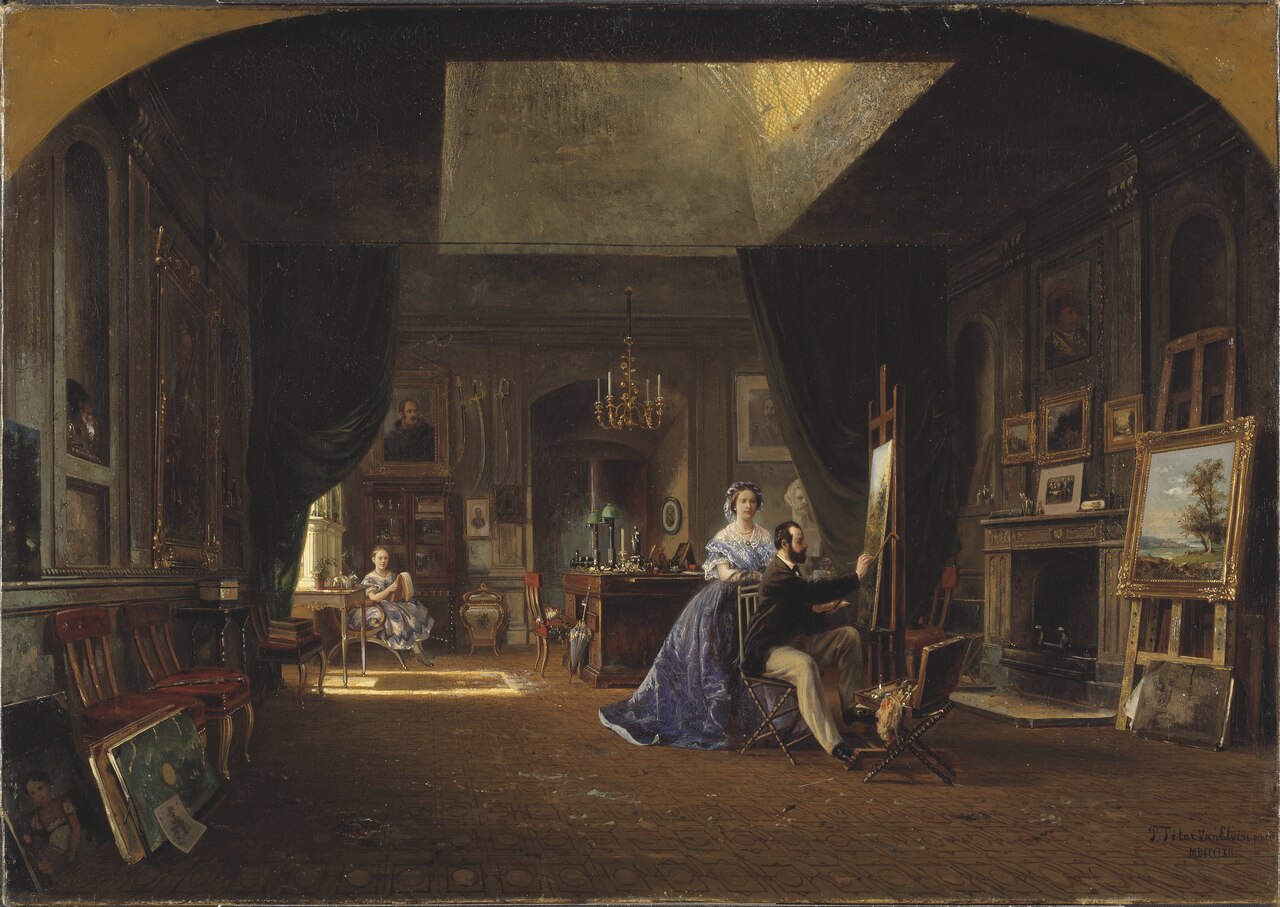
His career took him to several cultural centres. By the early 1850s he was active in the Netherlands, producing works such as "Interieur van het Tsaar Peterhuisje te Zaandam" (1851), a meticulous interior view that demonstrates his skill in rendering light and texture. In the 1860s he began to receive commissions from abroad, notably a portrait‑group of Karl XV of Sweden and Norway in his studio (1862), which reflects his ability to blend portraiture with narrative detail. The 1870s saw him working in France, where he painted genre scenes for aristocratic clients, including the flamboyant "Costumed Ball at Baron Lycklama's" (1874). By the late nineteenth century he had settled in Italy, eventually dying in Milan in 1908. Throughout his peripatetic career, he maintained a consistent focus on architectural ambience, whether depicting Dutch interiors, Scandinavian courts, or Mediterranean harbours.
Signature techniques Tetar van Elven’s technical repertoire was distinguished by several recurring approaches:
* Linear precision – His background in academic drawing gave his works a clear, exacting line, especially evident in the rendering of columns, arches and other structural elements. * Atmospheric watercolor washes – In his watercolors he employed layered washes to convey the subtle shifts of light that define interior and exterior spaces. This technique allowed him to suggest depth without heavy brushwork. * Etching for architectural detail – His etchings often served as studies for larger oil or watercolor pieces, capturing the intricate ornamentation of façades and interiors with fine line work. * Panoramic composition – When creating panoramas, he employed a wide, almost cinematic perspective, integrating multiple vanishing points to create immersive scenes that guided the viewer’s eye across the composition.
These techniques combined to give his works a sense of both documentary accuracy and artistic elegance.
Major works
1. Costumed Ball at Baron Lycklama's (1874) – This large oil painting captures a lavish masquerade hosted by the Dutch aristocrat Baron Lycklama. Tetar van Elven renders the opulent décor, sparkling chandeliers and richly dressed guests with meticulous attention to texture. The composition balances a bustling crowd with the architectural grandeur of the ballroom, illustrating his ability to merge genre narrative with structural setting.
2. Karl XV of Sweden and Norway in his studio, 3 people (1862) – Commissioned by the Swedish court, this work depicts the young king alongside two attendants within a studio environment. The painting showcases Tetar van Elven’s skill in portraiture while retaining his characteristic focus on the surrounding space. The subtle play of daylight through the studio windows highlights his command of light effects.
3. Interieur van het Tsaar Peterhuisje te Zaandam (1851) – A detailed interior view of the historic Peterhuisje, a modest wooden house associated with Peter the Great’s early years in the Netherlands. The work demonstrates Tetar van Elven’s interest in historic architecture, capturing the modest timber framing and the soft glow of interior lighting.
4. View of a Harbor (1850) – This early landscape presents a tranquil harbour scene, likely inspired by his travels along the Dutch coast. The composition emphasizes the calm water surface, low‑lying sky and the orderly arrangement of ships and warehouses, reflecting his balanced approach to landscape and architectural elements.
These pieces collectively illustrate the breadth of Tetar van Elven’s oeuvre, ranging from intimate interiors to grand public gatherings, and from portraiture to topographical studies.
Influence and legacy Although Pierre Tetar van Elven never achieved the fame of contemporaries such as Johan Barthold Jongkind or Jean‑Louis Ernest Meissonier, his work occupies a niche within nineteenth‑century European art. His careful synthesis of Dutch realism with the decorative demands of French patrons anticipates later transnational artistic exchanges that characterised the Belle Époque. Moreover, his veduta‑style cityscapes contributed to the visual documentation of Italian urban environments before the advent of photography, providing valuable reference material for historians.
In the Netherlands, his paintings are held in several regional museums, where they are appreciated for their technical proficiency and historical relevance. In Italy, his later years in Milan placed him among a community of expatriate artists who exchanged ideas across national borders, enriching the cultural tapestry of the city. While his name is not widely known in popular art history, scholars of Dutch Romanticism and 19th‑century panorama painting cite him as a representative figure whose work bridges national traditions and the emerging cosmopolitan market for visual culture.
Overall, Tetar van Elven’s legacy endures through the preserved canvases that reveal a steadfast dedication to architectural accuracy, an elegant handling of light, and a versatile adaptability to the varied tastes of a pan‑European clientele.
Frequently asked questions
Who was Pierre Tetar van Elven?
Pierre Tetar van Elven (1828–1908) was a Dutch painter, draftsman, etcher and watercolorist noted for his architectural interiors, landscapes, and Italian cityscapes.
What artistic style or movement is he associated with?
He is not linked to a single movement; his work blends Dutch realist precision with the decorative elegance favoured by French high society and the veduta tradition of Italian cityscape painting.
What are his most famous works?
Key works include "Costumed Ball at Baron Lycklama's" (1874), "Karl XV of Sweden and Norway in his studio, 3 people" (1862), "Interieur van het Tsaar Peterhuisje te Zaandam" (1851) and "View of a Harbor" (1850).
Why is he important in art history?
He provides a valuable visual record of nineteenth‑century architecture and urban scenes, and his cross‑national commissions illustrate the growing European art market of his time.
How can I recognise a Tetar van Elven painting?
Look for meticulous linear drawing, careful rendering of architectural detail, subtle atmospheric light, and a balanced composition that often juxtaposes human activity with a well‑defined built environment.