Philips Wouwerman
1619 – 1668
In short
Philips Wouwerman (1619–1668) was a Dutch Golden Age painter from Haarlem, celebrated for his dynamic hunting, landscape, and battle scenes, especially those featuring cavalry. He was a prolific member of the Haarlem Guild of St. Luke and left a legacy of vivid, narrative-driven works.
Notable works

_01.jpg)


Early life Philips Wouwerman was born in 1619 in Haarlem, a thriving artistic centre of the Dutch Republic. Little is known about his family background, but the city’s vibrant guild system provided a structured path for aspiring painters. Haarlem’s Guild of St. Luke, which regulated artistic production and training, would later play a pivotal role in Wouwerman’s professional life. Growing up amid the flourishing Dutch Golden Age, he was exposed to a market eager for both domestic interiors and expansive outdoor scenes, setting the stage for his later specialisation.
Career and style Wouwerman began his independent career in the early 1640s, quickly establishing a reputation for equestrian subjects. He produced a prodigious output of canvases that combined meticulous observation with imaginative storytelling. His work reflects the broader Dutch preference for realism, yet he infused his scenes with a theatrical quality that distinguished him from contemporaries focused solely on topographical accuracy.
His paintings typically depict open countryside, winding roads, and atmospheric skies, populated by riders, hunters, and soldiers. Though the exact artistic movement he belonged to is not formally defined, his oeuvre aligns with the Dutch genre tradition of the mid‑17th century, where everyday activities—particularly those involving the aristocratic pastime of horse riding—were rendered with both technical skill and narrative depth. Wouwerman’s colour palette often features warm earth tones punctuated by the bright reds and blues of military uniforms, creating a visual contrast that draws the viewer’s eye to the central action.
Signature techniques Wouwerman’s technical hallmarks include:
* Dynamic composition – He frequently employs diagonal lines created by roads, fences, or the flight of horses to guide the viewer through the picture. * Atmospheric perspective – Distant elements are rendered with softer focus and cooler hues, enhancing depth and a sense of vast space. * Detailed rendering of horses – His knowledge of equine anatomy is evident in the precise musculature, varied postures, and the way light catches the sheen of a horse’s coat. * Narrative vignettes – Small groups of figures or animals are often placed in the foreground, providing a momentary glimpse of a larger story without overcrowding the canvas. * Use of light – He manipulates sunlight to illuminate key elements, such as a rider’s helmet or a burning mill, creating dramatic focal points.
These techniques, combined with a disciplined brushwork that balances fine detail with broader washes, gave his works a distinctive rhythm that collectors and fellow artists admired.
Major works Wouwerman’s most documented pieces illustrate the breadth of his subject matter:
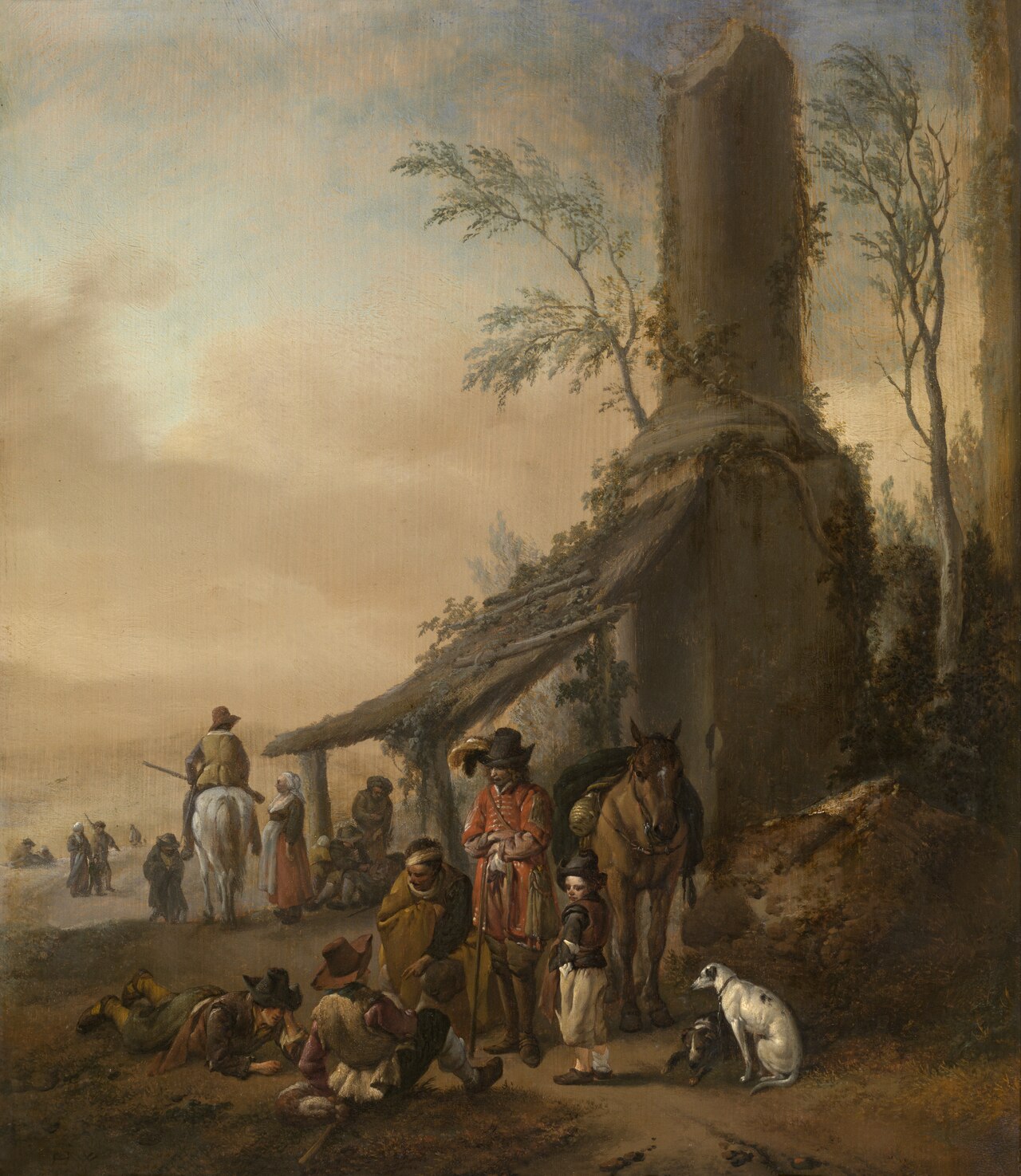
* The Grey Horse (1646) – This canvas captures a solitary grey horse standing on a marshy bank, its reflective coat contrasting with a muted, mist‑filled background. The work exemplifies his skill in rendering texture and light, while the subdued colour scheme conveys a quiet, contemplative mood. * The Rider’s Halting Place – In this scene, a rider pauses beside a rustic inn, with a dog at his feet and a laden carriage in the distance. The composition balances human activity with the surrounding landscape, showcasing Wouwerman’s talent for integrating narrative detail into a broader setting. * A Cavalry Battle Scene between Polish Hussars and Ottoman forces (1650) – This large‑scale battle tableau features heavily armoured Polish hussars charging against Ottoman troops. The painting is notable for its vivid depiction of military dress, the chaotic movement of horses, and the smoky atmosphere that hints at the ferocity of conflict. * Cavalry in front of a Burning mill (1660) – Here, a group of mounted soldiers is shown silhouetted against a burning mill, the flames casting dramatic light across the scene. The work demonstrates Wouwerman’s capacity to incorporate dramatic natural phenomena—fire, smoke, and light—into a coherent narrative. * A Coastal Scene (1650) – Diverging from his typical inland subjects, this piece portrays a windswept shoreline with fishing boats and distant dunes. The painting highlights his versatility, as he adapts his compositional techniques to maritime subjects while retaining his characteristic treatment of light and atmosphere.
These works, together with a vast catalogue of similar paintings, solidified Wouwerman’s reputation as a master of equestrian and battle imagery.
Influence and legacy Philips Wouwerman’s productivity—estimated at several hundred paintings—made him one of the most sought‑after artists of his time. His works were widely reproduced in prints, allowing his stylistic devices to permeate the broader Dutch market. Later painters, such as Jan Griffier and the members of the so‑called “Wouwerman school,” emulated his equestrian motifs and compositional structures.
His influence extended beyond the Netherlands; collectors in England and the German states acquired his canvases, and his approach to narrative landscape contributed to the evolution of genre painting across Europe. Although he was not formally aligned with a specific artistic movement, his synthesis of realism, drama, and technical precision helped shape the visual language of 17th‑century Dutch painting.
Philips Wouwerman died in his native Haarlem in 1668. Today, his paintings are held in major museums—including the Rijksmuseum, the Louvre, and the Metropolitan Museum of Art—and continue to be studied for their contribution to the visual culture of the Dutch Golden Age. His legacy endures in the way he elevated the humble subjects of hunting and travel into compelling, story‑driven compositions that still captivate viewers centuries later.
Frequently asked questions
Who was Philips Wouwerman?
Philips Wouwerman (1619–1668) was a Dutch Golden Age painter from Haarlem, best known for his lively hunting, landscape, and battle scenes, especially those featuring cavalry.
What artistic style or movement is he associated with?
While not tied to a formal movement, his work aligns with the Dutch genre tradition of the mid‑17th century, combining realistic detail with narrative drama.
What are his most famous works?
Key paintings include The Grey Horse (1646), The Rider’s Halting Place, A Cavalry Battle Scene between Polish Hussars and Ottoman forces (1650), Cavalry in front of a Burning mill (1660), and A Coastal Scene (1650).
Why does Philips Wouwerman matter in art history?
He was one of the most prolific Dutch painters of his era, influencing later artists with his dynamic compositions, detailed equestrian depictions, and integration of narrative into landscape.
How can I recognise a Philips Wouwerman painting?
Look for expertly rendered horses, diagonal road or fence lines, warm earth tones contrasted with bright military colours, and a clear focal point highlighted by dramatic light or fire.