Philip Gilbert Hamerton
1834 – 1894
In short
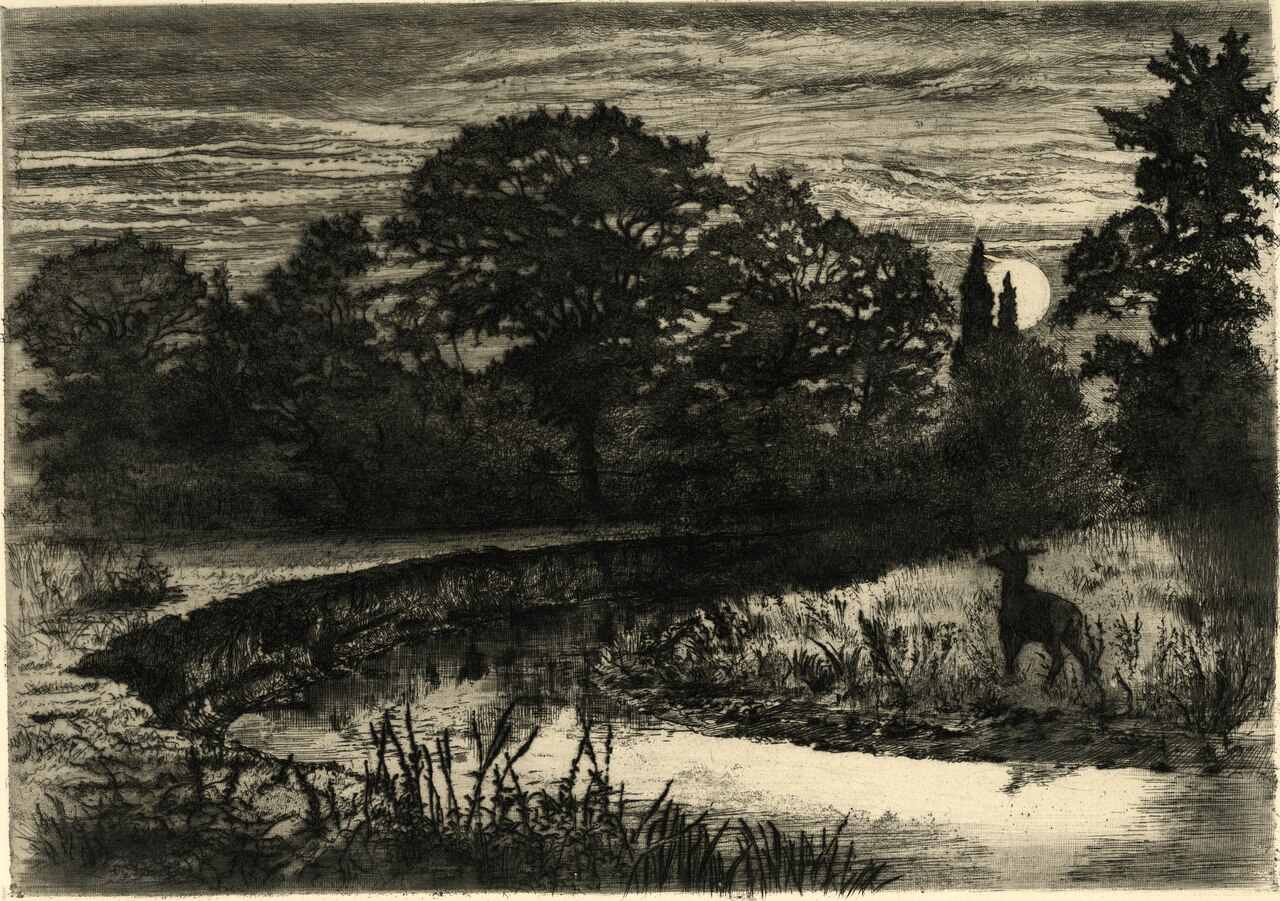
Philip Gilbert Hamerton (1834–1894) was an English painter, writer and critic who championed the medium of etching and helped shape the British Etching Revival. He is remembered for his landscape paintings such as Moonrise on the Ternin and for influential books on graphic art.
Notable works


_-_The_River_Yonne_-_BURGM-paoil10_-_Towneley_Hall_Art_Gallery_And_Museum.jpg)
_-_Sens_from_the_Vineyards_-_BURGM-paoil11_-_Towneley_Hall_Art_Gallery_And_Museum.jpg)
Early life Philip Gilbert Hamerton was born in 1834 in the industrial town of Shaw and Crompton, situated in the historic county of Lancashire. His family was comfortably middle‑class, which allowed him to receive a solid education and develop an early appreciation for the visual arts. As a boy he spent time sketching the surrounding countryside, an experience that fostered a lifelong fascination with natural light and atmospheric effects. By his teenage years Hamerton had already begun to experiment with drawing and watercolor, skills that would later underpin his mature landscape practice.
In the early 1850s Hamerton moved to London to pursue artistic training. While the precise institutions he attended are not recorded, the capital’s vibrant art scene exposed him to the work of leading painters and printmakers. The city also provided opportunities to meet fellow artists who shared his interest in the revival of etching, a medium that had fallen out of favour after the early nineteenth century.
Career and style Hamerton’s professional career unfolded on two parallel tracks: that of a practising painter and that of a prolific writer on art. As a painter he specialised in atmospheric landscapes, often depicting river valleys, vineyards and rural villages under varied sky conditions. His style combined a keen observation of natural light with a restrained palette, producing works that balance realism with a subtle poetic tone. The influence of the French Barbizon school is evident in his treatment of foliage and earth, yet his compositions retain a distinctly British sensibility.
Beyond the canvas, Hamerton became a leading voice in the promotion of contemporary printmaking. In the 1860s he began publishing articles and essays that argued for the artistic merit of etching, positioning it as a medium capable of fine tonal variation and expressive line work. His critical writings were collected in a series of influential books that addressed both technical aspects of printmaking and its broader cultural significance. Through these publications he helped to galvanise the English Etching Revival, encouraging younger artists to explore the medium with renewed enthusiasm.
Signature techniques Hamerton’s paintings are marked by several recurring technical approaches. First, he employed a muted colour scheme dominated by earth tones, allowing the subtle shifts of light to become the primary visual driver. Second, his brushwork is often soft and blended, especially in the rendering of sky and water, which creates an impression of depth without relying on sharp outlines. Third, he favoured compositional devices such as winding river lines and gently sloping hills to guide the viewer’s eye through the picture plane.
In his print work, Hamerton favoured a fine, controlled line that could suggest texture without heavy cross‑hatching. He also experimented with aquatint to achieve delicate tonal washes, a technique that complemented his landscape subjects by reproducing the translucency of mist and water. His writings reveal an ongoing concern with the balance between line and tone, a principle that underpins much of his artistic output.
Major works Hamerton’s oeuvre includes several notable oil paintings that exemplify his landscape focus. *Moonrise on the Ternin* (1871) captures the fleeting glow of a setting moon reflected on the river’s surface, with a composition that emphasizes the quiet stillness of the scene. *Smith’s Yard at Etang* (1876) presents a rustic courtyard surrounded by trees, rendered with a muted palette that highlights the play of shadow and light across stone and foliage. *Val Sainte Veronique and Ancient Chestnuts* (1874) juxtaposes a tranquil valley with the gnarled trunks of old chestnut trees, showcasing Hamerton’s skill at conveying atmosphere through subtle colour shifts.
Two earlier works, *The River Yonne* (1863) and *Sens from the Vineyards* (1863), illustrate his fascination with French river landscapes and the cultivated countryside. Both paintings reveal a careful observation of water movement and the reflective qualities of sunlight on foliage, hallmarks of his mature style. Though the exact provenance of each piece varies, together they demonstrate Hamerton’s consistent engagement with natural scenery and his ability to translate fleeting moments into enduring visual records.
Influence and legacy Philip Gilbert Hamerton’s dual legacy as an artist and an advocate for printmaking left a lasting imprint on British art. His critical writings helped to legitimise etching as a fine art form, encouraging institutions and collectors to recognise prints as worthy of scholarly attention. By articulating a clear theoretical framework for the medium, he provided younger artists with both technical guidance and philosophical justification for their experiments.
As a painter, Hamerton contributed to the development of a distinctly British landscape tradition that blended continental influences with an appreciation for the subtle moods of the English countryside. His works continue to be exhibited in regional galleries and referenced in studies of nineteenth‑century landscape painting. Moreover, his emphasis on atmospheric effect and tonal harmony anticipated later developments in impressionism and the early modernist preoccupation with perception.
In contemporary scholarship, Hamerton is cited as a pivotal figure in the narrative of the Etching Revival, a movement that reshaped the relationship between artists, printers and the public. His books remain valuable primary sources for researchers examining Victorian attitudes toward graphic art. Overall, Hamerton’s career exemplifies the productive interplay between creation and criticism, illustrating how an artist can shape both visual practice and its critical discourse.
Frequently asked questions
Who was Philip Gilbert Hamerton?
Philip Gilbert Hamerton (1834–1894) was an English painter, art critic and author best known for his atmospheric landscapes and his advocacy of etching.
What artistic style or movement is he associated with?
He is linked to the British Etching Revival and his paintings reflect a naturalistic, tonal landscape style influenced by the French Barbizon school.
What are his most famous works?
Key works include *Moonrise on the Ternin* (1871), *Smith’s Yard at Etang* (1876), *Val Sainte Veronique and Ancient Chestnuts* (1874), *The River Yonne* (1863) and *Sens from the Vineyards* (1863).
Why does Hamerton matter in art history?
He helped legitimize etching as a fine‑art medium, wrote influential texts on graphic art, and contributed a distinctive tonal approach to British landscape painting.
How can I recognise a Hamerton painting?
Look for muted earth tones, soft blended brushwork, careful rendering of light on water, and compositions that often feature rivers, vineyards or quiet rural settings.