Peeter van Bredael
1629 – 1719
In short
Peeter van Bredael (1629–1719) was a Flemish painter from Antwerp who specialised in lively market and village scenes set in Italianate or contemporary urban landscapes. His works are noted for their detailed depictions of everyday commerce and vibrant colour, and they remain important examples of 17th‑century genre painting in the Habsburg Netherlands.
Notable works


_-_Market_Scene_Set_amidst_a_Capriccio_of_Ruins_-_719453_-_National_Trust.jpg)
Early life Peeter van Bredael was born in 1629 in Antwerp, a thriving artistic centre of the Habsburg Netherlands. He grew up in a family with strong ties to the visual arts; several members of the van Bredael lineage were active painters, which provided a natural environment for his early artistic development. Antwerp’s Guild of Saint Luke, the city’s principal painters’ guild, played a pivotal role in his training, exposing him to the techniques of established masters and the commercial realities of the art market.
Career and style By the mid‑1650s van Bredael had begun to establish himself as a professional painter, focusing on genre scenes that combined the bustling energy of market life with the picturesque qualities of Italianate landscapes. His work reflects a synthesis of Flemish realism and the idealised, sun‑drenched atmosphere favoured by Italian painters who were popular among northern collectors. While he did not align himself with a formal movement, his paintings belong to the broader tradition of 17th‑century Flemish genre painting, which prized meticulous detail, narrative depth, and a warm, accessible palette.
The subjects of his canvases—market stalls, village feasts, and processional gatherings—offer a window into the daily commerce and social rituals of his time. Van Bredael often placed these scenes against a backdrop of rolling hills, classical ruins, or the canals of Antwerp, creating a dialogue between the familiar and the exotic. This duality appealed to both local patrons, who recognised their own streets and markets, and to foreign buyers, who were attracted by the romanticised vision of Southern Europe.
Signature techniques Van Bredael’s paintings are distinguished by several recurring technical choices. He employed a bright, often golden, colour palette that heightened the sunlit quality of his outdoor settings. Careful modulation of light allowed him to model figures and architectural elements with a subtle chiaroscuro, lending depth without sacrificing the overall clarity of the composition.
His handling of texture is particularly noteworthy: the gleam of copper pots, the weave of market awnings, and the rough stone of ruined arches are rendered with precise, yet economical brushwork. This economy of detail enables the viewer’s eye to wander across the canvas, discovering new narrative pockets—such as a child stealing a fruit or a merchant haggling over price—while maintaining a cohesive visual rhythm.
Atmospheric perspective is another hallmark. Van Bredael often placed the horizon line low, allowing distant elements to recede into a muted blue‑grey, thereby accentuating the foreground’s activity. This technique not only creates a convincing sense of space but also reinforces the lively immediacy of the market scene.
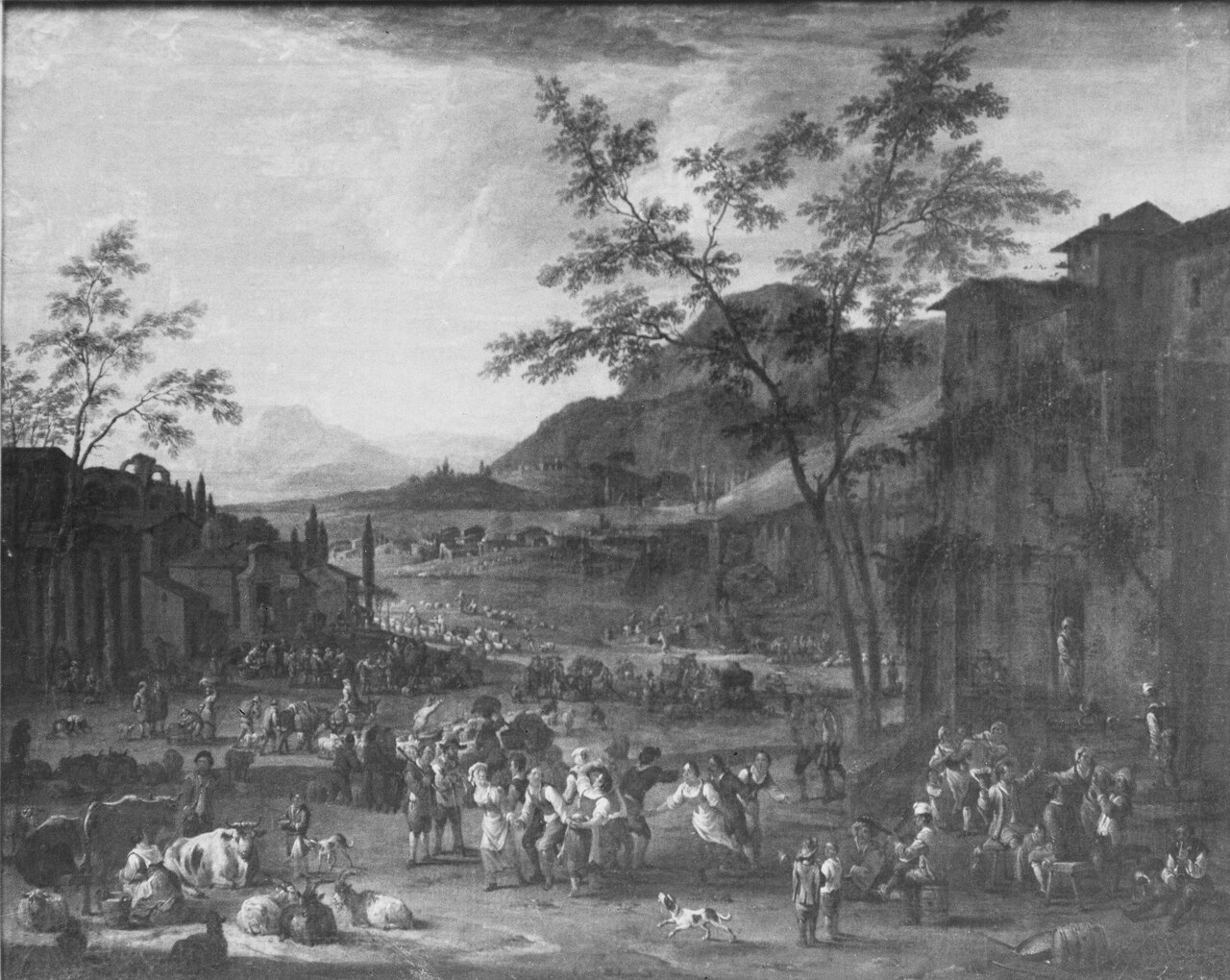
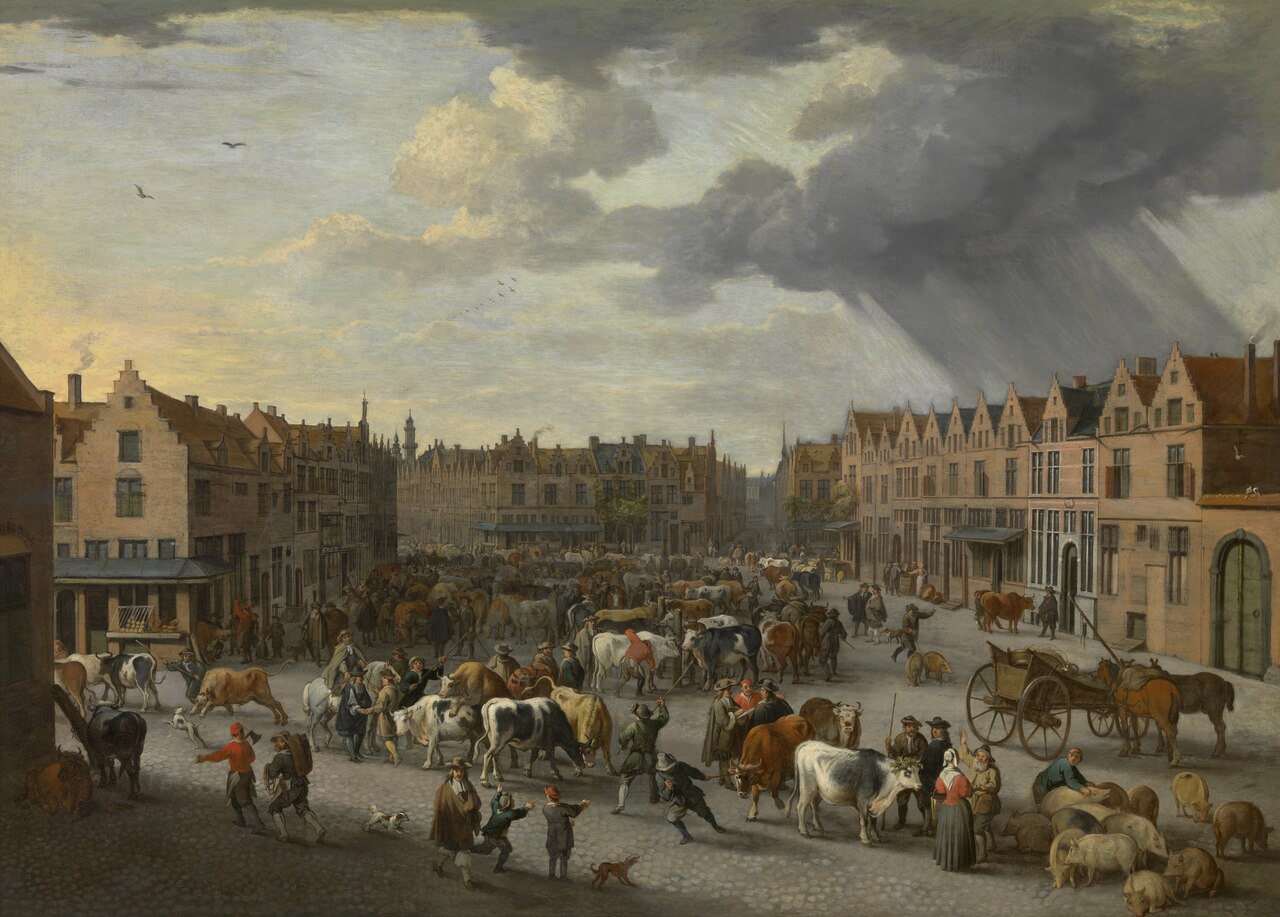
Major works - **Italian Market** – This composition presents a bustling stall scene set beneath a Mediterranean sky. Figures in contemporary Flemish dress mingle with merchants in more exotic attire, illustrating van Bredael’s blend of local and foreign motifs. The market’s colourful produce and the play of light across the tiled ground exemplify his mastery of colour and texture. - **The old cattle market in Antwerp (1681)** – One of his later works, it captures the historic cattle market that once dominated Antwerp’s economic life. Van Bredael places the massive herds against the recognizable city skyline, anchoring the painting in a specific urban context while retaining the genre’s characteristic vibrancy. - **Italianate Landscape with a Market Scene (1680)** – Here the artist foregrounds a tranquil countryside dotted with a modest market. Classical ruins loom in the background, creating a capriccio that merges pastoral serenity with commercial activity. The work demonstrates his skill in integrating narrative and landscape. - **A Lady with Her Retinue beside a River** – Diverging slightly from the overt market theme, this painting portrays an aristocratic group traveling along a riverbank, underscoring van Bredael’s ability to depict refined social occasions alongside everyday commerce. The delicate rendering of the lady’s garments and the reflective water surface highlight his attention to surface effects. - **Market Scene set amidst a Capriccio of Ruins (1664)** – One of his earlier dated pieces, it features a lively market framed by imagined ruins, a common Flemish device that evoked the allure of antiquity. The juxtaposition of bustling trade with the decay of ancient architecture creates a narrative tension that was popular among collectors of the period.
Each of these works exemplifies van Bredael’s consistent thematic focus while showcasing subtle evolutions in composition, lighting, and narrative complexity over his long career.
Influence and legacy Peeter van Bredael’s oeuvre contributed significantly to the visual vocabulary of Flemish genre painting. By marrying the quotidian with the idealised, he helped sustain the market for scenes that were both relatable and aspirational. His paintings were widely disseminated through prints and copies, influencing younger artists who emulated his compositional balance and colouristic vigor.
Although he never achieved the fame of contemporaries such as David Teniers the Younger, van Bredael’s works remain valuable to scholars for their documentation of 17th‑century mercantile life and for their embodiment of the cross‑cultural tastes that characterised the Habsburg Netherlands. Today, his canvases are held in major European museums and continue to be referenced in studies of the period’s genre painting, affirming his lasting place in art‑historical discourse.
Frequently asked questions
Who was Peeter van Bredael?
Peeter van Bredael (1629–1719) was a Flemish painter from Antwerp known for lively market and village scenes set in Italianate or contemporary urban landscapes.
What artistic style or movement is he associated with?
He worked within the Flemish genre painting tradition, blending realistic detail with the idealised, sun‑lit atmosphere of Italianate landscapes, but he did not belong to a formal movement.
What are his most famous works?
Key works include *Italian Market*, *The old cattle market in Antwerp* (1681), *Italianate Landscape with a Market Scene* (1680), *A Lady with Her Retinue beside a River*, and *Market Scene set amidst a Capriccio of Ruins* (1664).
Why is Peeter van Bredael important in art history?
He documented everyday commercial life in the 17th‑century Netherlands, pioneered a blend of local and Italianate motifs, and influenced later Flemish genre painters through his vibrant colour and detailed compositions.
How can I recognise a van Bredael painting?
Look for bustling market scenes with bright, sun‑lit colours, detailed textures of goods and architecture, and a background that often includes Italianate ruins or the recognizable Antwerp cityscape.