Peeter Allik
1966 – 2019
In short
Peeter Allik (1966–2019) was an Estonian surrealist painter known for his provocative, dream‑like canvases that blend everyday Soviet‑era motifs with uncanny symbolism. His work, including pieces such as Women are Running (2003) and St Martin's Day (1989), remains influential in post‑Soviet Baltic art circles.
Notable works



Early life Peeter Allik was born in 1966 in the small town of Põltsamaa, then part of the Estonian Soviet Socialist Republic. Growing up under Soviet rule, he experienced a cultural environment where official art was dominated by socialist realism, while underground movements—particularly those influenced by Western modernism—found expression in private studios and informal gatherings. Allik’s early exposure to folklore, the stark Estonian landscape, and the visual vocabulary of state propaganda would later inform his surrealist practice. He attended local schools before enrolling at the Estonian Academy of Arts in Tallinn, where he studied painting during the late 1980s, a period marked by increasing political liberalisation and the rise of the Singing Revolution.
Career and style Allik emerged as a painter in the waning years of the Soviet Union, aligning himself with the broader European surrealist tradition while adapting its language to a Baltic context. His work is characterised by a juxtaposition of ordinary objects—often domestic or bureaucratic—with disquieting, fantastical elements. This duality reflects the tension between the publicly sanctioned reality of the Soviet state and the private, often irrational, interior lives of its citizens. Throughout the 1990s, after Estonia regained independence, Allik continued to explore these themes, employing a muted colour palette punctuated by vivid accents that heighten the uncanny atmosphere of his canvases.
While not formally attached to a specific post‑Soviet movement, Allik’s practice resonates with the neo‑surrealist tendencies that emerged across Eastern Europe in the 1990s. He incorporated symbolic motifs drawn from Estonian folklore, such as mythic animals and ritualistic scenes, but filtered them through a modern, often satirical lens. His paintings frequently address the legacy of surveillance, censorship, and the collective memory of state secrecy, positioning him as a critical voice in the cultural reckoning that followed the collapse of the Soviet system.
Signature techniques Allik’s technical approach combines traditional oil painting with layered glazing to achieve depth and a slightly luminous surface. He often began with a precise, realist underdrawing before allowing the composition to dissolve into more fluid, dream‑like forms. This method creates a tension between clarity and ambiguity, inviting viewers to negotiate the boundary between the familiar and the surreal. His brushwork varies from tight, controlled strokes in the depiction of objects—such as uniforms, documents, or household items—to looser, gestural marks that suggest movement or emotional turbulence. The artist also employed collage‑like assemblage within the painted surface, integrating photographic fragments or printed text to reference state documentation, thereby reinforcing the thematic concerns of secrecy and control.
Major works - **Women are Running (2003)** – This large‑scale canvas presents a group of women in motion, their bodies elongated and overlapping. The figures appear to be fleeing an unseen threat, their hurried strides rendered in muted tones against a stark, industrial background. Subtle details—a torn flag, a discarded badge—hint at the lingering presence of Soviet authority, while the overall composition evokes a sense of collective anxiety and resilience.
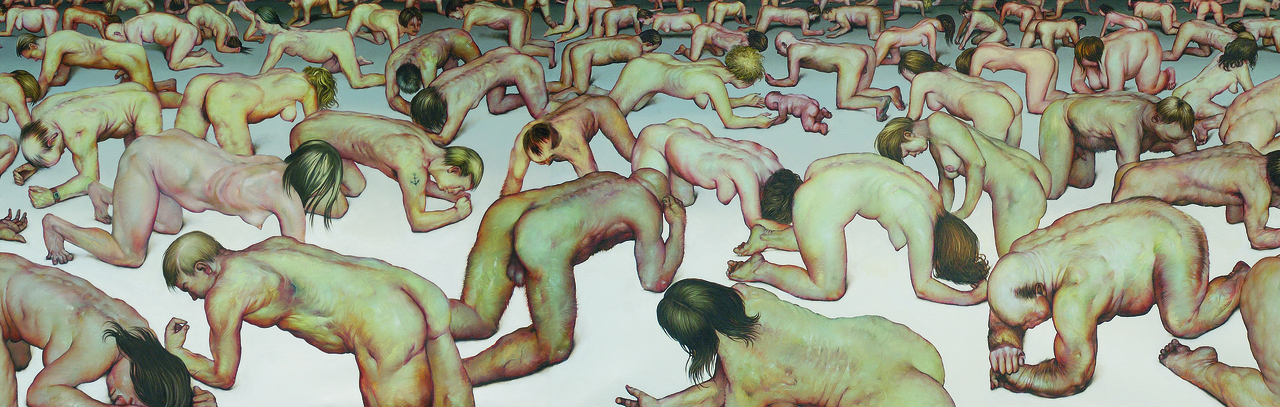
- I saw that. State secret – to capture the people (2003) – In this politically charged work, Allik juxtaposes a bureaucratic filing cabinet with fragmented human silhouettes. The title, taken from a censored report, underscores the artist’s preoccupation with surveillance. The painting’s muted palette and the stark contrast between the cold metal of the cabinet and the warm flesh tones of the figures emphasize the dehumanising impact of state control.
- St Martin's Day (1989) – Created just before Estonia’s independence, this piece reflects the artist’s engagement with traditional folk celebrations. The canvas depicts a rural procession illuminated by lanterns, yet the figures’ faces are obscured, and the scene is interspersed with surreal elements—floating objects and distorted perspectives—that suggest an underlying tension between cultural continuity and impending political change.
- Lusty girl I (1990) – This provocative portrait merges eroticism with surreal distortion. The subject’s exaggerated features and the background’s abstracted architectural forms create a disorienting effect, challenging conventional representations of femininity. The work’s bold colour choices and ambiguous symbolism exemplify Allik’s willingness to confront taboos within a rapidly transforming society.
Influence and legacy Peeter Allik’s oeuvre occupies a distinctive niche in Estonian and broader Baltic art history. By integrating surrealist aesthetics with an acute awareness of the Soviet experience, he contributed to a visual language that helped articulate the complexities of post‑Soviet identity. His paintings are frequently exhibited in Estonian museums and have been included in regional surveys of contemporary surrealism. Scholars cite Allik as an exemplar of artists who navigated the transition from state‑controlled art production to the freer, market‑driven environment of the 1990s, preserving a critical perspective on the past while embracing new expressive possibilities.
In the years following his death in 2019, Allik’s work has experienced renewed interest, particularly among younger artists exploring themes of memory, surveillance, and the uncanny. His signature blend of meticulous realism and dream‑like disruption continues to inform contemporary practices that interrogate the lingering effects of authoritarian regimes. As such, Allik remains a pivotal figure for understanding how surrealist strategies can be employed to critique, remember, and re‑imagine socio‑political realities in post‑Soviet Estonia.
Frequently asked questions
Who was Peeter Allik?
Peeter Allik (1966–2019) was an Estonian painter known for his surrealist works that blend everyday Soviet‑era imagery with uncanny, symbolic elements.
What artistic style or movement is he associated with?
Allik is generally linked to surrealism, using its visual language to comment on the social and political climate of late‑Soviet and post‑Soviet Estonia.
What are his most famous works?
His most recognised paintings include Women are Running (2003), I saw that. State secret – to capture the people (2003), St Martin's Day (1989) and Lusty girl I (1990).
Why is Peeter Allik important in art history?
He provides a unique visual critique of Soviet authority through surrealist imagery, influencing later Baltic artists who explore memory, surveillance and identity.
How can I recognise a Peeter Allik painting?
Look for a precise realist underdrawing that dissolves into dream‑like forms, muted colour palettes with vivid accents, and recurring motifs of bureaucratic objects juxtaposed with distorted human figures.