Paul Vredeman de Vries
1567 – 1617
In short
Paul Vredeman de Vries (1567–1617) was a Flemish painter and draughtsman from the Habsburg Netherlands, celebrated for his meticulously rendered architectural scenes, particularly church interiors. Operating in Antwerp and later Amsterdam, he blended rigorous perspective with imaginative compositions, leaving a lasting impact on the tradition of architectural painting in the Low Countries.
Notable works

_-_Ballroom_Scene_at_a_Court_in_Brussels_-_244_-_Mauritshuis.jpg)

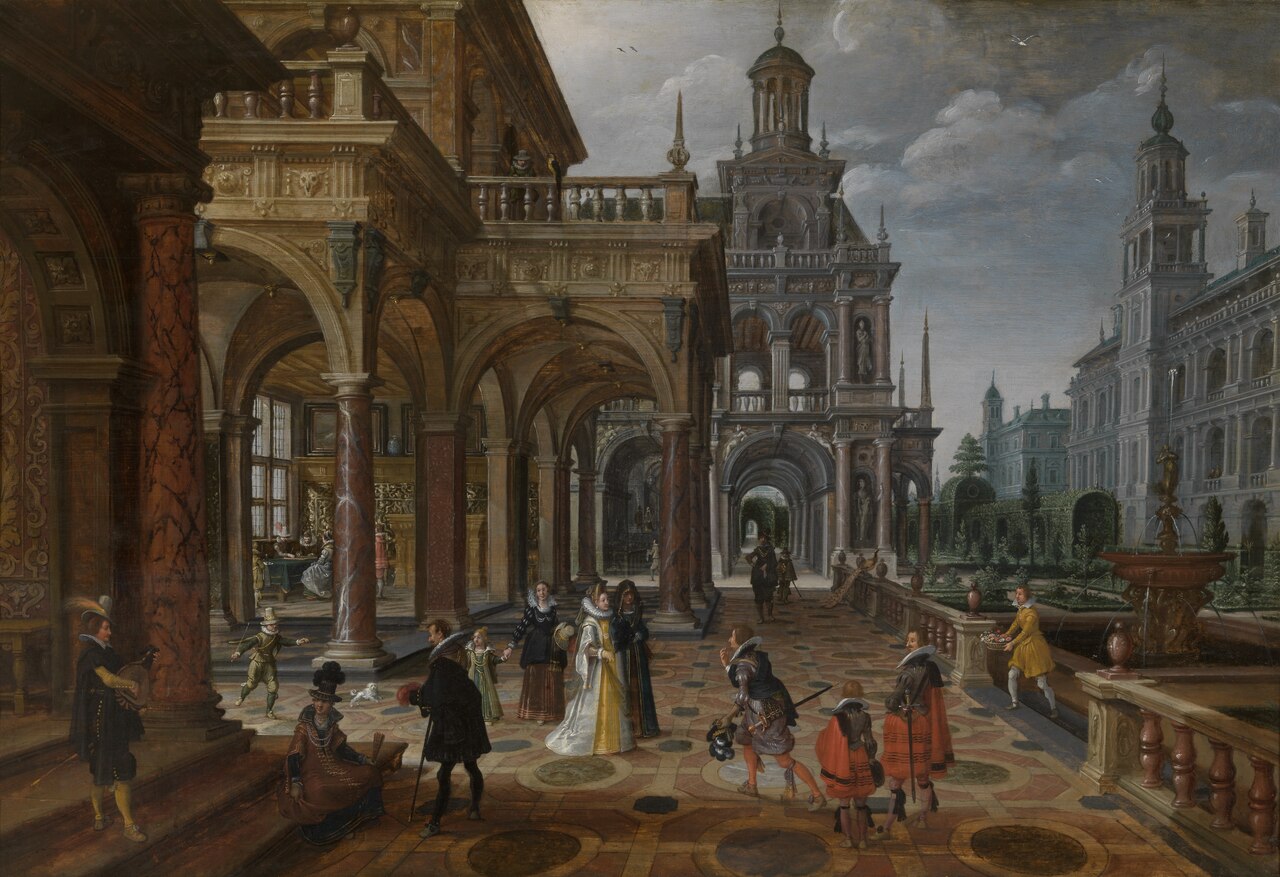

Early life Paul Vredeman de Vries was born in 1567 in Antwerp, a thriving centre of artistic activity in the Habsburg Netherlands. He was the son of the well‑known painter Hans Vredeman de Vries, who specialised in architectural subjects and ornamental design. Growing up in a workshop environment, Paul received early training in drawing and perspective, skills that would become the cornerstone of his own artistic practice. Little is recorded about his formal education, but the family’s connections to the court of the Spanish Netherlands and the vibrant guild system in Antwerp provided ample exposure to contemporary trends in painting and architectural theory.
Career and style By the late 1580s Paul had established himself as an independent artist, producing a series of architectural capricci that combined accurate linear perspective with fanciful, often idealised, settings. His work reflects the broader Flemish interest in architectural painting that emerged in the mid‑sixteenth century, yet his style is distinguished by a heightened attention to light and spatial depth. After marrying and securing a modest inheritance, Vredeman de Vries moved to Amsterdam around 1600, where he continued to work for a clientele that included merchants, civic officials and members of the emerging Dutch elite. Although he never aligned himself with a specific avant‑garde movement, his paintings embody the transitional aesthetics of the late Renaissance moving toward the early Baroque, characterised by clear structural order, restrained colour palettes and an emphasis on the harmonious relationship between built space and surrounding landscape.
Signature techniques Vredeman de Vries is best known for his command of linear perspective, a skill he honed under the tutelage of his father and through the study of contemporary treatises on geometry. He often employed a grid system on his canvases to ensure that vanishing points and orthogonal lines converged convincingly, producing a convincing illusion of depth. In addition to perspective, his technique includes meticulous rendering of architectural details—such as ribbed vaults, column capitals and tracery—executed with fine brushwork. Light is treated with subtle chiaroscuro, allowing the interiors to appear luminous without overwhelming the structural clarity. He frequently used a limited palette of earth tones, muted blues and warm ochres, which enhanced the sense of materiality in stone and wood.
Major works - **Buildings and Gardens (1650)** – Although dated after Vredeman de Vries’s death, this work is generally understood to be a posthumous publication of sketches that he produced earlier in his career. The composition juxtaposes an idealised mansion with a meticulously plotted garden, demonstrating his ability to integrate architecture with natural landscape. - **Ballroom Scene at a Court in Brussels (1610)** – This painting captures a lively interior of a Brussels courtly ballroom, rendered with precise perspective that guides the viewer’s eye toward a grand chandelier. The work reflects the artist’s occasional forays beyond strictly religious architecture into secular, aristocratic settings. - **Interior of a Gothic Cathedral (1612)** – One of his most celebrated pieces, this canvas depicts a soaring Gothic cathedral interior, complete with ribbed vaults, stained‑glass windows and a richly carpeted nave. The use of light filtering through the windows creates a serene atmosphere that underscores Vredeman de Vries’s skill in rendering sacred space. - **Palaces (1600)** – This series of drawings, later turned into prints, illustrates various palatial facades and courtyards. The emphasis on symmetry and proportion reveals his deep engagement with contemporary architectural theory. - **Interior of a Gothic Church (1597)** – An early example of his mature style, this work presents a detailed view of a Gothic church interior, highlighting the interplay of stone, timber and light. The composition demonstrates his mastery of spatial organization and his capacity to convey the spiritual ambience of ecclesiastical architecture.
Influence and legacy Paul Vredeman de Vries contributed significantly to the development of architectural painting in the Low Countries. His precise treatment of perspective and his ability to render both real and imagined spaces influenced a generation of Dutch and Flemish artists, including the later works of Pieter Saenredam and Jacob van Campen. The instructional value of his drawings persisted through the seventeenth century, serving as models for apprentices learning the fundamentals of architectural rendering. While he never achieved the fame of his father, Hans Vredeman de Vries, Paul’s oeuvre remains a vital reference point for scholars investigating the transition from Renaissance rationalism to Baroque exuberance in northern Europe. His paintings continue to be exhibited in major museums and are frequently reproduced in academic publications on Northern European architecture and art history.
Frequently asked questions
Who was Paul Vredeman de Vries?
Paul Vredeman de Vries (1567–1617) was a Flemish painter and draughtsman known for his detailed architectural paintings, especially interiors of Gothic churches and cathedrals.
What style or movement is he associated with?
He worked within the late Renaissance tradition, blending precise linear perspective with early Baroque sensibilities, but he is not linked to a specific formal movement.
What are his most famous works?
Key works include *Interior of a Gothic Cathedral* (1612), *Ballroom Scene at a Court in Brussels* (1610), and the series *Palaces* (1600), among others.
Why does Paul Vredeman de Vries matter in art history?
His meticulous approach to perspective and architectural detail helped shape the genre of architectural painting in the Low Countries and influenced later artists such as Pieter Saenredam.
How can I recognise a painting by Paul Vredeman de Vries?
Look for a strong, mathematically precise perspective, careful rendering of Gothic architectural elements, a restrained colour palette, and a calm treatment of light that highlights structural depth.