Paul Dougherty
1877 – 1947
In short
Paul Dougherty (1877–1947) was an American marine painter known for bold, Impressionist depictions of the coasts of Maine and California. His work, characterised by dramatic sea‑scapes and rugged cliffs, remains a celebrated example of early‑20th‑century American art.
Notable works
.jpg)
.jpg)


Early life Paul Hampden Dougherty was born in 1877 in Brooklyn, New York, to a family with modest means. Growing up near the bustling waterfront of New York City, he was exposed early to the visual drama of water and sky, an influence that would later dominate his artistic output. Dougherty showed an aptitude for drawing as a child and pursued formal training at the Art Students League of New York, where he studied under teachers who emphasized plein‑air observation and the emerging trends of Impressionism. By the late 1890s he had begun to exhibit locally, gaining modest recognition for his ability to capture light on water.
Career and style In the first decade of the 20th century Dougherty travelled to the New England coast, where the rugged cliffs and turbulent seas of Maine provided the subject matter that would define his career. He settled for periods in coastal towns such as Rockport and Portland, painting directly from observation. His style merged the loose brushwork of French Impressionism with a distinctly American vigor; colour palettes were often saturated, with deep blues, greys and ochres that conveyed both the physical weight of the sea and its atmospheric effects.
Dougherty’s work was also influenced by the Barbizon tradition of landscape painting, evident in his treatment of foreground rock formations and the way he balanced foreground and background to create depth. By the 1910s he had begun exhibiting on the West Coast, where the light of California’s coastline inspired a brighter, more luminous variant of his earlier, more somber New England scenes. Throughout his career he remained a freelance artist, selling directly to collectors and participating in juried exhibitions at institutions such as the National Academy of Design and the California Art Club.
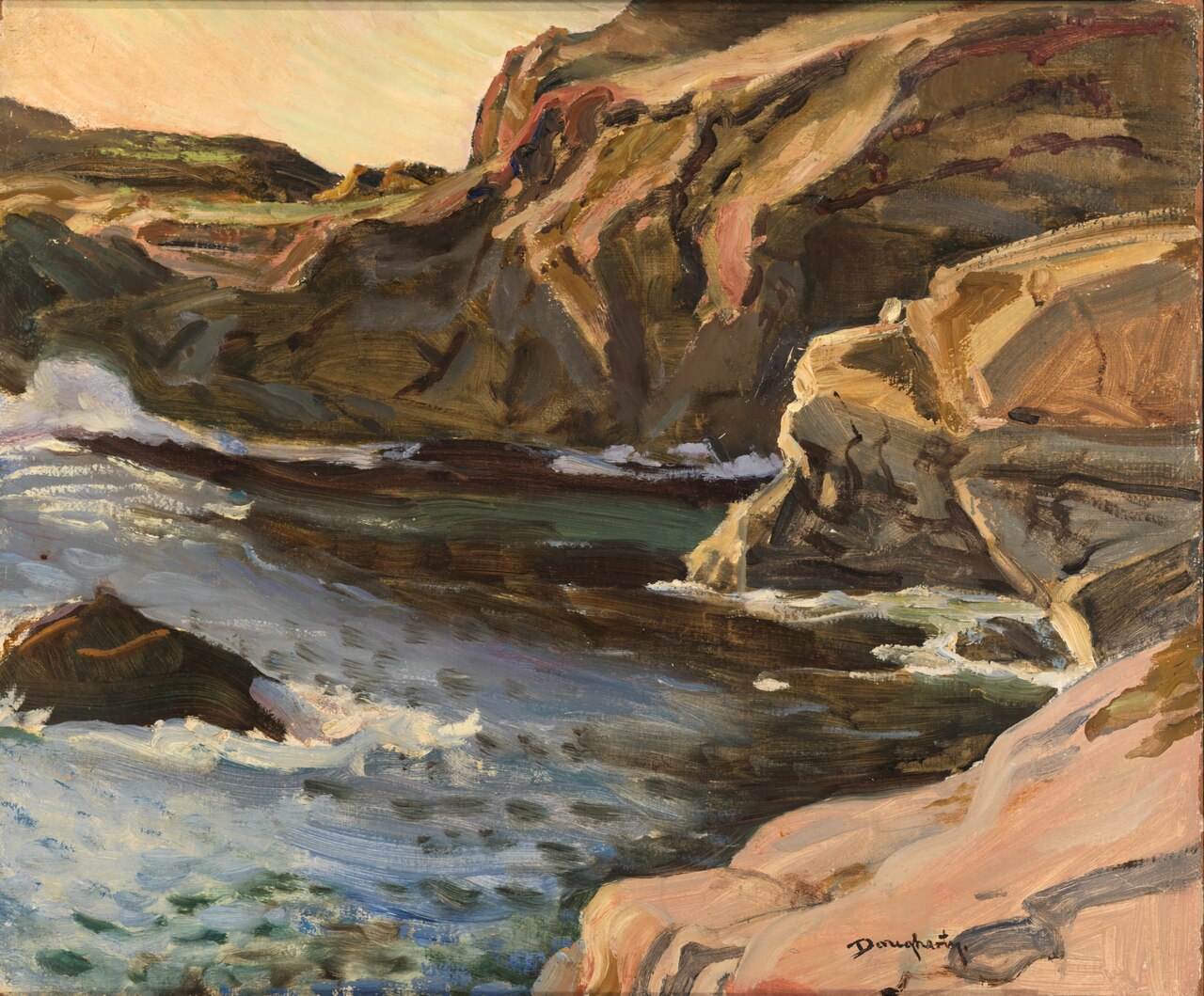
Signature techniques Dougherty’s paintings are recognisable for several technical hallmarks. He employed a rapid, impasto application of paint to suggest the movement of waves, often laying thick layers of pigment that catch the light and give a tactile quality to the sea‑foam. His brushwork varies from broad, sweeping strokes for the sky to finer, almost stippled touches for the spray of water, creating contrast between the expansive atmosphere and the intricate detail of crashing surf.
Colour modulation is another hallmark; he juxtaposed cool blues and greens with warm ochres and siennas to convey the shifting temperature of water and rock. Light is rendered through subtle graduations rather than stark highlights, producing a sense of depth that draws the viewer’s eye into the distance. In many of his later works he incorporated a limited, almost monochromatic palette to emphasise mood, especially in stormy scenes where the sky and sea merge into a unified, brooding tone.
Major works - **Sun and Storm (1907)** – One of Dougherty’s early masterpieces, this canvas captures a sudden squall over a sun‑lit shoreline. The composition is dominated by a dark, rolling cloud bank that threatens the horizon, while the sun’s reflected light glints on the churning water. The piece demonstrates his early mastery of atmospheric contrast.
- Maine Coast (1909) – Painted during his intensive New England period, the work presents a panoramic view of a rocky Maine inlet. The foreground rocks are rendered with crisp, linear strokes, while the sea behind them is depicted in fluid, sweeping gestures that convey both movement and the weight of the tide.
- Crashing Waves (Coast of Maine) (1915) – Often cited as his signature image, this painting shows massive breakers colliding with a craggy shoreline. The thick impasto technique makes the foam appear three‑dimensional, and the muted palette reinforces the raw power of the sea.
- Heavy Sea (1918) – Created shortly after his first visits to California, the canvas juxtaposes the tumultuous Atlantic style with a brighter, West‑coast light. The wave forms are more aggressive, and the sky is rendered in a pale, almost turquoise hue that hints at the Pacific atmosphere.
- California Cliffs – This work marks Dougherty’s full embrace of the West‑coast landscape. The cliffs are bathed in golden sunlight, and the sea below reflects a calm, sapphire tone. The composition is more relaxed than his New England pieces, highlighting his adaptability to different coastal environments.
These works collectively illustrate Dougherty’s evolution from a New England‑focused marine painter to an artist capable of capturing the varied moods of both Atlantic and Pacific shorelines.
Influence and legacy Paul Dougherty’s paintings contributed to the development of American marine art at a time when the nation was seeking its own visual identity separate from European conventions. By integrating Impressionist colour theory with a distinctly American sense of scale and vigor, he helped pave the way for later 20th‑century landscape painters who emphasised the drama of the natural world. His works remain in the collections of several regional museums, including the Portland Museum of Art and the Laguna Art Museum, and are frequently reproduced in art‑history texts that examine the transition from academic realism to modernist approaches in the United States.
Although his name is not as widely known as some of his contemporaries, collectors and scholars value Dougherty for his technical skill, his ability to convey the power of the sea, and his contribution to the visual narrative of America’s coastal heritage. Contemporary marine artists continue to study his handling of light and water, and his paintings are cited as exemplars of how to render atmosphere without sacrificing structural integrity. In recent years, renewed interest in early American Impressionism has led to exhibitions that feature his work alongside that of fellow marine painters, reaffirming his place in the canon of American art history.
Frequently asked questions
Who was Paul Dougherty?
Paul Dougherty (1877–1947) was an American painter best known for his dramatic marine scenes of the coasts of Maine and California.
What artistic style or movement is he associated with?
He worked within an American Impressionist framework, blending loose brushwork and vibrant colour with a bold, masculine depiction of sea‑scapes.
What are his most famous works?
Key paintings include *Sun and Storm* (1907), *Maine Coast* (1909), *Crashing Waves (Coast of Maine)* (1915), *Heavy Sea* (1918) and *California Cliffs*.
Why is Paul Dougherty important in art history?
Dougherty helped define early‑20th‑century American marine painting, merging Impressionist colour theory with a uniquely vigorous portrayal of the sea, influencing later landscape artists.
How can I recognise a Paul Dougherty painting?
Look for thick impasto waves, a palette of deep blues and warm earth tones, and a focus on rugged coastlines where the sea’s motion is rendered with sweeping, energetic brushstrokes.