Otto Marseus van Schrieck
1613 – 1678
In short
Otto Marseus van Schrieck (1613–1678) was a Dutch Baroque painter renowned for his detailed forest‑floor still lifes that combine flora, insects and reptiles. Working in the Dutch Golden Age, he pioneered the soggetto bosco genre and influenced a generation of still‑life artists.
Notable works


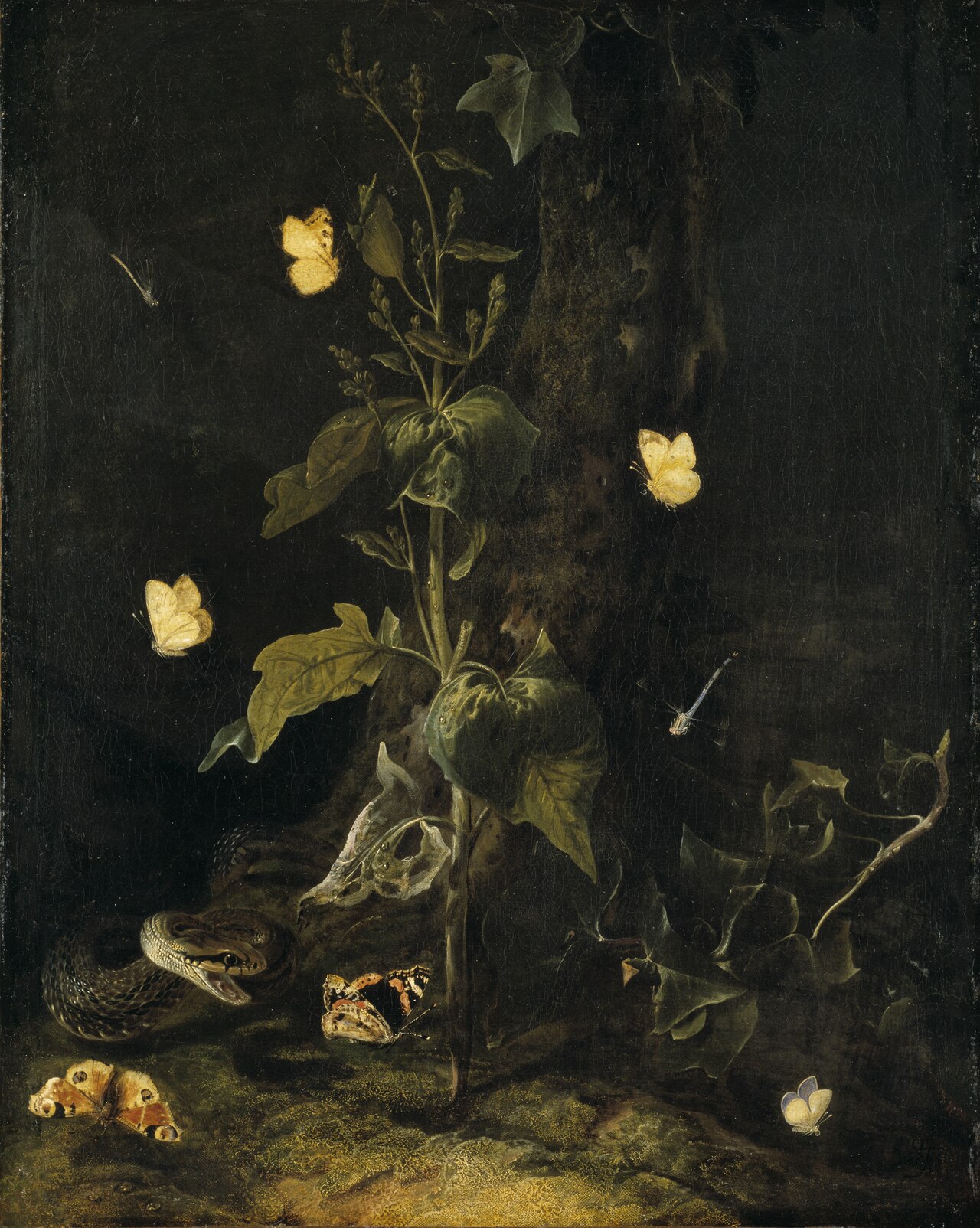
Early life Otto Marseus van Schrieck was born in 1613 in Nijmegen, a town in the eastern part of the Dutch Republic. Little is recorded about his family background, but he likely received a basic education before moving to pursue artistic training. In his early twenties he travelled to Italy, a common practice for Dutch artists seeking exposure to classical art and contemporary trends. He spent several years in Rome, where he joined the informal association of Dutch and Flemish painters known as the Bentvueghels. The experience broadened his visual vocabulary and introduced him to the dramatic chiaroscuro favoured by Caravaggisti, an influence that would later surface in his own work.
Career and style On his return to the Netherlands around 1640, van Schrieck settled in Amsterdam, the thriving commercial centre of the Dutch Golden Age. He established a workshop that attracted apprentices and collectors alike. Van Schrieck’s oeuvre is dominated by a single, highly specialised subject matter: the forest floor, rendered with an almost scientific precision. His paintings depict a tangled carpet of leaves, moss, mushrooms, and small creatures such as snakes, toads, lizards, butterflies and beetles. This focus placed him at the forefront of the *sottobosco* (Italian for “under‑the‑woods”) genre, a niche that merged still‑life tradition with natural‑history illustration.
His style is firmly rooted in Baroque aesthetics. He employed strong contrasts of light and shadow to model forms and to draw the viewer’s eye to the minute details of each organism. The colour palette is restrained, dominated by earthy greens, browns and muted ochres, with occasional vivid accents provided by the wings of insects or the bright red of a poppy. The compositions are often tightly cropped, creating an intimate, almost theatrical tableau that foregrounds the fragility and transience of nature.
Signature techniques Van Schrieck’s technique can be summarised by three recurring methods:
1. Close‑up observation – He rendered his subjects with a level of detail comparable to contemporary naturalists. The textures of bark, the translucency of insect wings, and the scaly skin of reptiles are depicted with meticulous brushwork. 2. Layered glazing – By applying thin layers of transparent paint over a darker underpainting, he achieved depth and a luminous quality that makes the foliage appear three‑dimensional. 3. Symbolic chiaroscuro – Light often falls on a single element—a butterfly or a snake—while the surrounding vegetation recedes into shadow, a compositional device that both heightens drama and hints at moral allegories common in Dutch still life.
These techniques, combined with a keen eye for composition, allowed van Schrieck to produce works that were simultaneously scientific studies and emotive visual poems.
Major works
- A forest floor with a snake, lizards, butterflies and other insects (1650) – This early masterpiece presents a serpentine creature winding through a carpet of leaves, flanked by lizards and a flutter of butterflies. The painting exemplifies van Schrieck’s fascination with the coexistence of predator and prey, and his skill in rendering the delicate anatomy of each animal.
- Snakes, toads and butterflies (1639) – Created during his Italian period, this work shows a more dramatic use of light, with the snakes emerging from darkness. The presence of toads and butterflies adds a narrative balance between danger and innocence, reflecting the Baroque interest in vanitas themes.
- Still Life with Poppy, Insects, and Reptiles (1670) – One of his later pieces, it incorporates a vivid poppy flower as a colour focal point amidst a darker underworld of insects and small reptiles. The poppy’s bright red provides a striking contrast that underscores the fleeting beauty of life.
- Plants and Insects (1665) – This composition is a study of botanical accuracy; the leaves are depicted with botanical exactness, while the insects are arranged in a naturalistic yet aesthetically pleasing manner. It demonstrates van Schrieck’s continued commitment to observation even as he refined his palette.
- Serpent and Butterflies in the Woods (1670) – In this late work, the serpent coils around a tree trunk while butterflies alight on nearby foliage. The juxtaposition of the venomous snake with the delicate butterflies creates a visual tension that is characteristic of his oeuvre.
Each of these works underscores van Schrieck’s mastery of the *sottobosco* genre and his ability to convey both the beauty and the peril inherent in natural ecosystems.
Influence and legacy Otto Marseus van Schrieck’s singular focus on forest‑floor subjects left a lasting imprint on Dutch still‑life painting. His meticulous naturalism inspired a cohort of younger artists, including Jan van Kessel the Elder, Jacob Marrel and later Flemish painters who adopted the *sottobosco* motif. The genre itself spread beyond the Netherlands, influencing Italian and French still‑life traditions.
Beyond stylistic imitation, van Schrieck contributed to the early modern visual culture of natural history. His paintings pre‑date the systematic botanical illustrations of the late 17th and 18th centuries, offering a visual record of species that were otherwise undocumented. Consequently, his work is valued by both art historians and scholars of early scientific illustration.
In contemporary museums, van Schrieck’s paintings are displayed alongside other Dutch masters to illustrate the diversity of still‑life practice during the Golden Age. His ability to fuse scientific observation with Baroque drama continues to captivate audiences, confirming his status as a pivotal figure in the development of still‑life art.
---
Through a career that spanned more than four decades, Otto Marseus van Schrieck transformed a modest corner of the natural world into a profound visual language, securing his place in the canon of Dutch Baroque painters.
Frequently asked questions
Who was Otto Marseus van Schrieck?
He was a Dutch Baroque painter (1613–1678) famed for his detailed forest‑floor still lifes that combine plants, insects and reptiles.
What artistic style or movement is he associated with?
Van Schrieck worked within the Dutch Golden Age, specifically developing the *sottobosco* genre of Baroque still life.
What are his most famous works?
Key works include *A forest floor with a snake, lizards, butterflies and other insects* (1650), *Snakes, toads and butterflies* (1639), *Still Life with Poppy, Insects, and Reptiles* (1670), *Plants and Insects* (1665) and *Serpent and Butterflies in the Woods* (1670).
Why is Otto Marseus van Schrieck important in art history?
He pioneered the forest‑floor still‑life, influencing later Dutch and Flemish painters and contributing early visual documentation of natural subjects.
How can I recognise a van Schrieck painting?
Look for close‑up, dark‑grounded compositions featuring a dense carpet of leaves populated by snakes, insects or small reptiles, rendered with meticulous detail and strong chiaroscuro.