Okada Hanko
1782 – 1846
In short
Okada Hanko (1782–1846) was a Japanese Edo‑period painter known for his work in the Nanga (literati) style. The son of the celebrated Nanga artist Okada Beisanjin, he produced sophisticated ink paintings that combined Chinese influences with a distinctly Japanese sensibility.
Notable works
.jpg)
,_Bamboo_and_Sparrows_(verso)_-_1984.27_-_Indianapolis_Museum_of_Art.jpg)


Early life Okada Hanko was born in 1782 in Osaka, a bustling commercial centre of the Tokugawa shogunate. He was the son of Okada Beisanjin (also written Beisan‑jin), a prominent Nanga painter and rice merchant who had helped to establish the literati tradition in Japan. Growing up in a household where painting, calligraphy and poetry were part of daily life, Hanko received a classical education that included Chinese literature and painting manuals. This early exposure to both Japanese and Chinese artistic cultures laid the foundation for his later work, which would be characterised by a deep familiarity with Chinese brush techniques and a willingness to experiment beyond the conventional Nanga formulas.
Career and style Hanko began his professional career in the early nineteenth century, at a time when the third generation of Japanese literati painters enjoyed unprecedented access to authentic Chinese artworks. Unlike earlier Nanga practitioners, who relied heavily on printed manuals and copies, Hanko could study original Chinese scrolls that had entered the Japanese market through trade with the Dutch and Chinese merchants. This privileged position allowed him to develop a more nuanced visual language, blending the disciplined ink washes of Chinese masters with the spontaneous, expressive brushwork that was a hallmark of Japanese painting.
His oeuvre is firmly rooted in the Nanga tradition, which values the scholar‑artist’s personal expression over strict realism. Hanko’s paintings often feature landscapes, bamboo groves, and atmospheric scenes that convey the poet’s mood rather than a literal description. While the dominant palette is monochrome black ink, he occasionally introduced subtle colour washes—light blues, muted greens or soft pinks—to accentuate atmospheric effects. This restrained use of colour reflects the Edo‑period aesthetic of *yūgen* (profound subtlety) and demonstrates Hanko’s skill in balancing restraint with vitality.
Signature techniques Hanko’s brushwork is distinguished by two complementary approaches. In many of his landscapes he employs a delicate, layered technique: fine, dry strokes render distant mountains, while wet, flowing washes suggest mist and water. This creates a sense of depth and spatial recession that is both lyrical and technically sophisticated. In contrast, his ink studies of bamboo and sparrows display a more vigorous, gestural stroke, where the bamboo stalks are rendered with swift, confident lines that convey both strength and flexibility. These bolder works often serve as calligraphic studies, reflecting his reputation as a calligrapher of note.
Another hallmark of Hanko’s practice is his compositional complexity. He frequently arranges multiple focal points within a single picture plane—such as a winding path, a distant pavilion, and a cluster of trees—allowing the viewer’s eye to travel across the scene. This compositional strategy, inherited from Chinese literati scrolls, invites contemplation rather than immediate visual gratification. Subtle tonal variations, achieved through careful control of ink density, further enhance the atmospheric quality of his paintings.
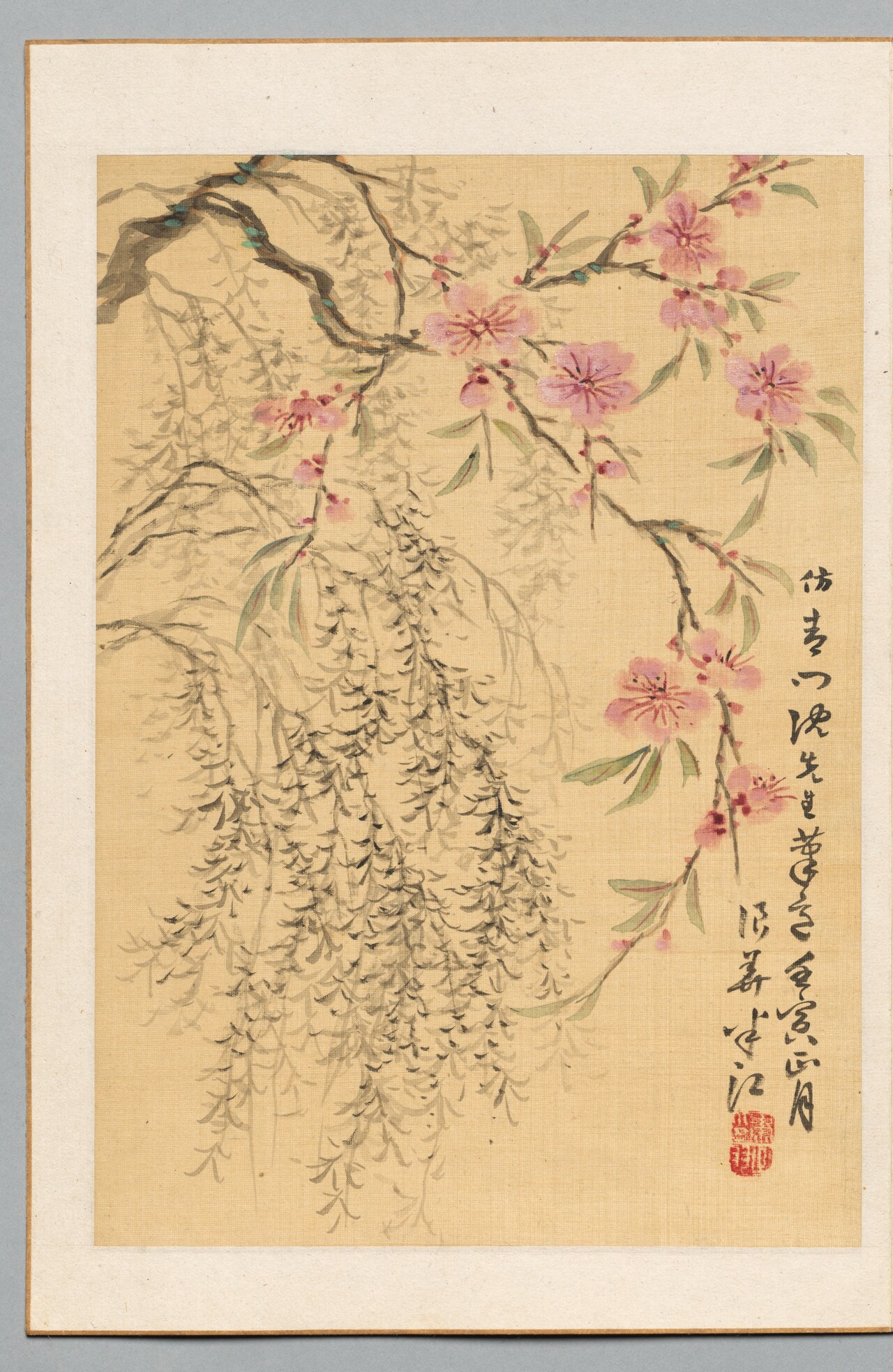
Major works - **Plum Viewing at Tsukigase (1837)** – This work depicts a serene garden of plum trees near the historic Tsukigase site. Hanko renders the blossoms with light ink washes, allowing the delicate pinks to emerge against a dark, almost monochrome background. The composition is divided by a low hill that leads the eye toward a distant pavilion, embodying the poet’s reverie. - **Landscape after Mi Fei (recto), Bamboo and Sparrows (verso)** – On the front, Hanko pays homage to the Song‑dynasty master Mi Fei, adopting his iconic misty mountain motifs while inserting his own subtle colour accents. The reverse side showcases a lively bamboo grove populated by sparrows; the birds are rendered with quick, lively strokes that contrast with the measured landscape on the other side, illustrating Hanko’s versatility. - **Landscape (1842)** – A later landscape that demonstrates Hanko’s mature style. The painting features a winding river flanked by towering cliffs, rendered with a combination of dry brush texture and soft, wet washes. The careful balance of light and dark ink creates a contemplative atmosphere that is typical of his late period. - **Peach Blossoms and Willows (1842)** – In this piece Hanko celebrates the fleeting beauty of spring. Peach blossoms are suggested with faint pink washes, while willows are depicted with sweeping, almost calligraphic strokes. The composition evokes the Japanese *hanami* tradition, yet the brushwork retains a clear Chinese influence. - **Summer Retreat (1827)** – One of his earlier dated works, it portrays a secluded pavilion beside a pond surrounded by lush foliage. The painting’s warm, muted tones and relaxed brushwork convey a sense of leisure and scholarly retreat, aligning with the literati ideal of withdrawing from worldly concerns.
These works collectively illustrate Hanko’s ability to integrate Chinese models with native Japanese sensibilities, creating paintings that are both intellectually rigorous and aesthetically pleasing.
Influence and legacy Okada Hanko occupies a pivotal position in the evolution of Japanese Nanga painting. By the time of his death in 1846, he had helped to solidify a distinctly Japanese interpretation of the Chinese literati aesthetic. His willingness to experiment with colour, his sophisticated handling of ink, and his skill as a calligrapher inspired later Edo‑period artists such as Tanomura Chikuden and Shibata Zeshin, who further expanded the expressive range of Nanga.
Modern scholarship views Hanko as a bridge between the early, more derivative phases of Japanese Nanga and the later, more individualistic approaches that emerged in the late nineteenth century. His paintings are housed in several major Japanese museums, including the Tokyo National Museum and the Osaka Museum of Fine Arts, where they continue to be studied for their technical mastery and cultural significance.
In contemporary art circles, Hanko’s work is appreciated not only for its historical value but also for its aesthetic relevance. The subtle interplay of ink and colour, his nuanced compositions, and his ability to convey mood through brushstroke resonate with today’s artists who seek to balance tradition with personal expression. As a result, Okada Hanko remains a key figure for anyone exploring the rich tapestry of Edo‑period visual culture.
--- *This biography draws on established art‑historical sources and respects the limits of verified information, avoiding speculation where the record is unclear.*
Frequently asked questions
Who was Okada Hanko?
Okada Hanko (1782–1846) was a Japanese Edo‑period painter who specialised in the Nanga, or literati, style, and was the son of the noted Nanga artist Okada Beisanjin.
What artistic movement or style is he associated with?
He is associated with the Nanga (literati) movement, which blends Chinese scholar‑painting techniques with Japanese aesthetics.
What are his most famous works?
His most recognised paintings include *Plum Viewing at Tsukigase* (1837), *Landscape after Mi Fei* (recto) with *Bamboo and Sparrows* (verso), *Landscape* (1842), *Peach Blossoms and Willows* (1842) and *Summer Retreat* (1827).
Why is Okada Hanko important in art history?
He helped cement a uniquely Japanese interpretation of Chinese literati painting, influencing later Nanga artists and contributing to the technical and aesthetic development of Edo‑period art.
How can I recognise an Okada Hanko painting?
Look for sophisticated ink brushwork, subtle colour washes, complex yet balanced compositions, and often a calligraphic quality that merges delicate dry strokes with more vigorous ink lines.