Nicolas Régnier
1588 – 1667
In short
Nicolas Régnier (1588–1667) was a Flemish-born Baroque painter who spent most of his career in Italy, producing Caravaggesque genre scenes, religious works and mythological subjects, and is best known for paintings such as Vanity (1630) and St Sebastian (1620).
Notable works
.jpg)
_-_St_Sebastian.jpg)

_-_Death_of_Sophonisba.jpg)
Early life Nicolas Régnier was born in 1588 in Maubeuge, a town that lay on the border between the County of Flanders and the Spanish Netherlands. His family were French‑speaking and part of the modest middle class. Little is recorded about his childhood, but the artistic environment of the Low Countries at the turn of the 17th century provided a fertile backdrop. Maubeuge lay close to the commercial hub of Antwerp, where the thriving market for prints, tapestries and paintings exposed young Régnier to the latest artistic trends. He is believed to have undertaken his initial training in Antwerp, a city that was then a centre for Flemish Baroque painting and a crossroads for artists travelling to Italy.
Career and style Around the first decade of the 1600s Régnier set out for Italy, a move common among Northern painters seeking artistic patronage and exposure to the Italian Baroque. He settled first in Rome, where he entered the circle of Caravaggisti – artists who adopted the dramatic chiaroscuro and naturalistic detail pioneered by Caravaggio. Régnier’s early Roman works reveal a clear assimilation of Caravaggio’s tenebrism, yet he quickly began to develop a personal idiom that blended Flemish colour sensibility with the stark lighting of his Italian peers.
By the 1620s Régnier had established himself in Venice, a city that offered a wealthy market for both religious commissions and private genre paintings. In Venice he adopted the local taste for lush colour and sumptuous textures, while retaining the dramatic narrative emphasis that characterised his earlier Roman output. Throughout his career he worked not only as a painter but also as an art dealer and collector, activities that gave him insight into the tastes of patrons across Europe and helped disseminate his works beyond Italy.
Signature techniques Régnier’s paintings are distinguished by several recurring technical traits. First, his use of chiaroscuro is precise: a single, often unseen light source creates deep shadows that model the forms of his figures, lending them a three‑dimensional presence. Second, his colour palette combines the warm, earthy tones of the Flemish tradition with the brighter, more saturated hues favoured by Venetian painters, resulting in a visual balance that feels both dramatic and harmonious. Third, Régnier frequently employed a refined brushwork that allowed him to render delicate fabrics, metallic surfaces and flesh tones with convincing realism. Finally, his compositions often incorporate symbolic objects – such as mirrors, musical instruments or extinguished candles – that enrich the narrative and invite moral interpretation.
Major works Among the works most closely associated with Régnier are the following:
* Vanity (1630) – This allegorical painting depicts a young woman gazing at herself in a mirror, a skull and a wilted flower lying nearby. The composition underscores the transience of beauty and the futility of self‑admiration, themes popular in 17th‑century moralising art. Régnier’s handling of light on the glass surface and the subtle flesh tones of the model demonstrate his mastery of Caravaggesque techniques.
* St Sebastian (1620) – In this religious work the saint is shown tied to a tree, his body pierced by arrows. Régnier captures the tension between suffering and serene acceptance, using a stark contrast between the bright, exposed flesh and the dark background to heighten the emotional impact. The painting reflects both the influence of Caravaggio’s martyr scenes and Régnier’s own sensitivity to human expression.
* Self‑Portrait with a Portrait on an Easel (1623) – This complex self‑portrait shows Régnier seated before an easel on which a smaller portrait of himself is displayed. The work is a meditation on identity and artistic reputation, and it showcases his skill in rendering reflective surfaces and intricate interior spaces.
* Death of Sophonisba (1666) – Although dated near the end of his life, this mythological scene remains stylistically consistent with his earlier output. It portrays the Carthaginian queen Sophonisba drinking poison to avoid capture by the Romans. The composition is charged with drama: the heroine’s poised gesture, the darkened background, and the careful rendering of fabric all contribute to a poignant narrative moment.
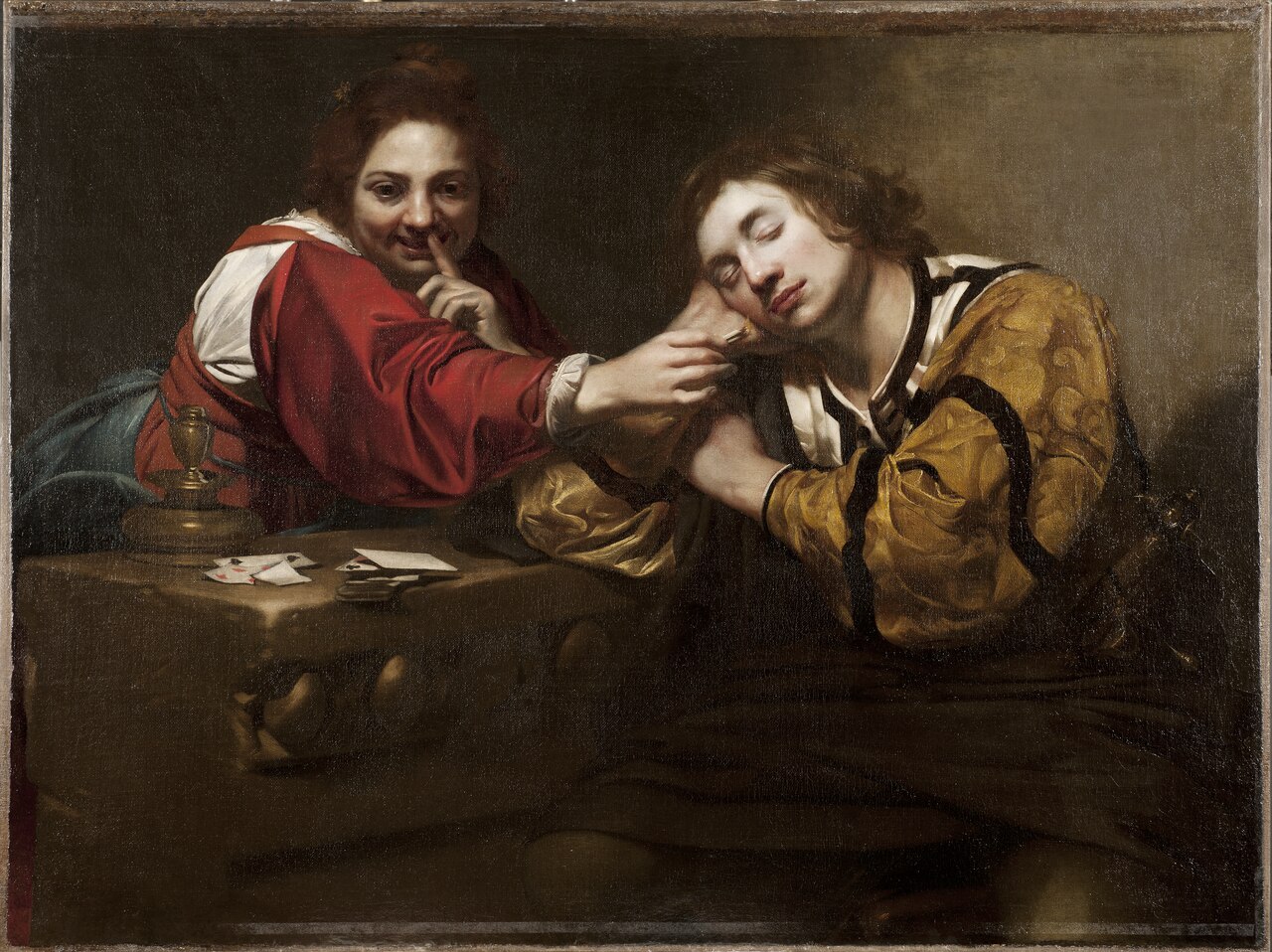
* Sleeper Awakened by a Young Woman with Fire (1620) – This genre scene captures a moment of intimate domestic drama, with a young woman gently nudging a sleeping figure while holding a candle. The work exemplifies Régnier’s ability to infuse everyday encounters with a subtle sense of tension, using the candle’s flame as a visual focal point that illuminates the figures and creates a warm ambience.
These works collectively illustrate Régnier’s versatility – from religious devotion to mythological storytelling and genre scenes – and his consistent use of light, colour and symbolic detail.
Influence and legacy Nicolas Régnier occupies a distinctive niche in Baroque art history. By bridging the Flemish and Italian traditions he contributed to the diffusion of Caravaggesque aesthetics beyond Italy, influencing local Venetian painters who began to experiment with stronger contrasts and more naturalistic modelling. His role as an art dealer further amplified his impact, as he facilitated the exchange of Northern and Southern artworks across Europe.
Although he never achieved the fame of Caravaggio or the later Venetian masters, Régnier’s paintings remain valuable for their insight into the cross‑cultural currents of the early 17th century. Modern scholarship recognises him as a key figure in the international network of artists who travelled, traded and collaborated, and his works are regularly exhibited in European museums that focus on Baroque and Caravaggesque painting. The enduring appeal of his genre scenes, with their psychological depth and moral undertones, continues to attract both scholars and collectors.
In sum, Régnier’s legacy lies in his synthesis of Northern realism and Italian drama, his adept handling of light and colour, and his contribution to the broader diffusion of Baroque visual language across Europe.
Frequently asked questions
Who was Nicolas Régnier?
Nicolas Régnier (1588–1667) was a Flemish‑born Baroque painter who worked mainly in Italy, producing religious, mythological and genre scenes in a Caravaggesque style.
What artistic movement is he associated with?
He is linked to the Baroque period and, more specifically, to the Caravaggesque movement that emphasized dramatic lighting and naturalistic detail.
What are his most famous works?
Key works include Vanity (1630), St Sebastian (1620), Self‑Portrait with a Portrait on an Easel (1623), Death of Sophonisba (1666) and Sleeper Awakened by a Young Woman with Fire (1620).
Why is Régnier important in art history?
He helped transmit Caravaggesque techniques from Italy to the Low Countries and Venice, and his dual role as painter and dealer facilitated cross‑regional artistic exchange.
How can I recognise a Régnier painting?
Look for strong chiaroscuro, a blend of Flemish colour richness with Venetian warmth, meticulous rendering of fabrics and reflective surfaces, and often symbolic objects that add moral or narrative depth.