Niccolo Rondinelli
1450 – 1510
In short
Niccolò Rondinelli (c.1450‑1510) was an Italian Renaissance painter from Ravenna, a pupil of Giovanni Bellini, whose work is characterised by delicate devotional imagery. He is best known for a series of Madonnas and a triptych that blend Venetian colourism with local devotional traditions.
Notable works




Early life Niccolò Rondinelli was born in Raven Ravenna around 1450 into a city that, while peripheral to the main centres of the Italian Renaissance, possessed a strong Byzantine artistic legacy. Little is known of his family background, but the cultural environment of Ravenna—marked by its historic mosaics and the presence of itinerant artists—provided a fertile ground for a young talent. By his teenage years he had moved to Venice, where he entered the workshop of Giovanni Bellini, the leading painter of the Venetian school. Under Bellini’s tutelage Rondinelli absorbed the principles of colour, light, and compositional balance that defined the period, while maintaining a connection to his native city’s devotional sensibilities.
Career and style Returning to Ravenna after his apprenticeship, Rondinelli established a workshop that catered to both ecclesiastical commissions and private devotional patrons. His style reflects a synthesis of Bellini’s luminous colour palette with the more austere, narrative‑driven approach favoured in the Emilia‑Romagna region. The figures in his paintings are often rendered with gentle, idealised features and an emphasis on serene, contemplative expression. Architectural settings are usually simplified, allowing the sacred subjects to dominate the visual field. Throughout his career, Rondinelli remained largely independent of the emerging High Renaissance trends in Florence, instead reinforcing a regional aesthetic that prized devotional intimacy over grandiose spectacle.
Signature techniques Rondinelli’s technique is distinguished by several recurring elements: - **Layered glazing**: Following Bellini’s method, he applied thin, translucent layers of pigment to achieve depth and a soft, almost ethereal glow. - **Delicate modelling of flesh**: Skin tones are built up with subtle gradations, giving his saints and the Virgin a lifelike yet idealised appearance. - **Gold leaf accents**: In his altarpieces, especially those intended for private chapels, he employed gold leaf for halos and decorative borders, linking his work to the Byzantine heritage of his hometown. - **Balanced composition**: His altarpieces often centre the Madonna and Child, flanked by saints or angels placed symmetrically, creating a harmonious visual equilibrium. - **Fine linear detail**: Drapery folds and architectural elements are rendered with precise, clean lines, lending a sense of order to the overall composition.
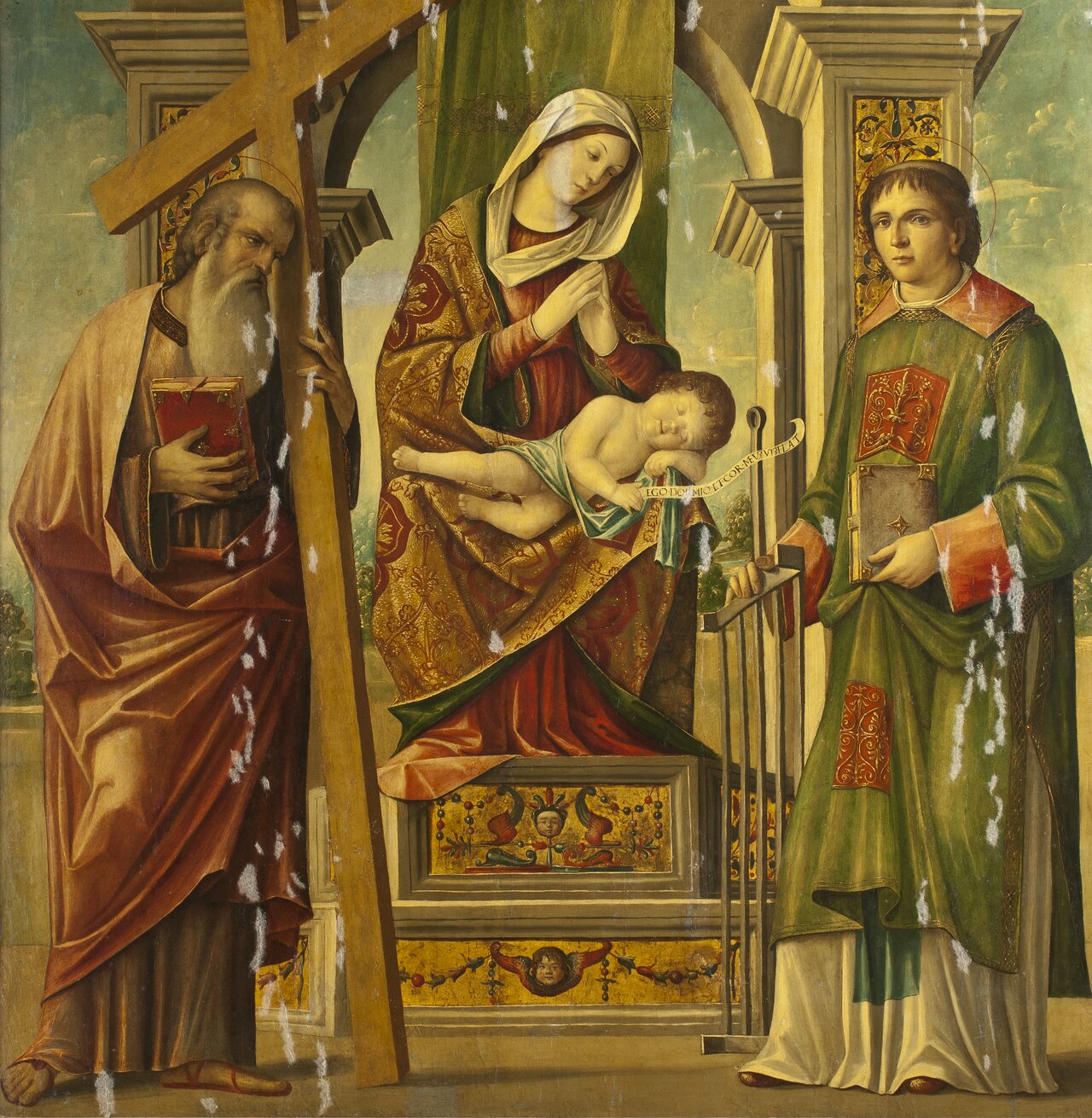
Major works Rondinelli’s surviving oeuvre is modest but showcases his devotional focus. Among his most recognised pieces are: - **Madonna col Bambino** – A tender depiction of the Virgin holding the infant Christ, characterised by soft lighting and a muted colour scheme that emphasises the intimacy of the mother‑child bond. - **Mary and Christ child (1500)** – Executed around the turn of the century, this work demonstrates Rondinelli’s mature handling of chiaroscuro, with a gentle modelling of the figures set against a restrained gold‑toned background. - **Madonna and Child with St Andrew and St Lawrence** – Here Rondinelli expands his compositional range, introducing two male saints on either side of the central pair, each rendered with distinct attributes that aid identification. - **Triptych with Madonna and Child Enthroned Between the Archangel Michael and Saint Peter (1500)** – This multi‑panel altarpiece is perhaps his most ambitious, presenting a central throne scene flanked by the archangel and the apostle, each figure imbued with a solemn dignity. The work’s balanced symmetry and careful use of colour illustrate his mastery of complex religious narratives. - **Madonna and Child (1500)** – A later, refined version of his recurring theme, this painting highlights Rondinelli’s continued interest in the delicate interplay of light and shadow, as well as his skillful rendering of the Virgin’s veil and the infant’s delicate hand.
Influence and legacy Rondinelli’s impact was principally regional. He trained a number of local artists, most notably Baldassare Carrari and Francesco da Cotignola, who carried forward his blend of Venetian colourism and Emilian devotional clarity. Although his name never achieved the pan‑Italian fame of contemporaries such as Bellini or Titian, his works remain valuable for understanding the diffusion of Venetian techniques into the Adriatic coast and the persistence of Byzantine‑influenced iconography in Renaissance art. Modern scholarship recognises Rondinelli as a bridge between the high Venetian style and the more restrained, locally rooted artistic traditions of Ravenna, offering insight into the diverse expressions of Renaissance spirituality.
Frequently asked questions
Who was Niccolò Rondinelli?
Niccolò Rondinelli was an Italian Renaissance painter (c.1450‑1510) from Ravenna, a pupil of Giovanni Bellini, known for his devotional works featuring the Madonna and Child.
What artistic style or movement is Rondinelli associated with?
Rondinelli worked in a regional style that combined Venetian colour and light techniques with the more austere, devotional aesthetic of the Emilia‑Romagna area.
What are his most famous works?
His best‑known pieces include the Madonna col Bambino, Mary and Christ child (1500), Madonna and Child with St Andrew and St Lawrence, and the triptych Madonna and Child Enthroned Between the Archangel Michael and Saint Peter (1500).
Why is Rondinelli important in art history?
He illustrates how Venetian painting methods spread beyond Venice, influencing local traditions in Ravenna and helping to preserve Byzantine‑inspired devotional imagery during the Renaissance.
How can I recognise a painting by Rondinelli?
Look for a serene Madonna and Child, soft layered glazes, delicate flesh modelling, balanced compositions with saints or angels flanking the central figures, and occasional gold leaf accents.