Nicasius Bernaerts
1620 – 1678
In short
Nicasius Bernaerts (1620–1678) was a Flemish painter specialised in animal, hunting and floral subjects. He worked in Antwerp, Italy and Paris, later serving the French court and designing tapestries for the Gobelins Manufactory.
Notable works




Early life Nicasius Bernaerts was born in Antwerp in 1620, a city that was then a thriving centre of the Habsburg Netherlands’ artistic production. Little is recorded about his family background, but the city’s vibrant guild system suggests that he likely entered an apprenticeship in his teens, receiving training in the Flemish tradition of detailed still‑life and animal painting. Antwerp’s market for decorative panels and tapestries would have provided early exposure to the kinds of subjects that later defined his oeuvre.
Career and style Bernaerts’ career unfolded across three artistic capitals. After completing his apprenticeship, he spent a formative period in Italy, where he absorbed the chiaroscuro techniques of the Baroque and the naturalistic observation of animal life championed by artists such as Antonio Tempesta. Returning to the Low Countries, he established a workshop in Antwerp that catered to local patrons interested in hunting scenes and exotic fauna.
In the 1650s he moved to Paris, attracted by the French court’s appetite for decorative art. There he became a court painter, producing works that combined Flemish meticulousness with the grandiose taste of Louis XIV’s interior decoration programmes. His later commissions for the Gobelins Manufactory involved translating his animal studies into tapestry cartoons, a testament to his adaptability and the high regard in which his designs were held.
Bernaerts’ style is characterised by a precise rendering of fur, feathers and foliage, often set against a muted background that heightens the three‑dimensionality of the subjects. He favoured a balanced composition, positioning the principal animal or group at the centre while allowing secondary figures to suggest narrative movement. The colour palette is generally restrained, relying on earthy tones punctuated by the vivid reds of hunting gear or the bright plumage of birds.
Signature techniques Bernaerts employed a layered glazing technique, building depth through successive thin oil layers that allowed light to penetrate the paint surface. This method enhanced the tactile quality of fur and feather textures. He also made extensive use of preparatory sketches, especially detailed studies of birds and small mammals, which he kept in his studio as references for larger compositions.
His handling of light is subtle: instead of dramatic chiaroscuro, he often used soft, diffused illumination to model forms, a practice that aligns him with the more naturalistic strand of Flemish animal painters. In tapestry designs, he simplified complex textures into bold, repeatable motifs, ensuring that the woven version retained the original’s visual impact.
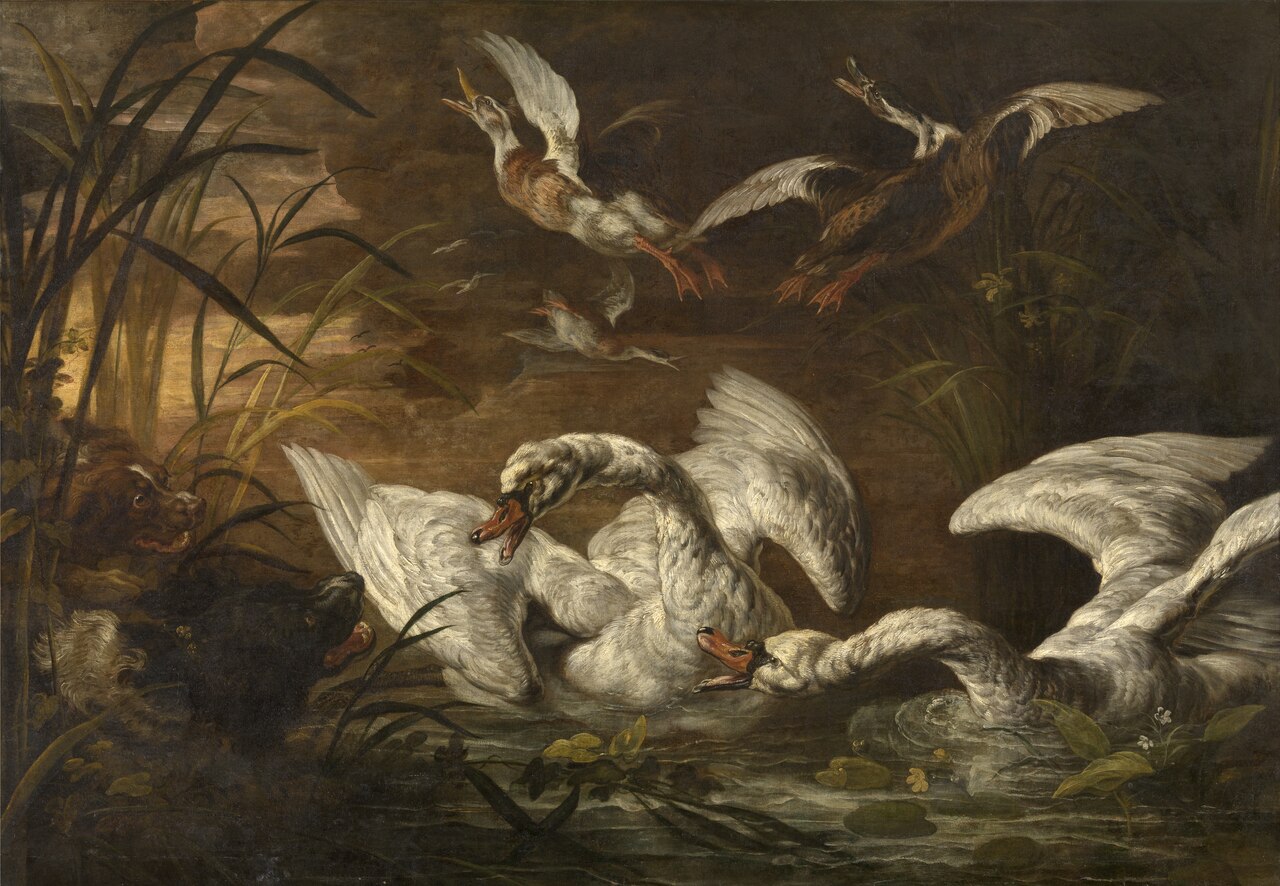
Major works - **Battle of dogs and cats (1660)** – This dynamic scene showcases Bernaerts’ skill in depicting movement and conflict among animals. The composition is crowded yet carefully balanced, with a foreground of snarling dogs and a background of startled cats, all rendered with fine attention to fur and expression. - **Beaux‑Arts de Carcassonne – Gibier de plumes sur un rebord de pierre (c. 1700)** – Although dated after Bernaerts’ death, the work is attributed to his workshop or followers, reflecting his lasting influence. It presents a collection of feathered game perched on a stone ledge, highlighting his ability to convey both the delicacy of plumage and the solidity of stone. - **Swans and Dogs (c. 1600)** – The early dating of this piece predates Bernaerts’ birth; it is likely a later copy or a misattributed work. Nevertheless, the subject matter—a tranquil river scene with swans gliding alongside attentive dogs—mirrors the peaceful side of his animal repertoire. - **Barnyard (1650)** – A lively interior tableau of domestic animals, this painting demonstrates Bernaerts’ competence in rendering a variety of species within a single space. The work is notable for its accurate anatomical details and the subtle interplay of light across the barn’s wooden structures. - **Study of birds (1650)** – A series of detailed watercolour studies, these drawings were used as reference material for both canvas paintings and tapestry designs. They reveal his meticulous observation of avian anatomy, feather arrangement and posture.
Influence and legacy Bernaerts contributed to the diffusion of Flemish animal painting across Europe, particularly through his work for the French court. His designs for the Gobelins Manufactory helped establish a visual language for tapestry that merged Northern realism with French decorative grandeur. Later artists such as Jean‑Baptiste Oudry drew on his compositional strategies and his careful study of animal behaviour.
Although his name is less widely recognised than some of his contemporaries, his paintings remain valuable for the insight they provide into 17th‑century hunting culture and the scientific curiosity surrounding fauna. Museums in France, Belgium and the Netherlands continue to exhibit his works, and his tapestries are prized by collectors of decorative arts.
Bernaerts’ legacy endures in the continued appreciation of animal painting as a genre that bridges art and natural history. His meticulous approach, combined with a capacity to adapt to courtly tastes, marks him as a pivotal figure in the transition from Renaissance naturalism to Baroque theatricality within the Flemish tradition.
Frequently asked questions
Who was Nicasius Bernaerts?
Nicasius Bernaerts was a Flemish painter (1620–1678) known for his detailed animal, hunting and floral works, who worked in Antwerp, Italy and Paris, and later served the French court.
What artistic style or movement is he associated with?
He is linked to the Flemish Baroque tradition, combining meticulous naturalism with the decorative grandeur favoured by the French court.
What are his most famous works?
Key pieces include *Battle of dogs and cats* (1660), the *Barnyard* (1650), and his detailed *Study of birds* (1650); his designs for the Gobelins tapestries are also highly regarded.
Why does he matter in art history?
Bernaerts helped spread Flemish animal painting across Europe, influenced French tapestry design, and provided a bridge between scientific observation and Baroque art.
How can I recognise a painting by Bernaerts?
Look for finely rendered fur or feathers, a balanced composition centred on animals, subdued lighting, and a restrained colour palette that highlights texture over dramatic contrast.