Marinus van Reymerswaele
1490 – 1546
In short
Marinus van Reymerswaele (1490–1546) was a Dutch Renaissance painter from the Habsburg Netherlands, best known for his genre scenes of financial and legal professionals and for religious compositions such as Saint Jerome in his study. He ran a prolific workshop that produced many versions of a small set of popular subjects, making his work a distinctive example of Northern Renaissance genre painting.
Notable works


.jpg)

Early life Marinus van Reymerswaele was born in 1490 in the town of Reimerswaal, a small settlement in the province of Zeeland, then part of the Habsburg Netherlands. Little is recorded about his family background, but it is clear that he received a substantial artistic education. He is believed to have studied in Leuven, a centre of humanist learning, before moving to Antwerp, the commercial and artistic hub of the Low Countries. In Antwerp he would have encountered the vibrant workshop culture that characterised the city’s art scene in the early sixteenth century, absorbing influences from both local masters and the influx of Italian Renaissance ideas.
Career and style After completing his apprenticeship, van Reymerswaele established himself as an independent painter in Antwerp. By the 1520s he was operating a sizeable workshop that catered to the tastes of a growing mercantile clientele. The artist’s output is characterised by a meticulous attention to detail, a restrained colour palette dominated by earth tones, and a compositional clarity that reflects the Northern Renaissance emphasis on observation and moral narrative. Although the precise artistic movement with which he is affiliated is not recorded, his work aligns closely with the broader currents of the Northern Renaissance, particularly the genre‑painting tradition pioneered by Pieter Bruegel the Elder and his contemporaries.
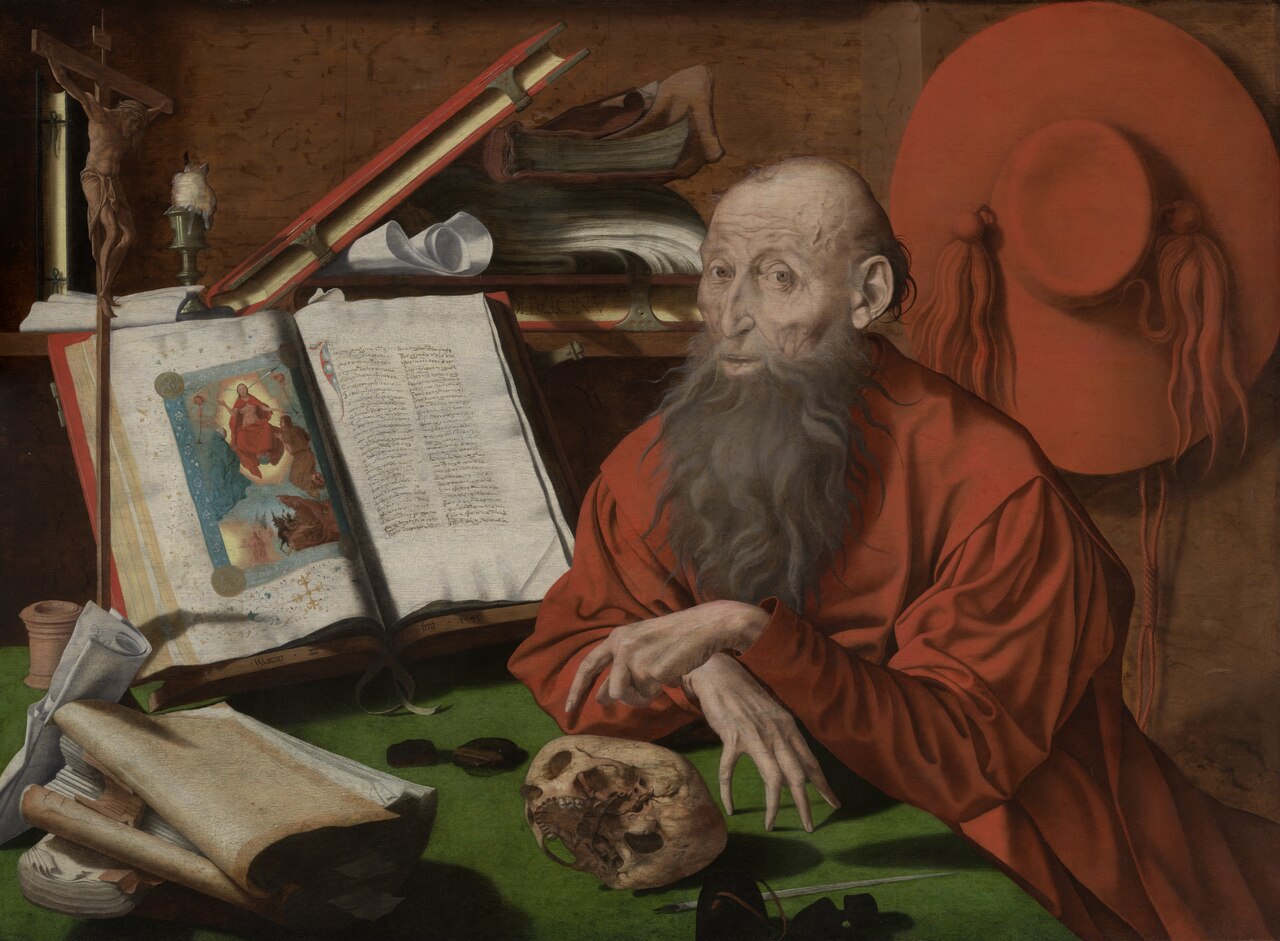
His paintings frequently depict scenes of everyday commercial and legal activity—money changers, tax collectors, lawyers—set within cramped interior spaces that reveal the material concerns of a burgeoning middle class. These works combine realistic detail with a subtle moralising tone, suggesting the artist’s awareness of the didactic potential of genre painting. In parallel, van Reymerswaele produced religious compositions, most notably his depictions of Saint Jerome in his study, which blend the same meticulous observation with a contemplative atmosphere appropriate to sacred subject matter.
Signature techniques Van Reymerswaele’s technique is distinguished by several recurring features. He employed a fine, almost linear brushwork to delineate objects, allowing textures such as parchment, metal, and wood to be rendered with convincing tactile quality. Light is used sparingly, often entering from a single source—typically a window on the left—to illuminate the central figures while casting deep shadows that enhance the three‑dimensionality of the space. This chiaroscuro effect, though more restrained than that of Caravaggio, contributes to a sense of intimacy and focus.
The artist’s palette is dominated by muted ochres, deep browns, and subdued greens, punctuated by occasional highlights of vermilion or blue that draw the viewer’s eye to key narrative elements (for example, a ledger or a crucifix). Van Reymerswaele also employed a compositional device of framing the central action with secondary figures or objects, creating a sense of depth and narrative richness. His workshop often reproduced successful compositions, resulting in multiple variants of the same theme; this practice ensured a consistent visual language across his oeuvre.
Major works ### The Moneychanger and His Wife (1539) One of van Reymerswaele’s most celebrated genre scenes, this painting presents a meticulous interior where a money‑changer counts coins while his wife, seated nearby, tends to a ledger. The composition is tightly organized, with a strong vertical axis formed by the column of coins and the ledger. The subdued colour scheme and the careful rendering of light on the metal surfaces exemplify the artist’s skill in depicting material wealth.
### Saint Jerome in His Study (1541) In this religious work, the saint is depicted absorbed in scholarly activity, surrounded by books, a crucifix, and a skull—traditional symbols of contemplation and mortality. Van Reymerswaele’s handling of the textures of vellum, wood, and stone demonstrates his capacity to convey the tactile reality of a monastic study. The painting’s calm, measured lighting and the quiet dignity of the figure reflect the devotional intent of the work.
### The Tax Collectors (attributed, c. 1600) Although dated after the artist’s death, this work is generally understood to be a later workshop copy or a derivative version of an original composition by van Reymerswaele. It shows a group of tax collectors surrounded by ledgers, coins, and official seals, echoing the moralising tone of his earlier genre pieces. The painting’s stylistic consistency with his authenticated works—particularly the handling of light and the precise detailing of documents—supports its attribution to his workshop.
### The Calling of Matthew (1536) and The Calling of Saint Matthew (1530) Both titles refer to a pair of compositions that depict the biblical moment when Jesus calls Matthew to become an apostle. In van Reymerswaele’s treatment, the scene is set within a modest interior that resembles a contemporary merchant’s office, thereby linking the sacred narrative to the everyday world of his patrons. The figures are rendered with the same exacting detail as his secular works, and the composition balances narrative clarity with a subtle moral message about vocation and conversion.
Influence and legacy Marinus van Reymerswaele’s work occupies a distinctive niche in the history of Northern Renaissance art. By focusing on the financial and legal professions, he provided a visual record of the economic realities of the early sixteenth‑century Netherlands. His paintings were widely circulated through prints and copies, influencing later genre painters such as Jan van Kessel the Elder and the broader tradition of Dutch vanitas imagery.
His workshop’s practice of reproducing successful compositions contributed to the diffusion of a recognizable visual vocabulary for scenes of commerce and piety. Modern scholarship regards van Reymerswaele as a pivotal figure in the development of genre painting, bridging the gap between the moralising intent of early Netherlandish art and the more secular concerns that would dominate Dutch painting in the seventeenth century. Although he is less celebrated than some of his contemporaries, his oeuvre remains a valuable resource for understanding the social and artistic currents of his time.
Today, van Reymerswaele’s paintings are held in major European collections, including the Rijksmuseum in Amsterdam and the Musée des Beaux‑Arts in Lille. Their continued exhibition and study attest to the enduring relevance of his precise observational style and his ability to render the ordinary with a quiet, moral gravity.
Frequently asked questions
Who was Marinus van Reymerswaele?
Marinus van Reymerswaele (1490–1546) was a Dutch Renaissance painter from the Habsburg Netherlands, known for his detailed genre scenes of merchants, tax collectors and lawyers, as well as religious works such as Saint Jerome in his study.
What artistic style or movement is he associated with?
His work is aligned with the Northern Renaissance, characterised by meticulous observation, restrained colour, and a moralising approach to everyday subjects.
What are his most famous works?
Key paintings include The Moneychanger and His Wife (1539), Saint Jerome in His Study (1541), The Tax Collectors (attributed, c. 1600), and two versions of The Calling of Matthew (1530 and 1536).
Why is Marinus van Reymerswaele important in art history?
He helped establish genre painting as a respected subject, providing a visual record of early‑sixteenth‑century commercial life and influencing later Dutch artists who explored similar themes.
How can I recognise a painting by van Reymerswaele?
Look for tightly composed interiors, a muted earth‑tone palette, careful rendering of metal objects, and a single light source that highlights the central activity—often a financial or legal transaction.