Marcantonio Raimondi
1480 – 1534
In short
Marcantonio Raimondi (1480–1534) was an Italian engraver who pioneered the reproductive print, copying paintings—especially Raphael’s—to disseminate High Renaissance styles across Europe. His systematic engraving technique and prolific output made him a central figure in early modern printmaking.
Notable works


Early life Marcantonio Raimondi was born in 1480 in the small town of Molinella, near Bologna, in the Emilia‑Romagna region of Italy. Little is recorded about his family background, but it is clear that he received a solid artistic education, likely through an apprenticeship in a local workshop. By his early twenties he had moved to Bologna, a thriving centre for the visual arts, where he began to develop his skills as a draughtsman and, most importantly, as an engraver.
Career and style Raimondi’s career took a decisive turn when he travelled to Rome in the first decade of the 16th century. There he encountered the workshop of the great painter Raphael, whose compositions, graceful figures and balanced compositions left a strong impression on the young engraver. Raimondi began to produce prints after Raphael’s designs, a practice that would become the hallmark of his work. These reproductive prints were not mere copies; through the medium of engraving he translated the painter’s colour and texture into a network of lines, creating a distinct visual language that emphasised chiaroscuro and fine hatching.
The early 1500s saw Raimondi establishing his own workshop in Rome, where he employed assistants and supplied prints to a growing market of collectors, scholars and other artists. His output was prolific and diverse, ranging from religious subjects to mythological scenes and allegorical compositions. The artist’s style remained closely tied to the High Renaissance aesthetic—idealised anatomy, harmonious proportions and a clear narrative structure—while his technique allowed those qualities to be reproduced in a format that could travel beyond the confines of a single painting.
Signature techniques Raimondi is credited with systematising a method of engraving that would dominate Italian printmaking for decades. He employed a burin (graver) to incise fine, parallel lines into copper plates, manipulating line density to suggest tonal variation. By varying the thickness and spacing of these lines, he could render delicate shadows, the sheen of fabric, and the three‑dimensionality of sculptural forms. This approach, often described as a ‘cross‑hatching’ technique, gave his prints a depth that approached the illusionistic quality of painted works.
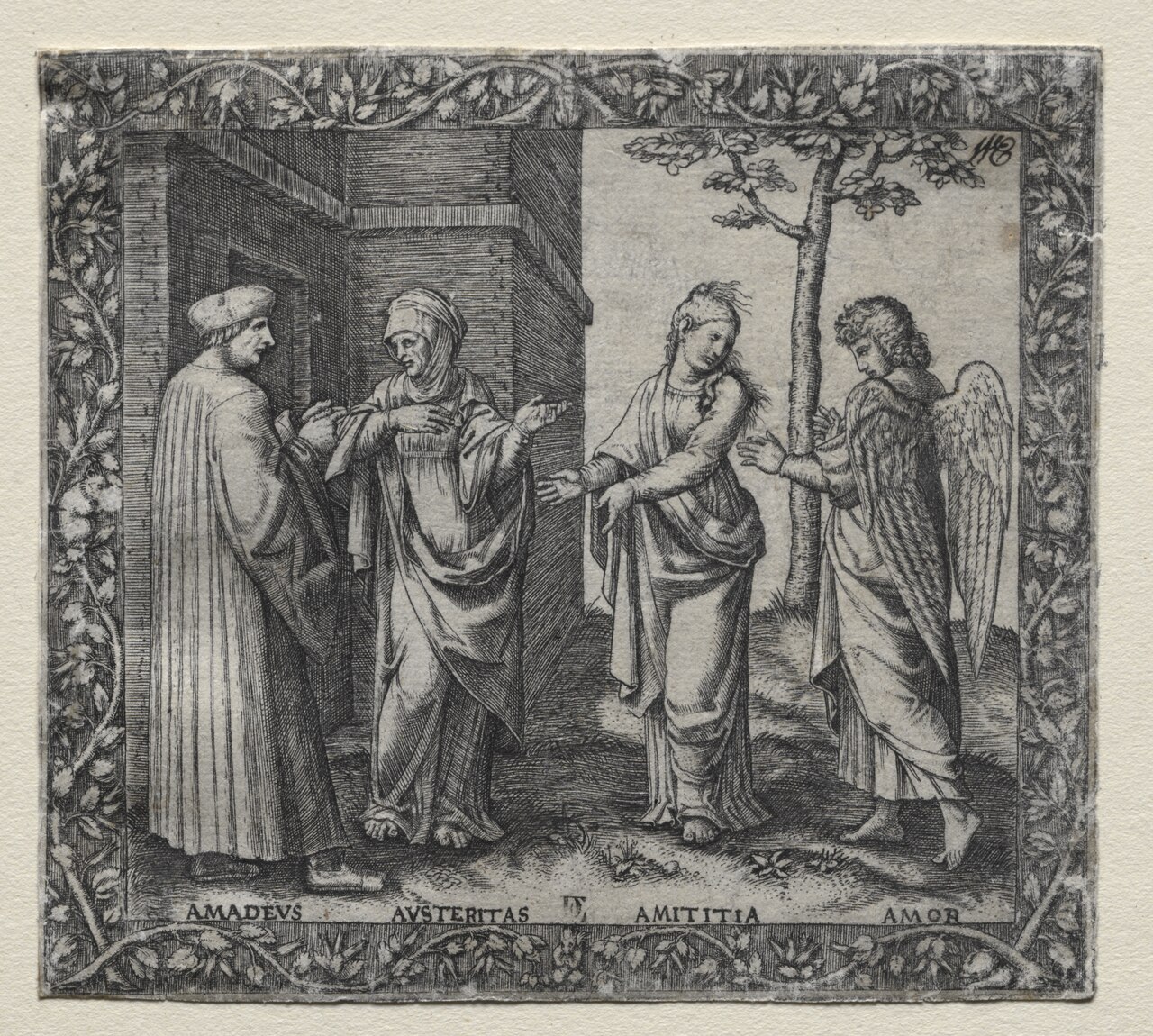
Another hallmark of his practice was the careful handling of compositional borders. Raimondi frequently added ornamental frames or decorative motifs that both protected the central image and reinforced the sense of a finished, autonomous artwork. His signatures, usually placed in a discreet corner, were rendered in a clear, legible hand, allowing scholars to attribute prints with confidence.
Major works - **The Judgment of Paris (c.1510)** – This print captures the classic mythological episode in which Paris must choose the fairest goddess. Raimondi’s composition mirrors Raphael’s earlier drawing of the same subject, translating the painter’s delicate gestures and flowing drapery into a finely worked engraving. The use of light‑to‑dark transitions highlights the figures’ three‑dimensionality. - **Charity** – A devotional image that portrays the allegorical figure of Charity, often depicted as a mother with children. Raimondi’s rendering emphasizes the tenderness of the maternal gesture, with soft line work that suggests the texture of skin and cloth. - **The Massacre of the Innocents (Without the Fir Tree)** – This violent biblical scene demonstrates Raimondi’s ability to convey drama through compositional complexity. Although the original painting is lost, the print retains a dynamic arrangement of figures, with a stark contrast between the chaotic foreground and the calmer background. - **Naked man carrying the base of a column (c.1530)** – A study in anatomy and movement, this print shows a muscular figure bearing a heavy column. The engraving showcases Raimondi’s skill in rendering the human form, with precise hatching that outlines the tension in the musculature. - **Illustration to Amadeo Berruti’s *Dialogue on Friendship* (Rome, 1517)** – This work demonstrates Raimondi’s versatility, as he produced a detailed illustration for a literary text. The image integrates symbolic elements that complement the philosophical discussion, reflecting the humanist interests of the period.
Influence and legacy Marcantonio Raimondi’s impact on the history of art is profound. By producing high‑quality reproductive prints, he became the first printmaker whose reputation rested on the systematic replication of paintings. This practice helped to disseminate the visual language of the High Renaissance far beyond Italy, reaching patrons and artists in northern Europe, Spain and the emerging markets of the Ottoman Empire. His prints served as visual references for artists who could not travel to see the original works, thereby shaping artistic education across the continent.
Raimondi’s technical innovations set a standard for engraving that persisted well into the Baroque period. The clarity of his line work, his disciplined approach to composition, and his ability to convey subtle tonal variations through hatching influenced later masters such as Agostino Carracci and the entire Bolognese school of printmakers. Moreover, his collaboration with Raphael established a precedent for artist‑printer partnerships, a model that would be emulated by later figures like Rembrandt and Goya.
The only surviving contemporary biography of a printmaker, the vita penned by Giorgio Vasari, underscores Raimondi’s singular status in the early 16th‑century art world. Vasari’s account, though occasionally anecdotal, provides valuable insight into the artist’s workshop practices, his network of patrons, and the esteem in which he was held by his peers.
In modern scholarship, Raimondi is recognised not only as a master engraver but also as a cultural conduit who helped to democratise visual culture. His prints remain essential primary sources for researchers studying Renaissance iconography, the diffusion of artistic styles, and the technical evolution of printmaking. Museums worldwide continue to display his works, and reproductions of his engravings are frequently used in academic publications to illustrate the interplay between painting and print.
Overall, Marcantonio Raimondi stands as a pivotal figure whose artistic contributions bridged the worlds of painting and print, ensuring that the visual ideals of the High Renaissance could be experienced by a far wider audience than ever before.
Frequently asked questions
Who was Marcantonio Raimondi?
Marcantonio Raimondi (1480–1534) was an Italian engraver renowned for pioneering the reproductive print, especially through his collaborations with Raphael.
What style or movement is he associated with?
His work reflects the High Renaissance style, characterised by idealised figures, balanced composition and a focus on classical themes.
What are his most famous works?
Key prints include *The Judgment of Paris* (c.1510), *Charity*, *The Massacre of the Innocents* (without the fir tree), the nude figure carrying a column base (c.1530), and the illustration for Amadeo Berruti’s *Dialogue on Friendship* (1517).
Why is Raimondi important in art history?
He established the practice of reproducing paintings as prints, spreading High Renaissance aesthetics across Europe and setting technical standards for engraving that influenced generations of printmakers.
How can I recognise a Raimondi engraving?
Look for finely executed cross‑hatching, clear line work that creates subtle tonal gradations, a balanced composition derived from a painted source, and often a discreet signature in the lower corner.