Lucas van Uden
1595 – 1672
In short
Lucas van Uden (1595–1672) was a Flemish landscape painter, draughtsman and engraver from Antwerp. He specialised in atmospheric rural scenes and frequently collaborated with figure painters, producing works noted for their naturalistic detail and subtle colour.
Notable works


Early life Lucas van Uden was born in 1595 in Antwerp, a major artistic centre of the Habsburg Netherlands. Little documentary evidence survives concerning his family background or formal apprenticeship, but it is clear that he spent his entire life in the city that dominated Flemish art production. Antwerp’s bustling market for prints and paintings offered ample opportunities for a young artist to learn the craft of drawing, engraving and painting, and van Uden likely received his training in a local workshop where the dominant influences were the established Flemish masters of landscape and still‑life.
Career and style By the early 1620s van Uden had established himself as a competent landscape painter and draughtsman. He worked primarily for the local market, producing canvases and prints that catered to the tastes of Antwerp’s merchants and collectors. His style reflects the mature Flemish landscape tradition pioneered by artists such as Jan Brueghel the Elder and later refined by Joos de Momper. Van Uden favoured expansive, gently rolling countryside scenes, often populated with shepherds, cattle and modest rural architecture. The compositions are balanced, with a clear foreground‑middle‑background structure that creates depth without resorting to dramatic theatricality.
A distinctive feature of his work is the integration of figure painters. Van Uden would lay down the natural setting, leaving space for specialist collaborators to add staffage – the human or animal figures that animate the scene. This practice was common in Antwerp, where workshops frequently shared commissions. The resulting paintings combine van Uden’s nuanced handling of light and atmosphere with the narrative detail supplied by his partners.
Signature techniques Van Uden’s technical strengths lie in his fine drawing and his subtle handling of colour. His preparatory sketches demonstrate a disciplined line quality, capturing the texture of foliage, rock and water with economical strokes. In his paintings, he employed a limited but harmonious palette of muted greens, earth tones and occasional warm highlights, allowing the overall effect to be one of calm realism. Atmospheric perspective is achieved through progressive softening of detail and a gradual lightening of colour as the view recedes, a technique that gives his landscapes a sense of depth and distance.
His engravings reveal a mastery of line engraving and etching, where cross‑hatching builds tonal variation. The prints often served as models for his painted works, and vice‑versa, reinforcing the close relationship between his graphic and pictorial output. Van Uden’s ability to render water, sky and cloud with delicate gradations made his scenes especially evocative, and his careful rendering of architectural elements—such as mills, bridges and cottages—adds a credible sense of place.
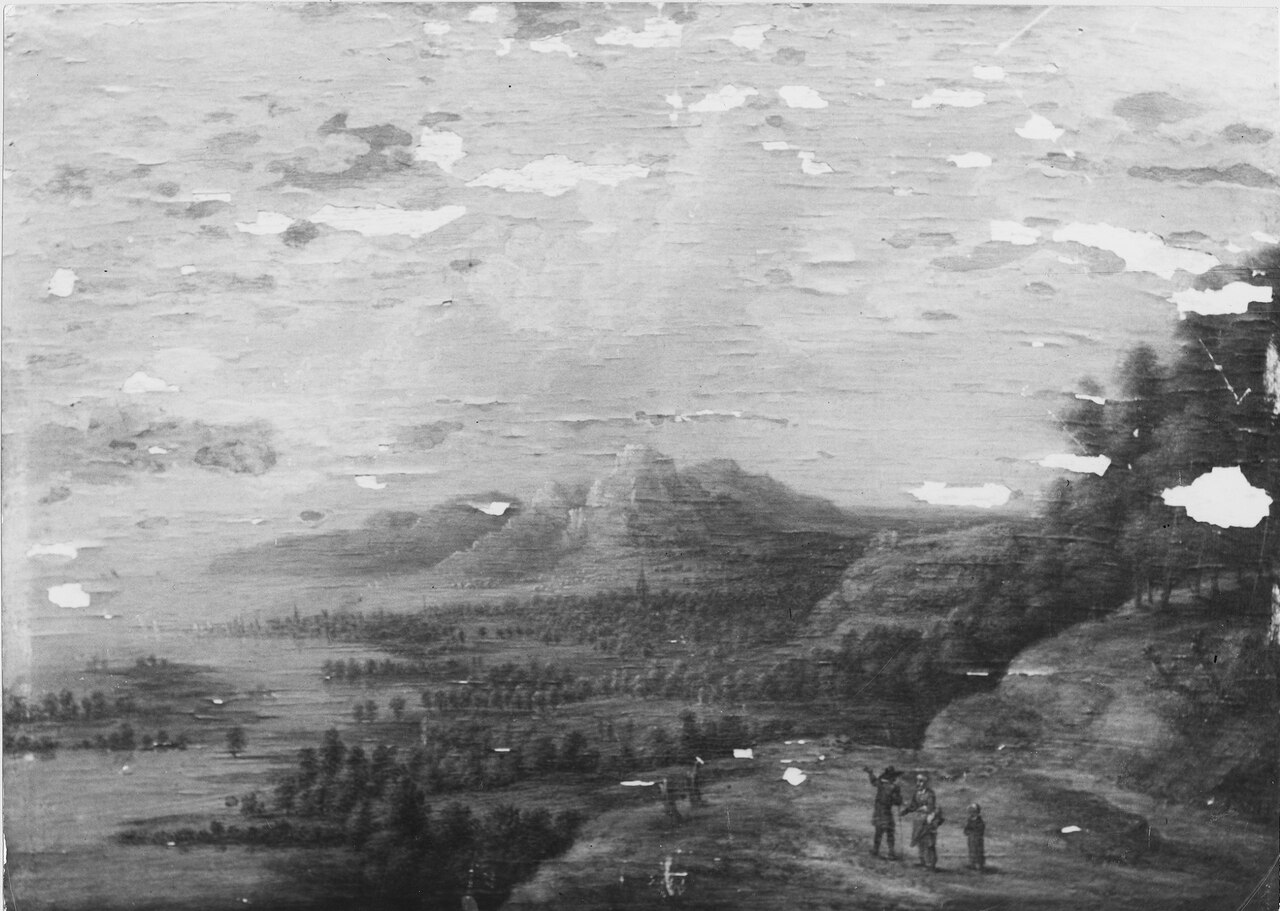
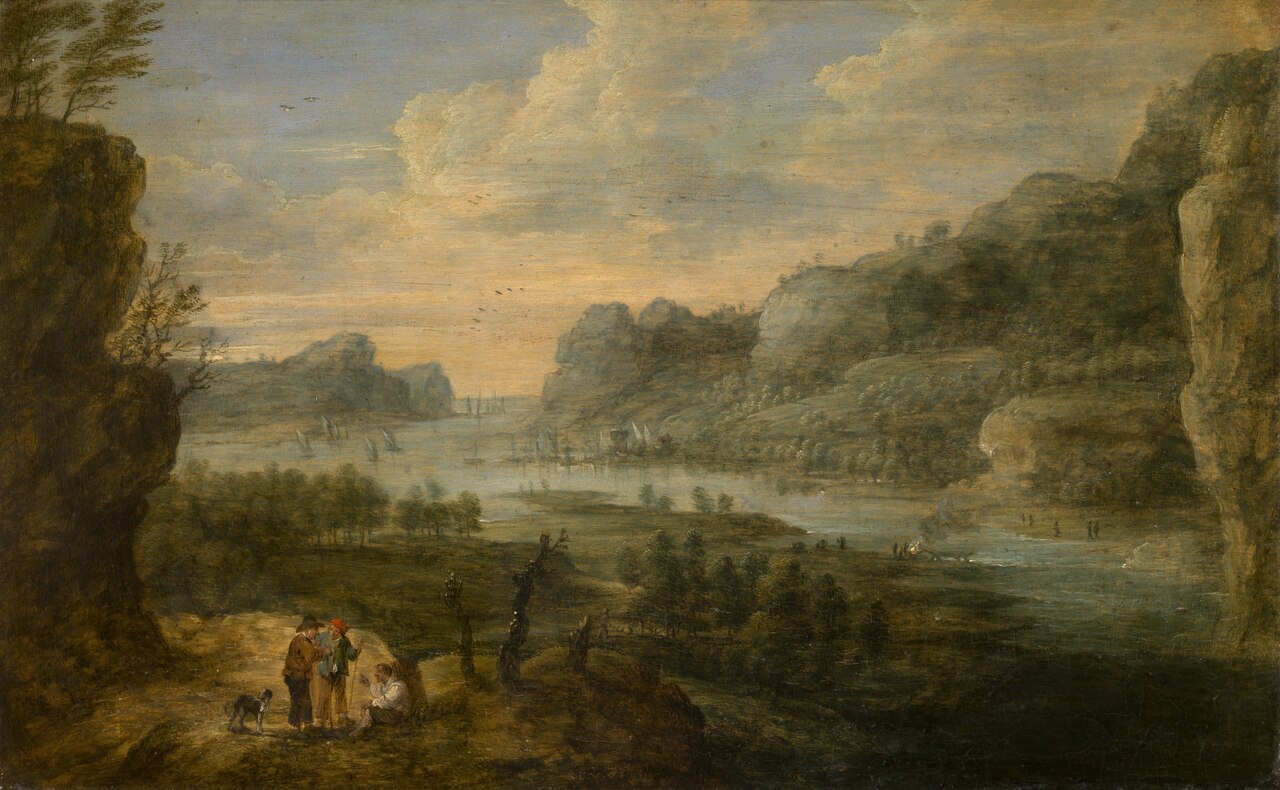
Major works - **Mountainous Landscape** – This canvas showcases van Uden’s skill at portraying rugged terrain softened by atmospheric haze. A distant mountain range dominates the horizon, while a tranquil valley below is dotted with modest farms and a winding river. The composition balances the grandeur of the highlands with the serenity of the cultivated land. - **Landscape with rainbow, shepherds and sheep (1648)** – In this work, a vivid rainbow arches across a cloudy sky, illuminating a pastoral scene where shepherds guide flocks of sheep through gentle slopes. The rainbow, rendered with delicate colour transitions, serves as a focal point that draws the eye into the centre of the composition, while the figures add narrative interest. - **Cattle with cowherds** – This painting emphasizes van Uden’s affinity for agrarian subjects. A group of cattle grazes peacefully while a few cowherds attend to the herd. The artist’s attention to the texture of animal hide and the play of light on the grass demonstrates his observational skill. - **Water Mill (1650)** – The water mill is set against a softly lit riverbank, its wheel turning under a gentle current. Van Uden captures the interplay of water, stone and timber with a restrained palette, allowing the mill’s functional architecture to become the visual anchor of the scene. - **Landscape with Sunset (1650)** – This composition is notable for its warm, golden light that suffuses the sky and landscape at dusk. The sunset creates a subtle glow on the foliage and distant hills, highlighting van Uden’s mastery of colour modulation to convey time of day.
Each of these works exemplifies the artist’s consistent approach: a calm, naturalistic rendering of the Flemish countryside, enriched by collaborative figures and a keen observation of light.
Influence and legacy Lucas van Uden occupies an important place in the development of 17th‑century Flemish landscape painting. His precise draughtsmanship and atmospheric palette influenced younger artists who sought to balance realistic observation with idealised scenery. Although he never achieved the fame of contemporaries such as Rubens or Van Dyck, van Uden’s works were widely collected in his lifetime and continued to appear in Dutch and Flemish art markets well into the 18th century.
His drawings, in particular, have been valued by collectors and scholars for their clarity of line and compositional insight. They provided models for later engravers and served as pedagogical material for aspiring landscape artists. Modern art historians view van Uden as a bridge between the highly decorative landscapes of the early 1600s and the more naturalistic approaches that emerged later in the century. His collaborative practice also illustrates the workshop culture of Antwerp, where specialization and joint authorship were common.
Today, van Uden’s paintings are held in several European museums, and his prints are studied for their technical excellence. His contribution to the Flemish landscape genre remains a testament to the quiet, observational tradition that complemented the more dramatic Baroque currents of his era.
Frequently asked questions
Who was Lucas van Uden?
Lucas van Uden (1595–1672) was a Flemish landscape painter, draughtsman and engraver from Antwerp, known for his atmospheric rural scenes and collaborations with figure painters.
What artistic style or movement is he associated with?
He worked within the Flemish Baroque landscape tradition, producing naturalistic countryside views that combine the influence of Jan Brueghel the Elder with his own subtle colour and light handling.
What are his most famous works?
Among his best‑known paintings are *Mountainous Landscape*, *Landscape with rainbow, shepherds and sheep* (1648), *Cattle with cowherds*, *Water Mill* (1650) and *Landscape with Sunset* (1650).
Why is Lucas van Uden important in art history?
He exemplifies the mature Flemish landscape genre, contributed high‑quality drawings and prints, and his collaborative approach illustrates the workshop culture of 17th‑century Antwerp.
How can I recognise a Lucas van Uden painting?
Look for calm, expansive rural scenes with muted green‑earth palettes, delicate atmospheric perspective, fine line work, and often collaborative figures such as shepherds, cattle or modest architecture.