Louise Nevelson
1899 – 1988
In short
Louise Nevelson (1899–1988) was a Russian‑born American sculptor renowned for monumental, monochromatic wooden wall assemblages and outdoor sculptures, and she is recognised as a leading figure of abstract expressionism.
Notable works

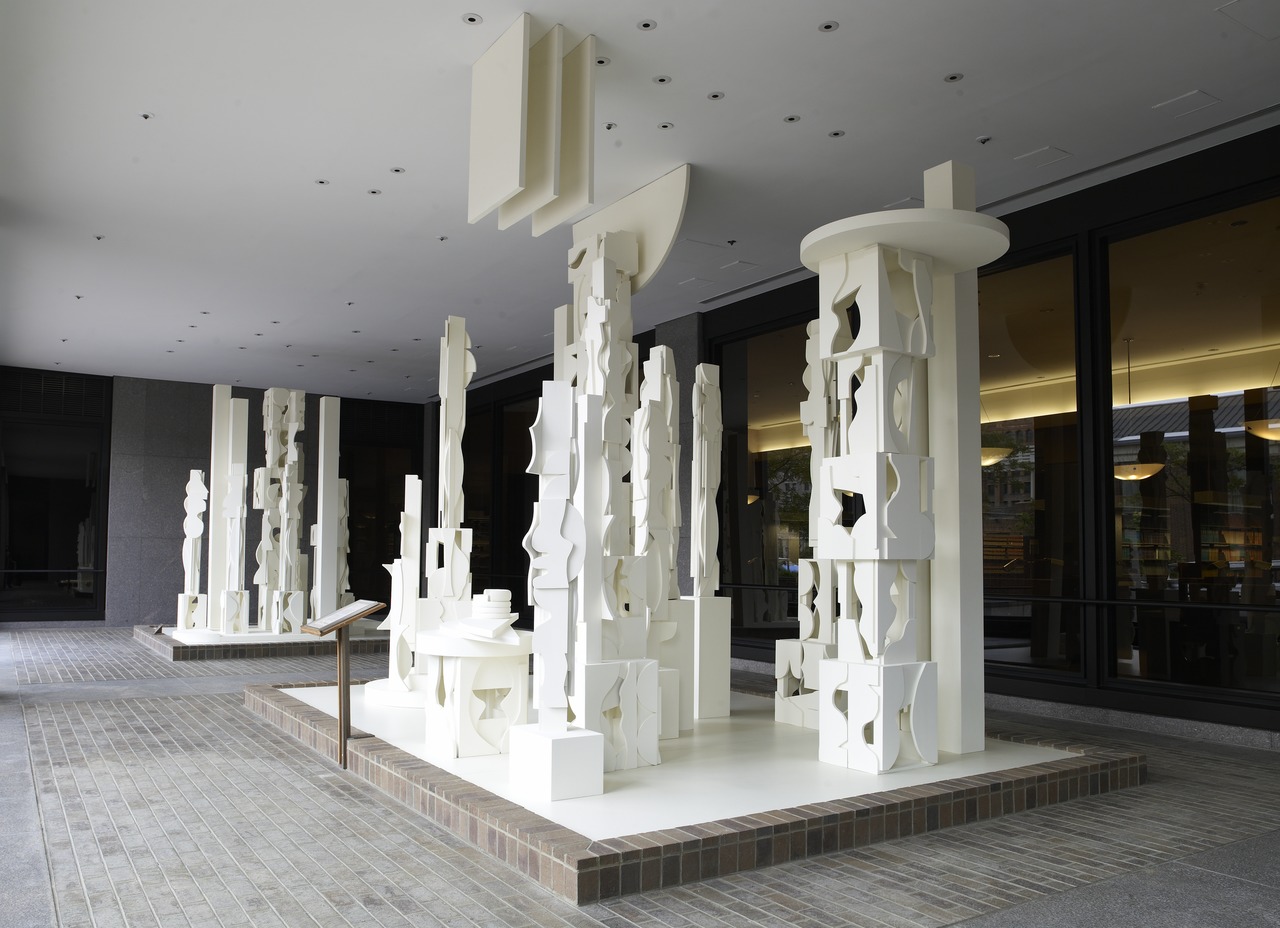

Early life Louise Nevelson was born on September 23, 1899 in Pereiaslav, then part of the Poltava Governorate of the Russian Empire. Her family were Jewish immigrants who moved to the United States in 1905, settling in the Lower East Side of Manhattan. At home Nevelson spoke Yiddish, while she learned English at school and later attended a girls' high school in New York City. The bustling immigrant neighbourhood, with its crowded tenements and discarded wooden objects, left an early imprint on her perception of space and material. She showed an aptitude for drawing and craft, but formal artistic training was delayed by the need to support her family.
Career and style In the 1920s Nevelson began taking night classes at the Art Students League of New York and later at Cooper Union, where she studied drawing, painting and sculpture. By the early 1930s she turned to sculpture, working initially in clay and plaster before discovering the expressive potential of wood. The Great Depression forced her to collect discarded wooden pieces from the streets, warehouses and construction sites, a practice that would become the foundation of her signature assemblage technique. Her first public exhibition, a group show at the New School for Social Research in 1941, introduced her monochrome wooden wall pieces to a wider audience. Throughout the 1940s and 1950s she refined a style characterised by dense, layered compositions that blurred the line between relief and three‑dimensional sculpture.
In the 1960s Nevelson’s reputation surged as she received large public commissions and solo retrospectives at major institutions such as the Museum of Modern Art. Although she is often linked with abstract expressionism—particularly for the gestural intensity and emotional depth of her compositions—her work also anticipates later developments in installation art and feminist sculpture. By the time of her death in New York City on April 17, 1988, Nevelson had established a distinct visual language that merged personal narrative, urban detritus and a profound sense of monumentality.
Signature techniques Nevelson’s hallmark was the use of found wooden objects—beams, pallets, furniture fragments and discarded lumber—assembled into complex, wall‑mounted structures. She meticulously sanded, repaired and painted each piece, often in a single, uniform colour. Black became her most iconic hue, creating a dramatic, almost sculptural chiaroscuro that emphasised form over colour. She also worked in white, gold and occasional earth tones, each palette reinforcing a unified visual field. The paintings served two purposes: they concealed the disparate origins of the components and unified the overall composition, allowing viewers to focus on the interplay of positive and negative space. Nevelson employed a modular approach, arranging wood in grid‑like patterns that could be expanded or reconfigured. Light played a crucial role; the monochrome surface reflected studio illumination, intensifying shadows and highlighting the depth of the layered assemblage.
Major works - **Night Wall I (1972)** – This large, black‑painted wooden wall piece was created for the Museum of Modern Art’s exhibition “Sculpture of the Seventies.” Measuring over twelve feet high, the work consists of dozens of reclaimed wooden elements tightly packed to form an abstract, almost architectural façade. Its rhythmic vertical and horizontal bands generate a sense of both enclosure and infinite depth, exemplifying Nevelson’s mastery of scale and monochrome. - **Bicentennial Dawn (1976)** – Commissioned for the United States Bicentennial, this outdoor sculpture was installed in Washington, D.C. Constructed from salvaged timber and painted a luminous gold, the piece evokes sunrise motifs while retaining Nevelson’s characteristic density. Its towering silhouette interacts with the surrounding landscape, inviting viewers to experience the work from multiple angles. - **Sun Disk / Moon Shadow V (1976)** – Part of a series exploring celestial dualities, this sculpture combines a circular, sun‑like disc with a contrasting, crescent‑shaped moon shadow. The two components are fashioned from reclaimed wood, painted respectively in stark black and muted white, and mounted on a shared base. The juxtaposition of light and darkness underscores Nevelson’s preoccupation with contrast and the metaphysical.
Influence and legacy Louise Nevelson’s impact extends far beyond her striking wall installations. She paved the way for later generations of women sculptors, demonstrating that large‑scale, site‑specific work could be created from humble, discarded materials. Her emphasis on monochrome surface and the transformation of everyday objects into monumental art prefigured the minimalist and post‑minimalist movements of the 1970s. Contemporary artists such as Eva Hesse, Rachel Whiteread and Kara Walker cite Nevelson’s assemblage methodology as an inspiration. Major retrospectives at institutions like the Los Angeles County Museum of Art and the Whitney Museum have reinforced her status as a central figure in 20th‑century art history. Today, her works command high prices at auction and continue to be displayed in public spaces, where their powerful presence invites viewers to contemplate the beauty that can emerge from the overlooked debris of modern life.
Frequently asked questions
Who was Louise Nevelson?
Louise Nevelson (1899–1988) was a Russian‑born American sculptor best known for her large, monochromatic wooden wall assemblages and outdoor sculptures.
What artistic movement is she associated with?
She is commonly linked to abstract expressionism, though her work also anticipates installation art and feminist sculpture.
What are her most famous works?
Her most recognised pieces include Night Wall I (1972), Bicentennial Dawn (1976) and Sun Disk / Moon Shadow V (1976).
Why does she matter in art history?
Nevelson pioneered the use of reclaimed wood and monochrome painting to create monumental sculptures, influencing later generations of artists and expanding the possibilities for large‑scale, site‑specific work.
How can I recognise a Louise Nevelson sculpture?
Look for dense, layered wooden assemblages painted in a single colour—most often black—with a strong emphasis on shadow, negative space and a wall‑like, architectural presence.