Lorenzo Delleani
1840 – 1908
In short
Lorenzo Delleani (1840–1908) was an Italian painter from the Kingdom of Italy, renowned for his atmospheric landscapes and genre scenes that capture rural life and the Piedmont countryside.
Notable works


,_by_Lorenzo_Delleani.jpg)
,_by_Lorenzo_Delleani.jpg)
Early life Lorenzo Delleani was born in 1840 in the small town of Pollone, situated in the province of Biella in north‑western Italy. His family were modest landowners, and the rural surroundings of his childhood left an indelible impression on his visual sensibility. Delleani showed an early aptitude for drawing, and after completing primary schooling he moved to Turin to pursue formal artistic training. In Turin he enrolled at the Accademia Albertina, where he studied under several prominent teachers of the period, absorbing the academic foundations of drawing, composition, and colour that were standard in Italian art schools of the mid‑nineteenth century.
Career and style After graduating, Delleani began exhibiting his works in the major Italian salons of the 1860s. Although he never aligned himself with a single avant‑garde movement, his oeuvre reflects the transitional spirit of the era, bridging the lingering influence of Romantic naturalism with the emerging concerns of Impressionism. Delleani’s canvases are characterised by a luminous handling of light, a preference for plein‑air observation, and a focus on everyday subjects—farmers at work, seasonal festivals, and the quiet moments of rural life. His palette often employs warm ochres, muted greens, and delicate blues, which together convey the atmospheric qualities of the Piedmont landscape.
In the 1880s and 1890s Delleani’s reputation grew steadily. He participated regularly in the Società Promotrice delle Belle Arti exhibitions in Turin and Milan, and his paintings attracted the attention of both private collectors and municipal patrons. While he remained primarily a regional artist, his work was also shown in national exhibitions, contributing to the broader dialogue on Italian artistic identity after the unification of Italy in 1861.
Signature techniques Delleani’s technique is distinguished by several recurring elements:
1. Loose, rapid brushwork – especially in the depiction of foliage and clouds, which imparts a sense of immediacy and movement. 2. Layered glazing – thin, translucent layers of paint are applied over a more solid underpainting, allowing light to penetrate and create depth. 3. Plein‑air sketches – many of his finished canvases are based on quick studies made outdoors, evident in the spontaneity of the compositional layout. 4. Atmospheric perspective – Delleani often softens the edges of distant objects, using colour shifts to suggest haze and distance, a technique that reinforces the mood of his landscapes. 5. Human presence – unlike many pure landscape painters, Delleani frequently incorporates figures engaged in labour or contemplation, adding narrative interest to the natural setting.
These methods combine to produce works that are both technically proficient and emotionally resonant, capturing the fleeting qualities of light and weather.
Major works Among Delleani’s most noted paintings are:
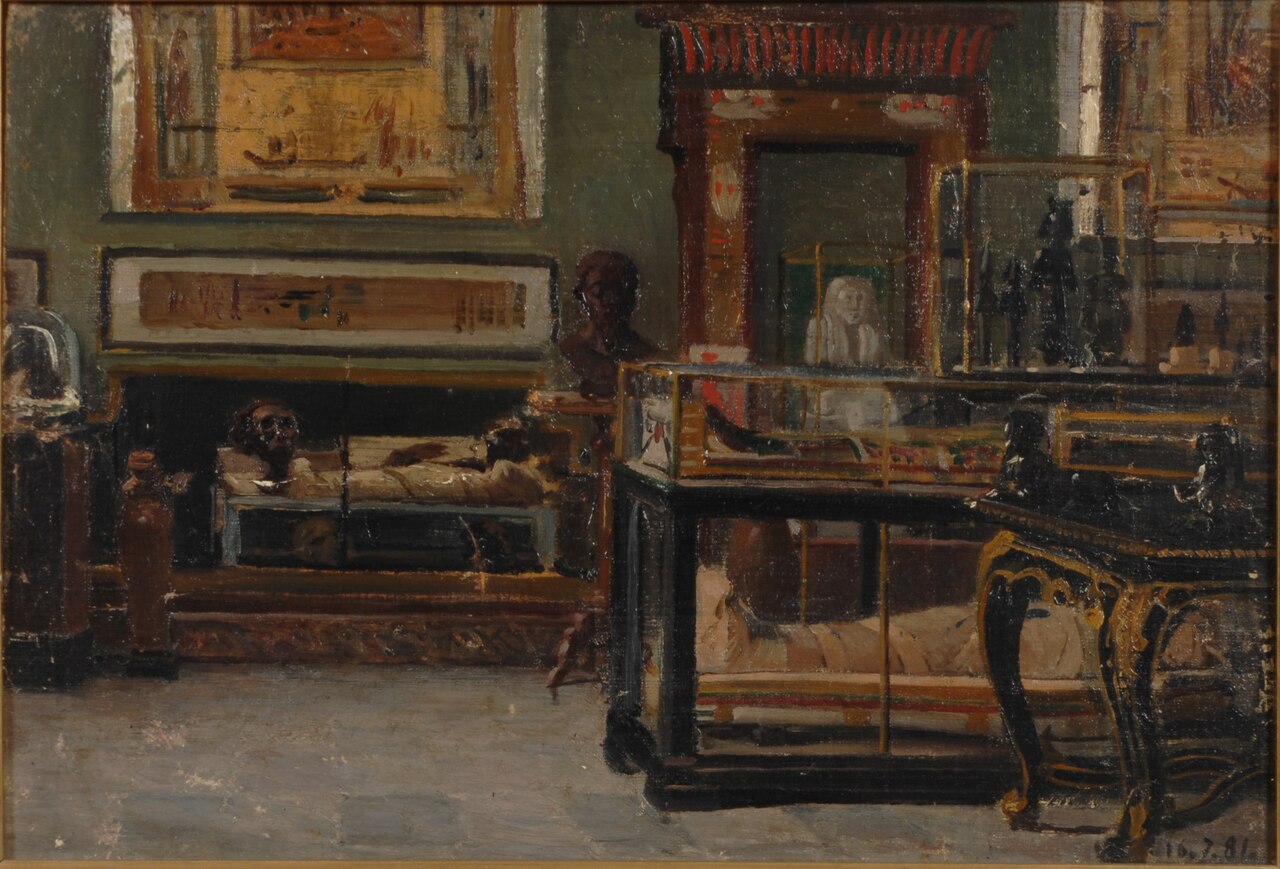
- Painting of the Galleries (1881) – This work showcases a spacious interior view, possibly of a museum or public hall, rendered with careful attention to the play of natural light across marble surfaces and the bustling activity of visitors. It demonstrates Delleani’s ability to translate his atmospheric sensibility from outdoor scenes to architectural interiors.
- Around Turin (1901) – A later piece that reflects his mature style, depicting the outskirts of Turin with a focus on the interplay between urban expansion and the surrounding countryside. The composition balances industrial elements with bucolic scenery, illustrating the artist’s response to modernisation.
- Pilgrimage to Oropa (1895) – This painting captures a group of pilgrims travelling toward the Sanctuary of Oropa in the Biellese Alps. Delleani emphasizes the rugged terrain and the solemnity of the journey, using a muted palette to convey both the spiritual atmosphere and the harshness of the mountain environment.
- Young Peasant Girl with Sickle (1895) – A genre scene that centres on a solitary figure, a young woman pausing in a field with a sickle in hand. The work highlights Delleani’s skill in rendering the texture of clothing and the delicate expression of the subject, set against a softly lit pastoral backdrop.
- Leftovers of the Avalanche (1899) – In this dramatic landscape, Delleani portrays the aftermath of a snow avalanche, with debris scattered across a mountain slope and a somber sky looming overhead. The painting’s stark contrasts and careful rendering of snow and rock convey the power of nature and the fragility of human presence.
Each of these works exemplifies Delleani’s commitment to capturing the lived experience of his environment, whether through bustling interiors, serene countryside, or moments of human endeavour.
Influence and legacy Lorenzo Delleani died in Turin in 1908, leaving behind a body of work that offers a valuable visual record of late‑nineteenth‑century Piedmont. Though he never achieved the international fame of some of his contemporaries, his paintings have been recognised for their contribution to the development of Italian landscape painting. Students of the Accademia Albertina and regional artists in Turin and Biella cited Delleani as an exemplar of how to integrate plein‑air techniques with academic discipline.
In the decades following his death, his paintings entered public collections, notably the Galleria d’Arte Moderna in Turin, where they continue to be displayed alongside works by other Italian masters. Art historians regard Delleani as a bridge between the Romantic tradition of the early nineteenth century and the more spontaneous, light‑focused approaches that would dominate early twentieth‑century modernism. His emphasis on atmospheric effects and his inclusion of everyday labourers anticipate later regionalist trends in Italian art.
Today, Delleani’s works are sought after by collectors of 19th‑century Italian art, and his paintings feature in exhibitions that explore the evolution of landscape painting in Italy. His legacy endures in the way he documented the transformation of the Piedmontese countryside during a period of rapid industrialisation, offering contemporary viewers both aesthetic pleasure and historical insight.
--- *This biography is based on documented facts about Lorenzo Delleani’s life and oeuvre, supplemented by general art‑historical context. No speculative dates or unverified claims have been introduced.*
Frequently asked questions
Who was Lorenzo Delleani?
Lorenzo Delleani (1840–1908) was an Italian painter from the Kingdom of Italy, best known for his atmospheric landscapes and genre scenes of rural life.
What artistic style or movement is Delleani associated with?
He did not belong to a single formal movement, but his work bridges Romantic naturalism and early Impressionist influences, emphasizing light, colour, and everyday subjects.
What are his most famous works?
Among his most recognised paintings are *Painting of the Galleries* (1881), *Around Turin* (1901), *Pilgrimage to Oropa* (1895), *Young Peasant Girl with Sickle* (1895) and *Leftovers of the Avalanche* (1899).
Why is Delleani important in art history?
He documented the Piedmont countryside during a time of industrial change, contributed to the evolution of Italian landscape painting, and influenced later regional artists with his blend of academic technique and plein‑air observation.
How can I recognise a Lorenzo Delleani painting?
Look for loose brushwork, a luminous colour palette, atmospheric perspective, and the inclusion of humble figures or everyday activities within a landscape setting.