Lodewijk de Vadder
1605 – 1655
In short
Lodewijk de Vadder (1605–1655) was a Flemish Baroque painter, draughtsman, engraver and tapestry designer noted for pioneering naturalistic landscape painting in the Habsburg Netherlands. He introduced dune‑filled scenes and a looser brushwork that moved Flemish art away from Mannerist conventions toward a more atmospheric style.
Notable works

_Paysage_avec_figures_et_animaux_-_Lodewyk_de_Vadder_-_Mus%C3%A9e_des_Beaux-Arts_de_Narbonne.jpg)

Early life Lodewijk de Vadder was born in 1605 in Grimbergen, a small town north of Brussels in the Habsburg Netherlands. Little is known about his family background, but archival records indicate that he grew up in a region where agricultural and riverine landscapes dominated daily life. This environment provided a visual vocabulary that would later appear in his paintings. De Vadder likely received his first artistic training in Brussels, the capital of the Spanish Netherlands, where a vibrant workshop culture offered apprenticeships to young talent.
Career and style By the late 1620s de Vadder had established himself as a professional artist in Brussels. He worked for a diverse clientele that included local aristocrats, members of the court, and the burgeoning merchant class. His output spanned oil paintings, drawings, engravings and tapestry designs, reflecting the multidisciplinary practice typical of Flemish artists of the period.
De Vadder’s landscape style marked a clear departure from the Mannerist tradition that had dominated Flemish painting for decades. Rather than the artificial, highly stylised compositions of earlier masters, his scenes display a more naturalistic arrangement of trees, water and sky. He employed a relatively restrained palette—muted greens, browns and earth tones—while allowing atmospheric effects to dominate the pictorial space. This approach shows the influence of Peter Paul Rubens, whose loose brushwork de Vadder adapted, and of the Dutch Republic, where artists such as Jan van Goyen were already experimenting with tonal colour and subtle gradations of light.
A distinctive feature of de Vadder’s work is his focus on dunes and coastal terrain, a subject that had received little attention in Flemish art. By foregrounding sand dunes as primary compositional elements, he broadened the visual language of landscape painting and anticipated later developments in Dutch and Flemish art. His scenes often contain modest human figures—farmers, hunters or travellers—who serve to animate the environment without dominating it.
Signature techniques De Vadder’s brushwork is characteristically fluid, allowing the paint to suggest rather than delineate forms. He achieved depth through layered washes of colour, creating a sense of distance that is reinforced by a hazy sky. Light is rendered with delicate highlights that catch the tops of trees or the edges of dunes, contributing to a sense of atmospheric perspective.
In his drawings and engravings, de Vadder employed fine, economical lines to convey texture. His hatching technique, especially in the rendering of foliage, demonstrates a keen observation of how light interacts with leaves and grasses. When designing tapestries, he translated his landscape motifs into woven form, simplifying complex scenes into bold, repeatable patterns suitable for large wall hangings.
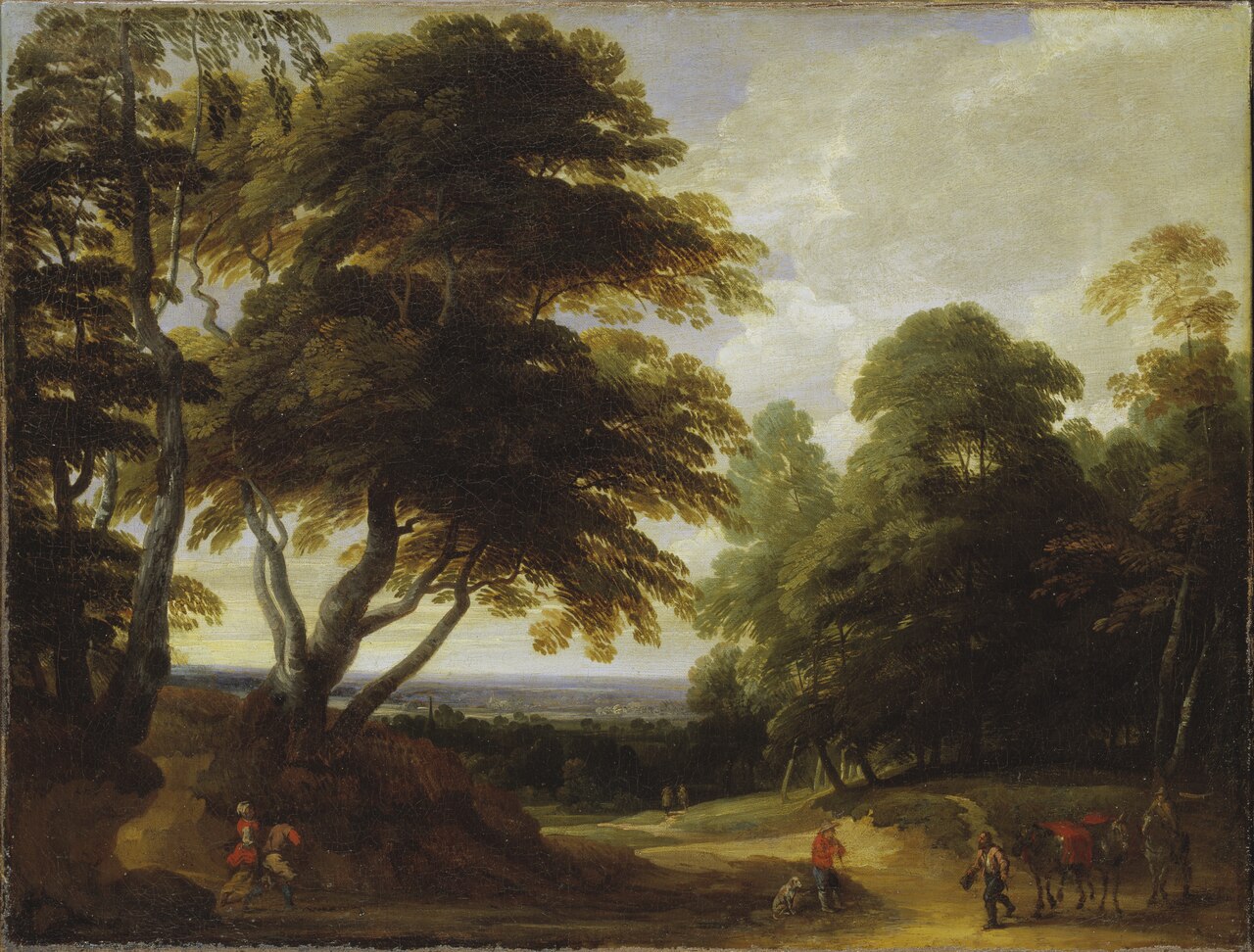
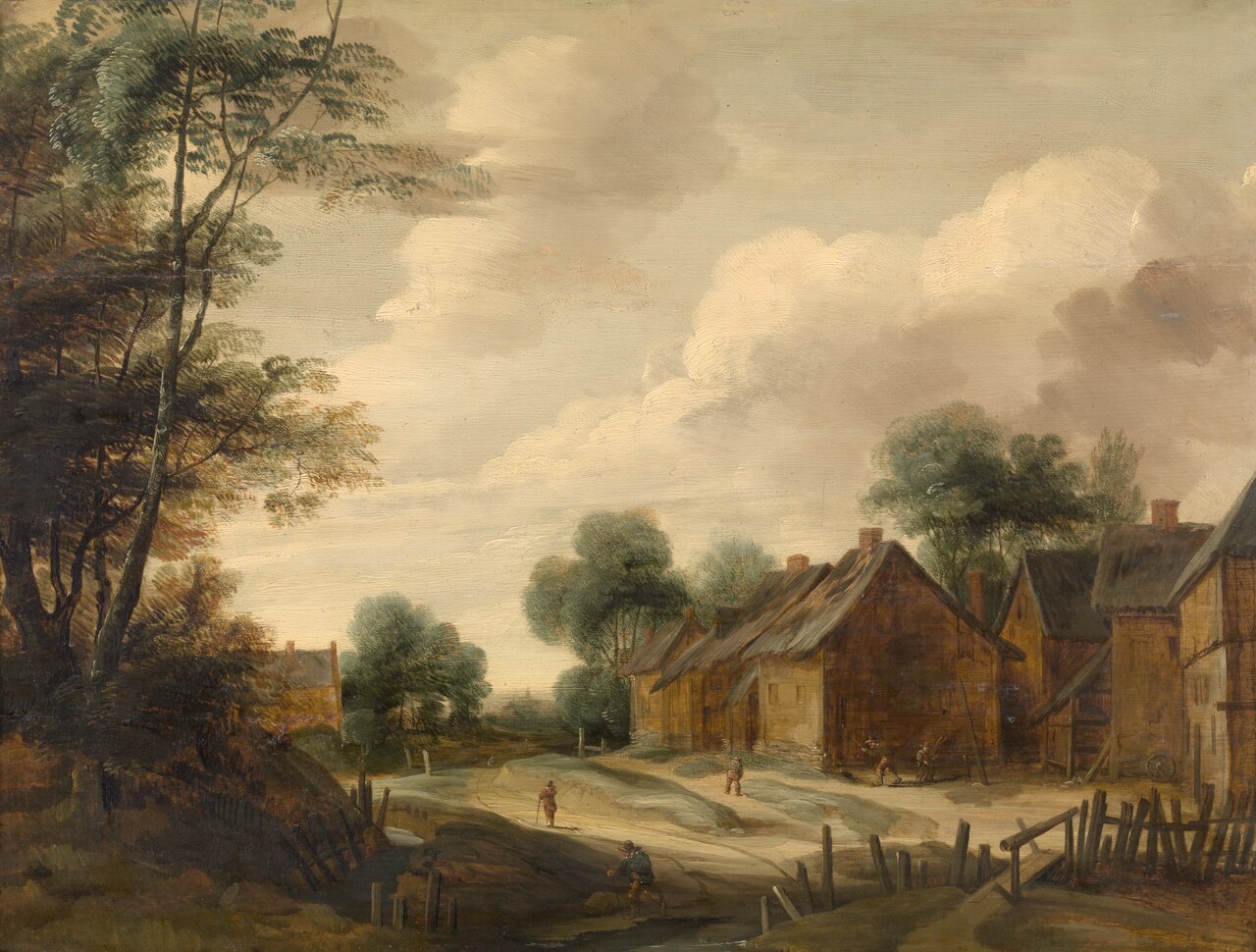
Major works - **Henry IV at the siege of Amiens (1630)** – Though primarily a historical subject, this painting showcases de Vadder’s ability to integrate landscape with narrative. The battlefield is set against a sweeping, cloud‑filled sky, with low‑lying dunes that frame the action. - **Landscape with figures and animals (1632)** – This work exemplifies his naturalistic approach, presenting a pastoral scene where shepherds and livestock move through a gently rolling terrain punctuated by dunes and a winding river. - **At the Edge of the Forest** – In this composition de Vadder places a dense woodland at the foreground, gradually opening onto a sandy plain. The transition between forest and dune reflects his interest in contrasting vegetation types within a single view. - **A Village Road (1630)** – The painting depicts a quiet lane leading through a village set among dunes, with modest dwellings and a few passing figures. The road’s perspective draws the eye toward a distant horizon, underscoring his mastery of depth. - **Landscape with a Farm (1638)** – One of his later dated works, it presents a farmstead nestled among dunes and a shallow pool. The muted palette and soft lighting illustrate the mature stage of his atmospheric technique.
These works collectively illustrate de Vadder’s evolution from early Baroque vigor toward a more contemplative, tonal landscape idiom that would influence subsequent generations.
Influence and legacy Lodewijk de Vadder’s contribution to Flemish landscape painting lies in his synthesis of Baroque dynamism with a nascent naturalism. By foregrounding dunes and employing a restrained colour scheme, he offered a visual alternative to the highly decorative Mannerist landscapes that preceded him. His style anticipated the tonal landscapes of the Dutch Golden Age and resonated with later Flemish artists such as Jan Siberechts and the early works of Jacob van Ruisdael, who also explored coastal and dune environments.
Although de Vadder never achieved the fame of Rubens, his work was collected by contemporary patrons and later rediscovered by 19th‑century scholars interested in the development of landscape painting. Modern art historians credit him with helping to bridge the gap between the exuberant Baroque of the Southern Netherlands and the more subdued, atmospheric approach that flourished in the Dutch Republic. His tapestries, though fewer in number, also contributed to the diffusion of landscape motifs across decorative arts.
De Vadder died in Brussels in 1655, leaving behind a modest but significant body of work. Today his paintings are held in several European museum collections, where they are valued for their pioneering treatment of sand‑filled scenery and their subtle handling of light and atmosphere. His legacy endures as a testament to the transitional period of Flemish art in the early 17th century, marking a move toward the naturalistic landscapes that would dominate the century’s artistic discourse.
Frequently asked questions
Who was Lodewijk de Vadder?
Lodewijk de Vadder (1605–1655) was a Flemish Baroque painter, draughtsman, engraver and tapestry designer known for pioneering naturalistic landscape painting in the Habsburg Netherlands.
What style or movement is he associated with?
He worked within the Flemish Baroque tradition but moved toward a more naturalistic, atmospheric style that foreshadowed the tonal landscapes of the Dutch Golden Age.
What are his most famous works?
Key works include *Henry IV at the siege of Amiens* (1630), *Landscape with figures and animals* (1632), *At the Edge of the Forest*, *A Village Road* (1630) and *Landscape with a Farm* (1638).
Why is he important in art history?
De Vadder introduced dune‑filled scenery and a restrained palette to Flemish landscape painting, bridging the gap between Mannerist conventions and the naturalism that later dominated Dutch and Flemish art.
How can I recognise a de Vadder landscape?
Look for loose brushwork, muted earth tones, atmospheric light, and the prominent use of sand dunes or coastal terrain, often with modest human figures that complement rather than dominate the scene.