Leo Mol
1915 – 2009
In short
Leo Mol (1915–2009) was a Russian‑born Ukrainian‑Canadian artist renowned for his stained‑glass windows, paintings and sculptures. He emigrated to Canada in the mid‑20th century, settled in Winnipeg, and created public monuments such as the Taras Shevchenko Memorial (1963) and the Statue of Saint Volodymyr (1988).
Notable works


Early life Leonid Molodozhanyn was born in 1915 in the small town of Polonne, then part of the Russian Empire (now Ukraine). His family were modest peasants, and the cultural life of his native region—rich in folk art, iconography and oral tradition—left an early imprint on his visual sensibility. Mol showed an aptitude for drawing from a young age, sketching local landscapes and church interiors. After completing primary schooling, he pursued formal training at the Kyiv Art Institute, where he was exposed to both classical techniques and the avant‑garde currents circulating in Soviet art circles. The outbreak of World War II disrupted his studies; Mol was conscripted, experienced the hardships of the Eastern Front, and later returned to a war‑torn Kyiv. The post‑war period saw him working as a muralist and designer for state‑commissioned projects, gaining practical experience in large‑scale composition and material handling.
Career and style In 1950, seeking artistic freedom and better prospects, Mol emigrated to Canada, eventually establishing his base in Winnipeg, Manitoba. The city’s vibrant immigrant community and its burgeoning public art programmes offered fertile ground for his multidisciplinary practice. Mol’s style evolved into a synthesis of his Eastern European heritage and the modernist impulses of his new environment. His paintings often feature lyrical, semi‑abstracted landscapes rendered in muted palettes, while his sculptures combine realistic portraiture with a smooth, almost lyrical treatment of form. Across media, a recurring theme is the celebration of cultural identity—particularly Ukrainian history and folklore—expressed through a restrained yet expressive visual language.
Signature techniques Mol’s most distinctive contribution lies in his work with stained glass. He employed traditional lead‑came techniques but introduced innovative approaches to colour layering and translucency, allowing light to become an active compositional element rather than merely a backdrop. His glass panels frequently incorporate motifs drawn from Ukrainian embroidery patterns, subtly woven into the narrative scenes of saints, historical figures or natural vistas. In sculpture, Mol preferred bronze and stone, favouring a polished finish that accentuates the play of light on curved surfaces. His portraiture is noted for its careful attention to facial expression, achieved through a delicate balance of realism and stylised simplification. Across all media, Mol’s emphasis on craftsmanship, material integrity and the harmonious integration of cultural symbolism defines his artistic signature.
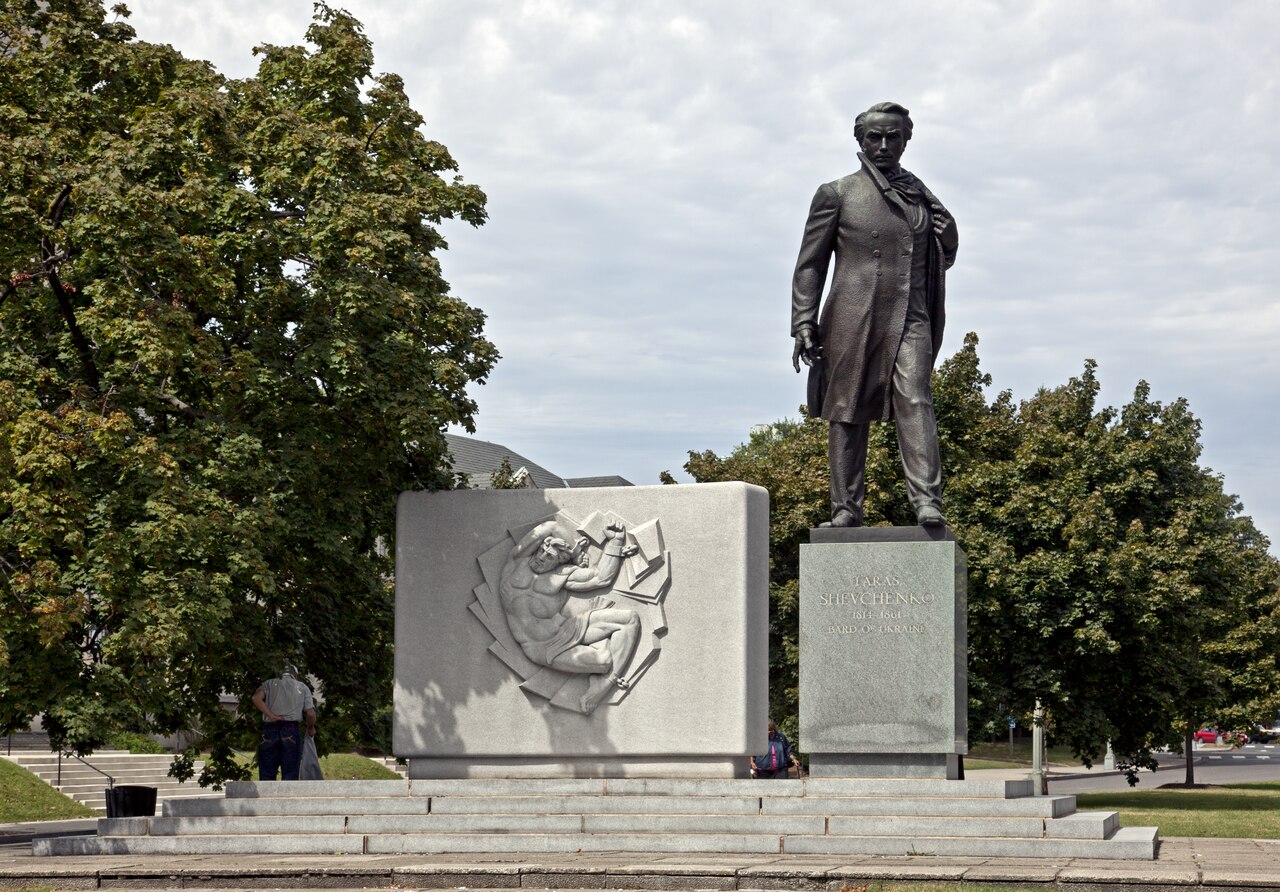
Major works Among Mol’s public commissions, the Taras Shevchenko Memorial (1963) in Winnipeg stands out as a landmark tribute to the Ukrainian poet‑reformer. The bronze monument captures Shevchenko in a contemplative stance, his features rendered with a blend of realism and idealisation that conveys both intellectual gravitas and national pride. In 1988, Mol completed the Statue of Saint Volodymyr, a towering bronze figure erected in the city’s Ukrainian cultural precinct. The work reflects Mol’s ability to translate religious reverence into a modern sculptural idiom, with smooth surfaces and a dignified pose that invites contemplation. He also produced a series of stained‑glass windows for churches and civic buildings across Canada, each piece integrating narrative scenes with abstracted decorative borders. These installations demonstrate his skill in marrying narrative content with the luminous qualities of glass, creating environments that are both spiritually resonant and aesthetically cohesive.
Influence and legacy Leo Mol’s impact on Canadian art is multifaceted. As a teacher at the University of Manitoba’s School of Art, he mentored generations of artists, imparting a rigorous respect for material and technique while encouraging personal expression. His public monuments have become focal points for Ukrainian‑Canadian identity, serving as sites of remembrance and cultural celebration. Moreover, his stained‑glass work helped elevate the medium within Canadian architectural contexts, inspiring subsequent artists to explore glass as a narrative and decorative vehicle. Mol’s oeuvre, spanning painting, sculpture and glass, exemplifies the immigrant artist’s capacity to bridge disparate artistic traditions, thereby enriching the cultural tapestry of his adopted homeland. Today, his works are held in major public collections, and his legacy endures through ongoing exhibitions, scholarly research, and the continued relevance of his public monuments in community life.
Frequently asked questions
Who was Leo Mol?
Leo Mol (1915–2009) was a Russian‑born Ukrainian‑Canadian artist known for his stained‑glass windows, paintings and sculptures, most famous for public monuments such as the Taras Shevchenko Memorial in Winnipeg.
What artistic style or movement is he associated with?
Mol did not belong to a single formal movement; his work blends Eastern European folk influences, modernist abstraction and a strong emphasis on craftsmanship, especially in stained glass.
What are his most famous works?
His best‑known pieces include the Taras Shevchenko Memorial (1963), the Statue of Saint Volodymyr (1988), and numerous stained‑glass windows for churches and civic buildings across Canada.
Why is Leo Mol important in art history?
Mol helped introduce high‑quality stained‑glass art to Canada, created iconic public monuments that embody Ukrainian‑Canadian identity, and influenced countless students as a university professor.
How can I recognise a Leo Mol artwork?
Look for smooth, polished surfaces, a subtle use of light, and motifs drawn from Ukrainian folk patterns—especially in his stained‑glass panels, which combine narrative scenes with decorative borders.