Kusumi Morikage
1620 – 1690
In short
Kusumi Morikage (1620–1690) was a Japanese Edo‑period painter from Ishikawa (formerly Kaga) who, after a dispute with his teacher Kanō Tan’yū, became the official artist of the Maeda clan. His work blends refined court painting with a compassionate focus on everyday life, especially the lives of farmers and the poor.
Notable works


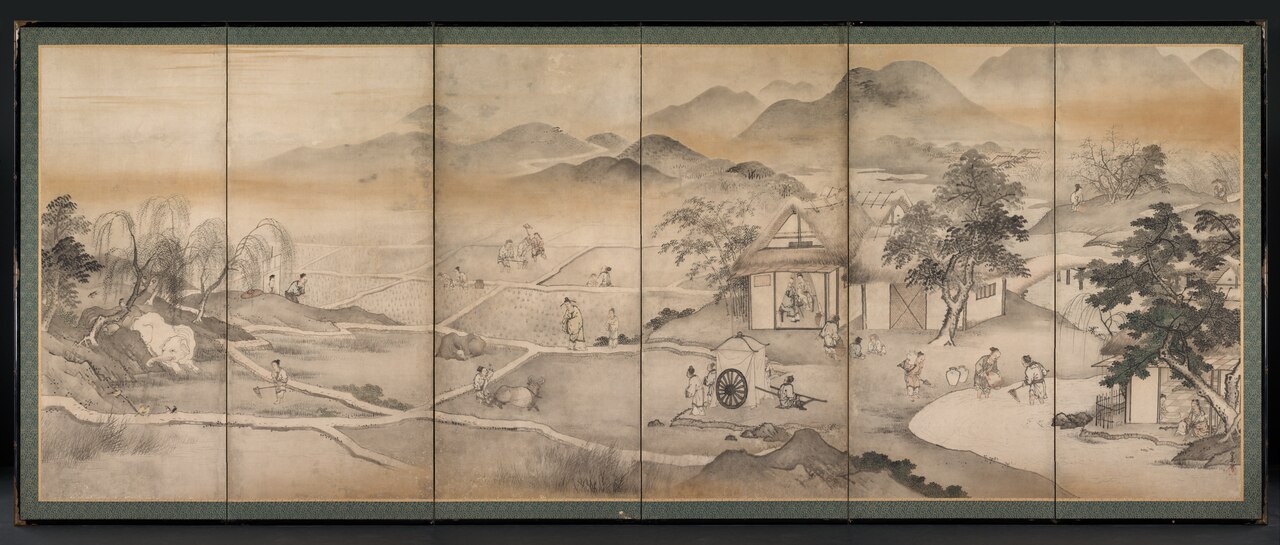

Early life Kusumi Morikage was born in 1620 in what is now Ishikawa Prefecture, historically the province of Kaga. The region was the heartland of the Maeda clan, one of the most powerful daimyō families of the Edo period. Little is recorded about his family background, but the cultural environment of Kaga was rich in both aristocratic patronage and rural tradition, providing a fertile ground for a young artist. Morikage’s early education would have included the study of classical Chinese literature and the fundamentals of brushwork, as was customary for aspiring painters in early‑17th‑century Japan.
Career and style Morikage entered the studio of Kanō Tan’yū, the pre‑eminent master of the Kanō school, where he received rigorous training in the highly stylised, monochrome ink techniques that dominated official court painting. The relationship with his teacher deteriorated, reportedly over artistic differences and perhaps personal discord, leading Morikage to leave the Kanō workshop. He then secured a position as the Maeda clan’s official painter, a role that offered both financial stability and a platform for artistic experimentation.
While his early work reflects the disciplined brushwork of the Kanō tradition, Morikage gradually developed a more personal visual language. He incorporated vivid colour, a looser handling of line, and subject matter that extended beyond the aristocratic and mythological themes typical of his training. This hybrid style placed him at a crossroads between elite court painting and the emerging genre scenes that depicted the daily lives of common people. His empathy for farmers and the urban poor is evident in the humanity and dignity he afforded to these subjects, a departure from the more idealised representations common among his contemporaries.
Signature techniques Morikage’s paintings are distinguished by several techniques that became hallmarks of his oeuvre:
1. Layered washes of colour – Unlike the stark ink‑only approach of the Kanō school, Morikage applied multiple translucent layers of pigment, creating depth and a subtle atmospheric quality. 2. Dynamic brushstrokes – He employed brisk, calligraphic strokes to suggest movement, especially in depictions of horses and wind‑blown foliage. 3. Narrative composition – Morikage arranged figures and landscape elements to convey a clear story, often using a diagonal axis that leads the viewer’s eye through the scene. 4. Humanising detail – Small, observational details—such as the worn texture of a farmer’s clothing or the expression on a peasant’s face—serve to personalise his subjects. 5. Integration of text – In many works, he incorporated poetic inscriptions or marginal notes, linking visual and literary traditions.
Major works
- Enjoying the Evening Cool – This composition captures a group of figures gathered under the soft light of dusk, their relaxed postures suggesting a moment of communal respite. The work showcases Morikage’s skill in rendering atmospheric light and his interest in everyday leisure.
- Bird on Branch (1650) – Executed in ink and subtle colour, the painting portrays a solitary bird perched on a slender branch. The piece is notable for its delicate line work and the quiet contemplation it evokes, reflecting the artist’s ability to find elegance in simplicity.
- Seven Sages of Bamboo Grove – A reinterpretation of a classic Chinese motif, Morikage places the legendary sages within a Japanese bamboo forest, blending cultural references. The composition balances scholarly gravitas with natural serenity, illustrating his adeptness at merging foreign themes with local sensibilities.
- Emperor Yao Visiting Yu Chonghua (1674) – This large narrative canvas depicts the legendary Emperor Yao’s audience with the hermit Yu Chonghua. Morikage’s rendering emphasizes the humility of the hermit against the imperial grandeur, underscoring his recurring concern for the virtuous poor.
- A Samurai on Horseback (1662) – A dynamic study of a mounted warrior, the painting highlights Morikage’s mastery of animal anatomy and movement. The samurai’s flowing robes and the horse’s muscular tension are rendered with vigorous brushwork, illustrating the artist’s capacity to convey martial energy while retaining a lyrical quality.
Each of these works illustrates a different facet of Morikage’s practice—whether it be his atmospheric landscapes, his nuanced portraiture, or his capacity to embed moral commentary within historical narratives.
Influence and legacy Kusumi Morikage’s career bridges the formal world of the Kanō school and the more populist visual culture that would flourish in the later Edo period. By integrating courtly technique with subjects drawn from the lives of farmers, merchants, and itinerant figures, he anticipated the ukiyo‑e movement’s focus on everyday scenes. Although he did not achieve the fame of later masters such as Hokusai or Hiroshige, his works were collected by the Maeda clan and circulated among regional samurai circles, ensuring a degree of dissemination.
Art historians regard Morikage as an early exemplar of socially conscious painting in Japan. His sympathetic portrayal of the lower classes contributed to a broader acceptance of genre subjects within elite artistic circles. Subsequent generations of painters, especially those operating in the Kansai region, drew upon his blended aesthetic, adopting his layered colour techniques and narrative compositional strategies.
In contemporary scholarship, Morikage is frequently cited as a figure who demonstrates the fluidity of artistic identity in Edo‑period Japan—where an artist could navigate between rigid school affiliations and personal expression. His surviving works, housed in a few regional museums and private collections, continue to provide insight into the cultural negotiations of his time, making him a valuable reference point for studies of Japanese visual culture and social history.
---
Through his nuanced synthesis of elite technique and populist empathy, Kusumi Morikage remains a compelling example of how art can both reflect and subtly critique the social hierarchies of its era.
Frequently asked questions
Who was Kusumi Morikage?
Kusumi Morikage (1620–1690) was a Japanese Edo‑period painter from Ishikawa who became the official artist of the Maeda clan after leaving the workshop of Kanō Tan’yū.
What artistic style or movement is he associated with?
He worked within the Kanō school tradition but developed a hybrid style that combined courtly brushwork with vivid colour, narrative composition, and a focus on everyday subjects.
What are his most famous works?
Key works include *Enjoying the Evening Cool*, *Bird on Branch* (1650), *Seven Sages of Bamboo Grove*, *Emperor Yao Visiting Yu Chonghua* (1674) and *A Samurai on Horseback* (1662).
Why does Kusumi Morikage matter in art history?
He bridges elite Kanō painting and genre scenes that celebrate ordinary life, influencing later Edo‑period artists and foreshadowing the socially aware aspects of ukiyo‑e.
How can I recognise a painting by Morikage?
Look for layered washes of colour, dynamic brushstrokes, narrative layouts, and subtle, empathetic details that humanise both aristocratic and common subjects.